


Economist Says PawSox Leverage Over RI is Overstated
Russ Moore, GoLocalProv Contributor
Economist Says PawSox Leverage Over RI is Overstated

Speaking to a crowded audience at the Pawtucket Tourism Council, Matheson highlighted a recent quote from Tim Murray, the President of the Worcester Regional Chamber of Commerce, to show that Massachusetts isn't really salivating at the prospect of forking over tens of millions of dollars to the new Pawtucket Red Sox owners.
"If the deal were to fall apart, I think people here would be willing to listen, but everyone recognizes this requires significant municipal assistance. Massachusetts, traditionally, has been reluctant to use tax dollars to (do) those kinds of things, and I think in most cases, appropriately so," Murray said.
GET THE LATEST BREAKING NEWS HERE -- SIGN UP FOR GOLOCAL FREE DAILY EBLAST
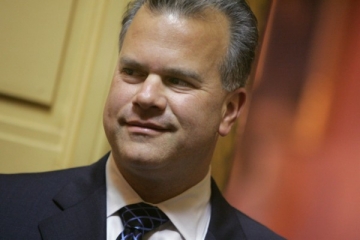
Matheson also went through a bullet point presentation explaining why a state financed deal requiring several tens of millions of dollars would make no sense from the state's point of view.
First and foremost, Matheson said that the economic multiplier effect of baseball fields never seems to live up to the hype of the proposals from the team.
"The families who are going to the game are not spending their money doing something else," Matheson said.
Minor league stadiums mostly draw fans from the surrounding areas of the ballpark. Matheson said those people spend their money at the games, not at the surrounding shops, bars, and businesses, assuming there are any.
And there usually aren't, he said. Matheson used an example close to home, to prove the point--McCoy Stadium. In the last 10 years, there have been roughly 6 million people who have attended McCoy, yet there's been almost no economic development in that area. And there really hasn't been much economic development in the 70 years the park has existed.
Matheson said that people shouldn't be fooled by team owners who claim they’re looking to help contribute to economic development. The team owners, he said, are interested in increasing their own revenue streams—not the businesses located in their close proximity. In fact, it behooves the owners to have little or no economic development in their immediate surrounding areas, he said.
“If I am a ballpark, I am not in the economic development business. I am in the revenue generation business.”
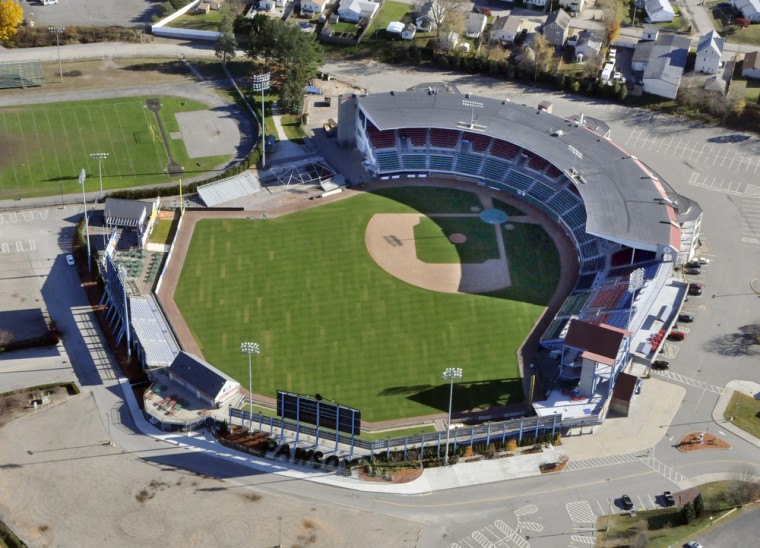
And a place like McCoy, with almost no economic development surrounding it, is the rule not the exception, for minor league ballparks across the country, Matheson said. Lehigh Valley as an example that was similar to Pawtucket and he pointed out several other examples.
Nevertheless, Matheson said that the Greater Providence area, which includes Pawtucket, remains one of the more attractive locations for a minor league baseball team given the fact that it has a large, concentrated population of more than 1.6 million people, and (with the Pawsox in limbo) doesn't have another major league or minor league team. The local population, he pointed out, is what the minor league teams rely on to fill the seats.
Matheson said that team owners tend to look for state funding because there isn't a good return on investment when they build the stadiums themselves. The spike in attendance and revenue doesn't justify the expenditure, he said. On average, when a team builds a new stadium, its revenues increase by roughly $2.7 million per year. But the team's owners are looking for roughly $4 million per year from state to cover the expenses of building the stadium.
Referring to Andrew Zimbalist, the economist hired by the state legislature to study the Pawtucket Red Sox proposal who said the team's proposal wasn't outlandish, Matheson said it isn't outlandish only if you're comparing it to other stadium proposals. But other stadium proposals almost never work out well for the state government, Matheson said.
"If you compare it to anything else in the real world, it's outlandish," Matheson said. "It's like saying everyone else is jumping off a 200 foot cliff and 'oh, no. We're not going to do that. We're only going to jump of a 100 foot cliff'."
Leaders React to PawSox Owners' Providence Stadium Proposal

Gary Sasse
Former Rhode Island Director of Administration, Executive Director of the Rhode Island Public Expenditure Council, and Founding Director of the Hassenfeld Institute for Public Leadership at Bryant University
"A minor league ballpark may not be an economic game changer. Thus it's cost and benefits must evaluate environmental, cultural, social and economic factors. The key point is any stadium should be consistent with the overall strategic development of Providence. This story has not been told yet."

Edward Mazze
University of Rhode Island Distinguished Professor of Business
"I would like to see the PawSox stay in Rhode Island. I do not think Rhode Islanders should pay for a new stadium for the next several decades or see Providence not collect taxes that could make it to a better city.....with better schools, lower property taxes and a lower automobile tax. To support the current proposal, there has to be tax payments to Providence, a financial deal with Pawtucket by the owners or the state to deal with the empty stadium and the owners paying for the new stadium with little in the way of state government assistance.
If there is state government financing assistance, there must be a guarantee that the team would not leave the state for the length of time of the financing. It would be interesting if the owners would consider selling "seat licenses" as a way of raising funds to build the stadium. This would be a real market test as to whether or not there is a need for a new stadium."

Monique Chartier
Spokesperson, RI Taxpayers
"The Paw Sox owners have asked the City of Providence for a waiver of property taxes. But the last thing that Providence needs is to remove yet another property from tax rolls. City Council President Luis Aponte's request that state taxpayers make up lost property taxes is understandable but out of the question, especially in light of the state's own very serious budget deficits.
Governor Raimondo has correctly pointed out that the state has very limited resources to invest in economic growth. These limited resources cannot go to develop prime public land into a very seasonal use that will have minimal impact on the economy at a substantial cost to local and state taxpayers. Our state leaders must say no to this project and return to the vitally important work of helping ALL businesses, not just one, by improving the state's tax and regulatory climate. We as a state can consider whether to participate in the luxury of a sports stadium as soon as our economy is healthy again."

Pam Gencarella
Spokesperson, OSTPA
"If Skeffington and his very wealthy partners want the PawSox in Providence then they should put an offer on the table that covers all of the costs to make it happen. They must provide revenue to the state for the land that they want to develop, and property tax revenue on its full value to the capitol city."
Pictured: James Skeffington

Mike Stenhouse
CEO, RI Center for Freedom and Prosperity
If the team is seeking taxpayer dollars, then taxpayers should get something in return, whether a share of equity or a slice of team revenues. For example, the federal government received equity for its investment in GM, while the Green Bay Packers are owned by citizen shareholders. It's not beyond possibility; let's find a way to make it happen."

Terrence Hassett
Senior Deputy Majority Leader, Providence City Council
"I believe the stadium is beneficial to Providence and the state. The parking capacity must be resolved in favor of the stadiums' fans that is fair and reasonable. What events and other uses are not being presented which I find troublesome. A stadium is a great venue for families, colleagues and generally, baseball fans to enjoy. A $120 million commitment from state taxpayers is a large role asked of them wherein the return on the participation is not convincing to date."

Aaron Regunberg
Rhode Island State Representative, (D-Dist 4, Providence)
"For me to support a deal, that $120 million figure needs to come down dramatically, and a strong community benefits agreement needs to be reached. I also think it would be reasonable - if the state is making a significant public investment in the project - to see the state receive a portion of the profits from the stadium."

Laurie White
President, Greater Providence Chamber of Commerce
"It is still in the early innings. The chamber was briefed on the proposal on Friday and we expect that it is subject to change. Conceptually, it is very exciting. Awaiting further details."

Gina Raimondo
Rhode Island Governor
"The PawSox are an important institution in Rhode Island and our goal is to keep them in the state," said Raimondo. "The idea of a stadium in downtown Providence that can be used for multiple purposes is exciting. That said, my top priority is getting Rhode Islanders back to work, and we have very limited resources to invest in economic growth - especially in the face of a large structural deficit. I am committed to working with Mayor Elorza, the Speaker, and the Senate President to evaluate whether this project is in the best interest of Rhode Island, and whether we can afford it."

Stefan Pryor
Rhode Island Commerce Secretary
"We hope and aim to keep this treasured team in Rhode Island. The project has the potential to enhance the vitality of a key district within our capital city. At the same time, this proposal involves a significant request for public resources. In collaboration with the City of Providence and the General Assembly, we will review this proposal in order to determine whether it makes financial sense and whether it will help catalyze the I-195 corridor."

Nicholas Mattiello
Rhode Island Speaker of the House of Representatives
"We have not received a written legislative proposal yet, but when we do, it will be thoroughly analyzed. I will be talking to my House colleagues and I will gauge public opinion before making any assessment on the direction the state should move in."

Teresa Paiva Weed
Rhode Island Senate President
"The proposal that has been presented by the new owners of the Paw Sox to build a professional ballpark in Providence potentially represents a significant investment in Rhode Island. The proposal will be fully analyzed by the full Senate in a thorough and transparent process.”

Jorge Elorza
Mayor, City of Providence
“The prospect of keeping the Red Sox’ Triple A team in Rhode Island represents a significant and exciting development opportunity for our city and state. We have coordinated to develop guidelines that ensure a thorough analysis of the stadium proposal. As Mayor, I am committed to continue working in close coordination with Governor Raimondo, Council President Aponte, our leaders in the General Assembly and the I-195 Commission as we move forward to make Providence and Rhode Island a better place to work, live and do business in the long term."

Luis Aponte
Providence City Council President
“The stadium has the potential to be catalytic and transformative in the way residents and visitors experience Downtown Providence. With the promise of drawing hundreds of thousands of spectators annually to the city, the stadium could help spur development of the nearby I-195 parcels, and generate additional revenue for the city and the state. We are committed to working with the Governor, the General Assembly, and the developers to ensure the project aligns with our goals and vision for the city, and that it is a good investment of our resources.”

Donald Grebien
Mayor of Pawtucket
"Perhaps the state should consider buying the franchise and reinvest in Pawtucket. It would be more cost effective and the state would have ownership at the end of the deal," said Grebien Communications Officer Rico Vota. "The Mayor has received many calls, emails and postings from fans throughout the state that do not support this current proposal. He is very careful to make sure that his decision is not solely based on the fact that he represents Pawtucket who would loose this valuable, historic ballpark. As someone who comes from the private sector, this deal only makes sense for the new business group and not the state of Rhode Island in its current structure."


