


Guest MINDSETTER™Joe Allen: The Metric-Mania of Higher Education
GoLocalProv
Guest MINDSETTER™Joe Allen: The Metric-Mania of Higher Education

However, major obstacles to these objectives are slogans, quotas, and numerical goals. The tenth management point of TQM states:
Eliminate slogans, exhortations, and targets for the work force asking for zero defects and new levels of productivity. Such exhortations only create adversarial relationships, as the bulk of the causes of low quality and low productivity belong to the system and thus lie beyond the power of the work force.
GET THE LATEST BREAKING NEWS HERE -- SIGN UP FOR GOLOCAL FREE DAILY EBLASTEliminate work standards (quotas) on the factory floor. Substitute leadership.
Eliminate management by objective. Eliminate management by numbers, numerical goals. Substitute leadership.
Unfortunately, higher education is currently at the mercy of metric-mania. Retention and completion quotas are current administrative buzzwords. And, as usual, inappropriate government intrusions related to federal funds are the driving force behind these quotas.
The College Scorecard tracks two-and four-year colleges across the country. The numbers that “inform” consumers of education services include cost, graduation rate, students who return after the first year, and salary after attending. Institutions are required to submit this data annually. But how does this affect students and faculty?
Rhode Island's Scorecard
Let’s look at public higher education in Rhode Island.
Data for the University of Rhode Island (URI), Rhode Island College (RIC), and the Community College of Rhode Island (CCRI) is posted at College Scorecard: Rhode Island.
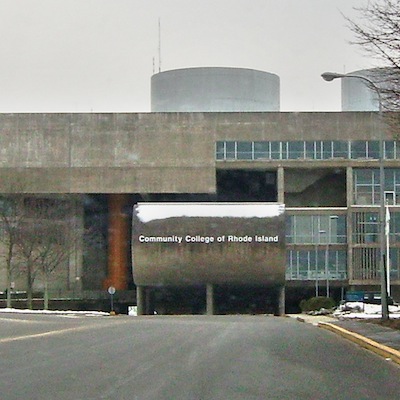
Are these numbers meaningful?
Not really!
Checking the public colleges in Massachusetts and Connecticut [College Scorecard: MA/CT Public] the graduation rate for community colleges is about 12%. The best graduation rate, 27% at Asnuntuck Community College in CT, is still below average. Clearly, graduation rate is a meaningless metric (for this and many other reasons).
To ensure schools are in compliance with the metrics, governing bodies, like Rhode Island’s Board of Education, mandate institutional accountability.
On November 9, 2016, the Council on Postsecondary Education (the Board’s oversight committee for higher education) approved institutional metrics for URI, RIC, and CCRI [Approval of Institutional Performance Metrics for CCRI, RIC and URI] Measure 1, Graduation and Retention, is addressed by all three schools. Measure 2 quantifies the number of certificates and degrees in high wage fields. This measure would impact the College Scorecard metric Salary after Attending.
The final set of metrics falls under the heading Measure 3: Mission Specific. These numbers directly impact students and faculty via course completion percentages. At CCRI, the Mathematics Department responded to the following requirement:
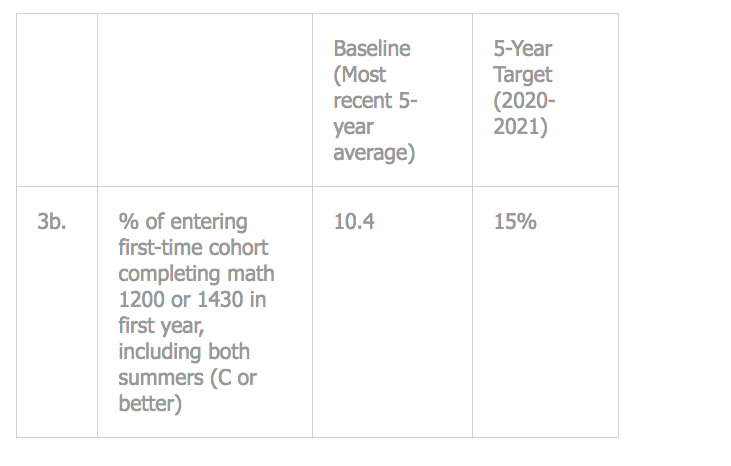
On December 22, 2016, CCRI posted the following announcement:
New math options available for spring.
Among the new options are course pairings Math 1420/Math 1430 and Math 0600/Math 1200. Each course listed is a 15 week course. Under the new course offerings for Spring 2017, each 15-week course will be condensed into 7.5 weeks. These pairs directly address metric 3b. The other options, Math 0500/Math 0600 and Math 0500/Math 1420, position students to complete Math 1200 or Math 1430 in the second semester of their first year.
Unfortunately, these accelerated course paths require students that are highly motivated, extremely self-disciplined, and who have an academic maturity which is uncommon within the general community college population. In addition, the time requirements for these courses demand a commitment that very few students can afford.
Schools Need Principles
This type of response betrays a put-out-the-fire mentality that TQM was designed to eliminate. Corporate-style administrators would do well to gain a better understanding of sound business principles. The uniqueness of the education industry demands innovation that preserves quality education. Regardless of what business opportunists try to sell, there is no such thing as just-in-time education.
Real learning demands time commitments that are best communicated by education professionals on the shop floor, the faculty in the classroom. Political and institutional policies that undermine their work continue to undermine real education.
Joe Allen, PhD was a faculty member at CCRI. He retired in December 2015 and currently resides in California.
US News 2016 College Rankings

1.
- #14 in National Universities
- #10 in Best Value Schools
- #4 in Best Undergraduate Teaching
- #5 (tie) in High School Counselor Rankings
- #22 in Most Innovative Schools
- #44 (tie) in Best Undergraduate Engineering Programs
US News Says:
"Brown University is a private institution that was founded in 1764. It has a total undergraduate enrollment of 6,652, its setting is city, and the campus size is 146 acres. It utilizes a semester-based academic calendar. Brown University's ranking in the 2017 edition of Best Colleges is National Universities, 14. Its tuition and fees are $51,367 (2016-17)."

2.
- #1 in Regional Universities North
- #183 (tie) in Business Programs
US News Says:
"Providence College is a private institution that was founded in 1917. It has a total undergraduate enrollment of 4,201, its setting is city, and the campus size is 105 acres. It utilizes a semester-based academic calendar. Providence College's ranking in the 2017 edition of Best Colleges is Regional Universities North, 1. Its tuition and fees are $46,970 (2016-17)."

3.
- #9 (tie) in Regional Universities North
- #5 in Best Colleges for Veterans
- #183 (tie) in Business Programs
US NEWS Says:
"Bryant University is a private institution that was founded in 1863. It has a total undergraduate enrollment of 3,459, its setting is suburban, and the campus size is 435 acres. It utilizes a semester-based academic calendar. Bryant University's ranking in the 2017 edition of Best Colleges is Regional Universities North, 9. Its tuition and fees are $40,962 (2016-17)"

4.
#32 (tie) in Regional Universities North
US News Says:
"Salve Regina University is a private institution that was founded in 1934. It has a total undergraduate enrollment of 2,158, its setting is city, and the campus size is 78 acres. It utilizes a semester-based academic calendar. Salve Regina University's ranking in the 2017 edition of Best Colleges is Regional Universities North, 32. Its tuition and fees are $37,820 (2016-17)."

5,
- #35 (tie) in Regional Universities North
- #19 (tie) in Best Colleges for Veterans
- #69 (tie) in Best Undergraduate Engineering Programs
- #283 (tie) in Business Programs
US News Says:
"Roger Williams University is a private institution that was founded in 1956. It has a total undergraduate enrollment of 4,555, its setting is suburban, and the campus size is 140 acres. It utilizes a semester-based academic calendar. Roger Williams University's ranking in the 2017 edition of Best Colleges is Regional Universities North, 35. Its tuition and fees are $32,100 (2016-17)."

6.
#67 (tie) in Regional Universities North
US News Says:
"Johnson & Wales University is a private institution that was founded in 1914. It has a total undergraduate enrollment of 8,768, its setting is urban, and the campus size is 126 acres. It utilizes a quarter-based academic calendar. Johnson & Wales University's ranking in the 2017 edition of Best Colleges is Regional Universities North, 67. Its tuition and fees are $30,746 (2016-17)."

7.
- #137 (tie) in Regional Universities North
- #47 (tie) in Top Public Schools
US News Says:
"Rhode Island College is a public institution that was founded in 1854. It has a total undergraduate enrollment of 7,446, its setting is suburban, and the campus size is 180 acres. It utilizes a semester-based academic calendar. Rhode Island College's ranking in the 2017 edition of Best Colleges is Regional Universities North, 137. Its in-state tuition and fees are $8,206 (2016-17); out-of-state tuition and fees are $19,867 (2016-17)."

8.
- #159 (tie) in National Universities
- #141 (tie) in High School Counselor Rankings
- #83 (tie) in Top Public Schools
- #150 (tie) in Business Programs
- #116 (tie) in Best Undergraduate Engineering Programs
US News Says:
"University of Rhode Island is a public institution that was founded in 1892. It has a total undergraduate enrollment of 13,641, its setting is rural, and the campus size is 1,245 acres. It utilizes a semester-based academic calendar. University of Rhode Island's ranking in the 2017 edition of Best Colleges is National Universities, 159. Its in-state tuition and fees are $12,862 (2015-16); out-of-state tuition and fees are $28,852 (2015-16)."


