


NEW: Raimondo, Despite Budget Priorities Being Stripped Out, Signs FY 2020 Budget
GoLocalProv News Team
NEW: Raimondo, Despite Budget Priorities Being Stripped Out, Signs FY 2020 Budget
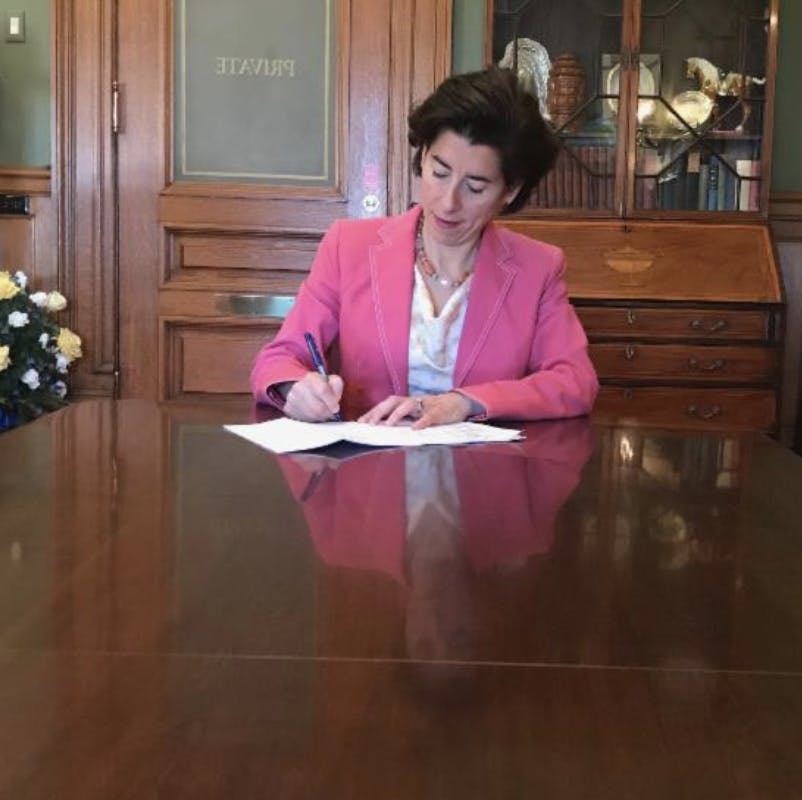
Raimondo’s signature comes a couple of weeks after the budget was passed by the Rhode Island House of Representatives, as GoLocalProv reported.
SLIDES: SEE WHAT IS IN AND OUT OF THE BUDGET BELOW
Raimondo's letter Friday stated the following:
GET THE LATEST BREAKING NEWS HERE -- SIGN UP FOR GOLOCAL FREE DAILY EBLAST“TO THE HONORABLE, SPEAKER OF THE HOUSE OF REPRESENTATIVES:
I hereby transmit to the Secretary of State, with my signature, 2019-H 5151 Substitute A as Amended, “An Act Relating to Making Appropriations in Support of FY 2020.”
Five years ago, we began a new way of doing business in Rhode Island, and that plan is beginning to show great results for the people of Rhode Island. Our economy is stronger than it has been in decades. Last year, we marked several undeniable signs of progress: our labor force grew for the first time in 13 years; between 2014 and 2018, we experienced the largest drop in unemployment in the country; and our state recorded its highest job counts in history. Just a few years ago, the unemployment rate in the construction trades was over 20 percent, today it is under 3 percent – that means thousands of Rhode Island families have the security of well-paying jobs.
But we have much more work to do to make sure that our progress is resilient. As recently as 2014, we had the highest unemployment in America. Our economic recovery is still in its early innings and we can’t make choices that risk us going backwards.
There are important steps forward for Rhode Island included in this budget, and I thank the legislature for its hard work. Several of my top priorities that will significantly improve the lives of all Rhode Islanders are contained in this budget, and I appreciate the legislature working with me to enact them. This budget makes significant strides toward my goal of universal public Pre-K by giving 300 more Rhode Island children the opportunity for a strong start in our program that is consistently ranked among the best in the nation. The budget continues to make record investments in K-12 education with the single largest funding increase of any part of the budget, and it fully funds my proposal for increased funding to English Language Learners. It also enshrines the protections of the Affordable Care Act in Rhode Island ensuring that regardless of what happens at the federal level affordable and high-quality health care will remain in reach for working families. Importantly, the budget also invests $4.5 million in higher wages for direct support professionals working with Rhode Island’s developmentally disabled community.
However, in other important ways, the General Assembly’s budget restricts our ability to grow the economy and unwisely takes our foot off the gas at a critical point in our comeback. By cutting our innovative and effective new economic development tools, our progress is put at risk.
Too many Rhode Islanders will be denied their opportunity at a better job because of the cuts to the Real Jobs Rhode Island job training program. This program has trained more than 6,000 Rhode Islanders for good paying jobs and is now experiencing increased demand because of its success. We have seen particular success in putting people to work in higher-paying manufacturing jobs, and hundreds of Rhode Island businesses have benefitted from it.
Shortsighted changes will also threaten the Qualified Jobs program, which has generated more than 3,000 jobs at an average salary of $65,000. Unlike some of the failed economic programs of the past, the Qualified Jobs initiative has demonstrable success, allows Rhode Island to compete with other states, and has excellent taxpayer protections. Weakening these two initiatives runs the risk of putting the brakes on our economic momentum.
Instead of bolstering these proven initiatives, the General Assembly’s budget creates a new controversial tax incentive program benefiting wealthy out-of-state investors that could put $42 million of taxpayer money at risk and increase our structural deficit. Four years ago, we created a new way of investing in economic development – with taxpayer protections, transparent processes, and professional evaluation. This new program does not do this and I am concerned it returns us to the old way of doing things.
This budget also creates a costly and unnecessary tax that will force every driver in Rhode Island to pay for new license plates. And it fails to address the root causes of marijuana entering the black market while also taking the responsibility of writing regulations away from professionals and putting it into the hands of legislators.
This budget places unprecedented restrictions on the ability of the executive branch to account for unforeseen increases in the number of children and families we serve as part of our legal and moral obligation to care for vulnerable Rhode Islanders. In the past five years we have had notable successes on this front: Rhode Island is one of a few states to actually see a decrease in the number of opioid-related overdose deaths two years in a row. We also have seen record increases in the number of kids placed into loving foster homes as opposed to institutional settings. The General Assembly’s budget puts all of that progress, and more, at risk.
This budget also does nothing to reduce spending—in fact, the legislative budget appropriates more spending than the budget that I submitted in January. It also doubles our out-year deficits while ignoring proposals to address increasing costs in our prison system.
Rhode Island has an unfortunate distinction in our budgeting process. We are one of only six states that lack a line-item veto – a critical tool for ensuring transparency and accountability. The line-item veto is the single best tool to increase transparency and protect taxpayers from unnecessary or unwise spending. It has the support of a solid majority of Rhode Islanders and I look forward to working with the General Assembly to put it on next year’s ballot.
Over the past four years, my administration has worked collaboratively with the General Assembly to produce budgets that reflect our shared priorities and put Rhode Islanders first. Those budgets have yielded great results – an economic turnaround, broad-based tax cuts and new investments that are rebuilding Rhode Island. This is what Rhode Islanders expect and deserve. I look forward to working hard in partnership with the legislature in the years to come.
Given the urgency of our shared mission to improve education and move Rhode Island forward, I cannot in good faith take action that would delay our progress. Therefore, I transmit, with my signature, 2019-H 5151 SUB A as Amended.”
House Budget - What Is In and What Is Out, June 14, 2019

IN
Legislature Cuts Sales Tax for Feminine Hygiene Products
A new addition to the budget which will take effect in the fall will be the elimination of the sales tax on feminine hygiene products.
The change will take effect in October, pending budget approval in the full House and Senate.
PHOTO: Wikipedia, Stilfehler

IN
Transforming URI's Governance
The proposal by URI President David Dooley to change the governance of the University from the state's Council which oversees Rhode Island College and the Community College of Rhode Island to a more independent board of trustees structure has been added to the budget -- functionally assuring its adoption.
In his remarks to the press late Friday night, Speaker Mattiello cited former Director of Administration Gary Sasse's comments on GoLocal LIVE that the measure is the "most important economic development this year" as his reason to put it in the budget.
Read the GoLocalProv Editorial HERE.

IN
Senate Majority Leader's 195 Legislation -- In the House Finance Budget
RI State Senate legislation sponsored by President of the Senate Dominick J. Ruggerio (D-Dist. 4, North Providence, Providence) that “takes a new approach to economic development on large tracts of state land. Spurred by delays and impediments imposed upon the [Fane] Hope Point Tower proposal for the I-195 Redevelopment District, the bill intends to create a more streamlined process for approvals on these state-owned parcels moving forward” is now an article in the budget.
“We have a rare opportunity for development at the former I-195 land and some other areas across the state,” said Ruggerio. “In the I-195 District, a developer is hoping to invest more than a quarter of a billion dollars to create an iconic structure that redefines the skyline. We should have welcomed this investment with open arms. Instead, we did everything we could to chase the developer away. Thankfully, he’s still here. This process has sent a terrible message to anyone looking to invest in Rhode Island.”
The legislation strips the remaining regulatory authority from the City of Providence.
Mattiello said that the 195 measure, along with the URI change in governance, constitute "economic development" -- the reason he said for placing them in the budget.

OUT
Commerce RI Takes a Hit
One of the agencies that took a hit is Commerce RI. Mattiello said the agency continues to enjoy $50 million in funding capacity, but the double incentive of Rebuild and sales tax exemption was removed. Tax exemptions in the future will be applied to the Rebuild program.
Rebuild and other Raimondo economic programs were trimmed.

OUT and IN
Raimondo's Beach Fees Out, Camping Fees In
Governor Raimondo's unpopular beach fee increase proposal is out.
Raimondo wanted to extend the hike for Rhode Island residents with a $2 increase in beach parking fees, bringing the cost to $8 during the week and $9 on the weekend.
Speaker Mattiello had indicated back in February the plan was dead on arrival -- read more here.
Camping fees are in.
The Rhode Island DEM proposed to increase camping fees, and depending on the offering (three different tiers), camping fees would increase by as much as $16 in 2019, or as little as $4 for residents.

OUT
Raimondo's Proposal to Expand RI Promise -- Free Tuition -- for RIC Is Out
Governor Raimondo wanted to expand the RI Promise program-- the "free" Rhode Island taxpayer-funded tuition currently at CCRI -- in two ways.
Raimondo wanted free tuition for Rhode Island College students and older students for both the Community College of Rhode Island and RIC.
Both expansions are dead.

OUT
Raimondo's Proposed Medicare Tax on Large Employers
Immediately after the introduction of Raimondo's budget that Wall Street Journal ravaged the proposal.
"She also wants to reimpose the ObamaCare penalty for individuals without health insurance. And she’d create a new $1,500 penalty on large “for-profit” employers for each employee who enrolls in Medicaid. This new tax is loosely based on legislation proposed by Bernie Sanders and would essentially punish businesses for hiring low-income workers," wrote the WSJ.
The Raimondo Medicaid tax -- dead.

OUT
Raimondo's Tax on Interior Designers
Governor Gina Raimondo's plan to tax the services of interior designers was roundly criticized. It was going to hit the small business for $1.4 million.
“I was pretty upset about it,” said designer Robin Garceau, who attended hearings at the Rhode Island General Assembly about the proposed tax on her business — and industry. “Why is [Raimondo] singling out certain services — why wouldn’t it be services across the board?”

IN
Expansion of Compassion Centers
The number of compassion centers under the approved House Finance budget is expanding from three to nine and the initial three owners have no claim on the new licenses.
The new licenses will cost $500,000 per license.
Lobbyists for the existing compassion centers tried to secure their rights to own the new licenses.
According to Mattiello's office, the expanded centers will be able to both grow and distribute.

OUT
Raimondo's Proposal to Legalize Marijuana Is Out
Raimondo had pushed for the legalization of marijuana -- it was estimated that the tax would generate $6.5 million.
Legislators were wary of the impact on business and cities and towns. Mattiello had repeatedly voiced concerns about lack of planning and societal impacts.

OUT and IN
Statewide Expansion of Pre-K Proposed by Raimondo Goes Down
Governor Raimondo said in her State of the State Address that she would push for a statewide Pre-K program -- it has a $10 million price tag, but her proposal is not in the budget.
"Tonight, I pledge to be the Governor who brings universal public Pre-K to Rhode Island. By the time I leave office, there will be a Pre-K seat for every four-year-old whose parents want it. The budget I'll submit later this week sets us on a path to make that happen. Let's get this done," Raimondo said.
Mattiello Friday night spoke to the House budget needing to address a shortfall of federal funding for Pre-K -- and that the proposal will expand the educational opportunity in Rhode Island, but will not be "universal" in 2020.
"We backfilled the Federal money $5 million — and added 280 high-quality seats. So it’s not universal. It’s an aggressive expansion to pre-K. The cost is $2.85 million," said Mattiello in a briefing to the press on Friday night, noting that the combined with the "back-fill" the state is investing close to $8 million next year.

OUT
Raimondo's Hospital Cuts -- Some Restored
"Hospitals were down $11M under [Raimondo's] budget — this is slightly better than proposed with a few million more in general revenues. They will be better off than proposed," said Mattiello.

IN
Raimondo's "Netflix" Tax -- In
The one Raimondo tax that was adopted was the so-called "Netflix" tax which places a 7% tax on digital downloads.
Mattiello said it put digital products on the same level as brick and mortar.
It is estimated to generate $5 million in new revenue.

IN
License Plate Fee
The cost of the issuance will be $8 per set of plates — 3M will do the initial issue.
The fee is to the citizen — and the $8 will cover the cost of the plates.

OUT
Raimondo's Cigarette Tax Increase-- OUT
Raimondo's increase in the cigarette tax was rejected to increase the cigarette tax by 25 cents per pack and 30 cents on cigars.
Mattiello said their decision was based on the impacts on small businesses, particularly border-town convenience stores who also benefit from sales of other products to people who come in to buy tobacco products.

IN
Education Financing
The bill fully funds the state’s education aid formula, increasing direct aid by $34.4 million over the current year’s amount. The committee granted the governor’s request for $5 million for more support for English language learners -- this initiative was strongly supported by the Senate leadership.
The budget also adds an additional $640,000 in funding for the Department of Education to help with education reforms.

IN/OUT
Double Loss for Raimondo -- PILOT Funded, But Her Enabling Power to Cities and Towns in Out
The House budget rejects both of Raimondo's initiatives. First, Raimondo's cuts to the PILOT program are restored. And, her initiative to allow cities and towns to create new local taxes on non-profits are out.

IN
New Tax on Opioids
Budget adopts Senate President Ruggerio’s proposed Opioid Stewardship Act (2019-S 0798) to establish a restricted receipt account for $5 million to fund "opioid treatment, recovery, prevention and education services" funded by a new tax to manufacturers and distributors on opioid products sold or distributed in Rhode Island.
Late negotiations added exemptions for those used for hospice care, addiction treatment and epidurals.

IN
GARVEE Bonds Are in the Budget
The budget includes up to $200 million in GARVEE bonds that will allow the state to take advantage of current low-interest rates to fund the reconstruction of the viaduct that carries Route 95 north through downtown Providence.
This is another freestanding bill dumped into the budget.

OUT
Raimondo's Minimum Wage Increase is Out
Mattiello said Raimondo's proposal to increase the minimum wage from $10.50 to $11.10 next year is OUT.
The General Assembly has increased the minimum wage in six of the last seven years.
Mattiello said that Rhode Island businesses were strongly opposed to an increase.

OUT
Defunded Vacant Positions
The House budget defunds all vacant state positions -- those positions that have historically been funded, but have not been filled by the Raimondo administration.

IN
Shekarchi's Small Business Tax-Cut Is In
House Majority Leader Joseph Shekarchi legislation to help Rhode Island small business owners who will be adversely impacted higher federal taxes as a result of President Donald Trump’s new tax laws is now a budget article.
Shekarchi’s plan provides a "work-around" for owners of “pass-through” entities whose state and local taxes exceed the new $10,000 cap on the state and local tax (SALT) deduction on their federal tax returns.
Connecticut passed similar legislation in May of 2018 and the proposed Rhode Island law “is carefully designed to be revenue-neutral for the state.”
“This bill will help small businesses, most of whom report their taxes as pass-through entities, by having the business entity pay the taxes on the business income and allowing a federal income tax deduction – which might have been limited if reported on the owner’s personal income tax returns,” said Willey. “Regular C-Corporations get this benefit, and this bill would put the pass-through entities on an equal footing with big businesses.”

IN
911 Revised, Federal Compliance, New Training, More Fees
The controversial 911 fees have been revamped. On one hand, the fee has been cut from $1 to $.50 and those dollars are now being placed in a dedicated restricted receipt account to meet federal law.
But, a new tax is being implemented on mobile accounts.
The budget adds $220,000 in funding to help train E911 operators to better provide CPR instruction to callers while they await emergency responders, and established restricted receipts accounts for E911 surcharge fees on phone bills.
To comply with federal requirements, the surcharges on phone bills will be split into two separate charges, one to support E911 operations and another for funding other public safety needs. Both will go into restricted receipt accounts. This creates a net new $10 million in new revenue.


