New Plan for Arcade Offers More Stability: Architectural Critic Will Morgan
William Morgan, GoLocalProv Architectural Critic
New Plan for Arcade Offers More Stability: Architectural Critic Will Morgan

Evan Granoff, the downtown developer and guardian angel of one of this city's most important landmarks, has announced that the Providence Arcade will be converted to condominiums in an effort to secure its future.
GET THE LATEST BREAKING NEWS HERE -- SIGN UP FOR GOLOCAL FREE DAILY EBLAST
It was originally called Butler's Folly, in honor of its builder's decision to place it far from the hub of the city across the river at the Market.
Its most successful reiteration has been under Granoff, who five years ago had the brilliant idea of fashioning the upper two floors into micro-lofts: 48 apartments, ranging from 225 to 900 square feet.
Granoff's determination to keep the Arcade viable, even at considerable expense and economic risk, demonstrates an understanding of its role in the commercial life of the city, not to mention as an example of our patrimony.
(In 2014, the National Trust for Historic Preservation gave their highest award to Granoff’s renovation.)
Originally built at an estimated cost of $140,000, the 216-feet-long Arcade runs between Westminster and Weybosset Streets.
It is a narrow pedestrian street with a perfect scale for strolling.

The architects, Russell Warren and James Bucklin, modeled the imposing 45-feet-tall porticos after a temple in classical Greece.
But only the Ionic capitals are Greek, as the function of the building is unique to the modern period.


American entrepreneurs and their architects wanted something bolder and more monumental than the domestically-scaled Georgian style exemplified by, say, the Market House or University Hall at Brown.
Coming at the time of the Greek War of Independence, the Greek style had a certain resonance for a post-revolutionary America.
But our country's interpretations were freer and not that much about historical precedents.

Earlier arcades in New York and Philadelphia are often cited as sources.
However, the Providence one was no doubt indebted to the granite market in Boston designed for mayor Josiah Quincy by Alexander Parris.

Furthermore, the Westminster Street commercial venture was intended to be fireproof, with extensive masonry, the use of cast iron, and iron shutters.
A huge skylight spans the roof.
Such iron and glass innovations were hallmarks of 19th-century technology.
Providence was as up to date as Paris.

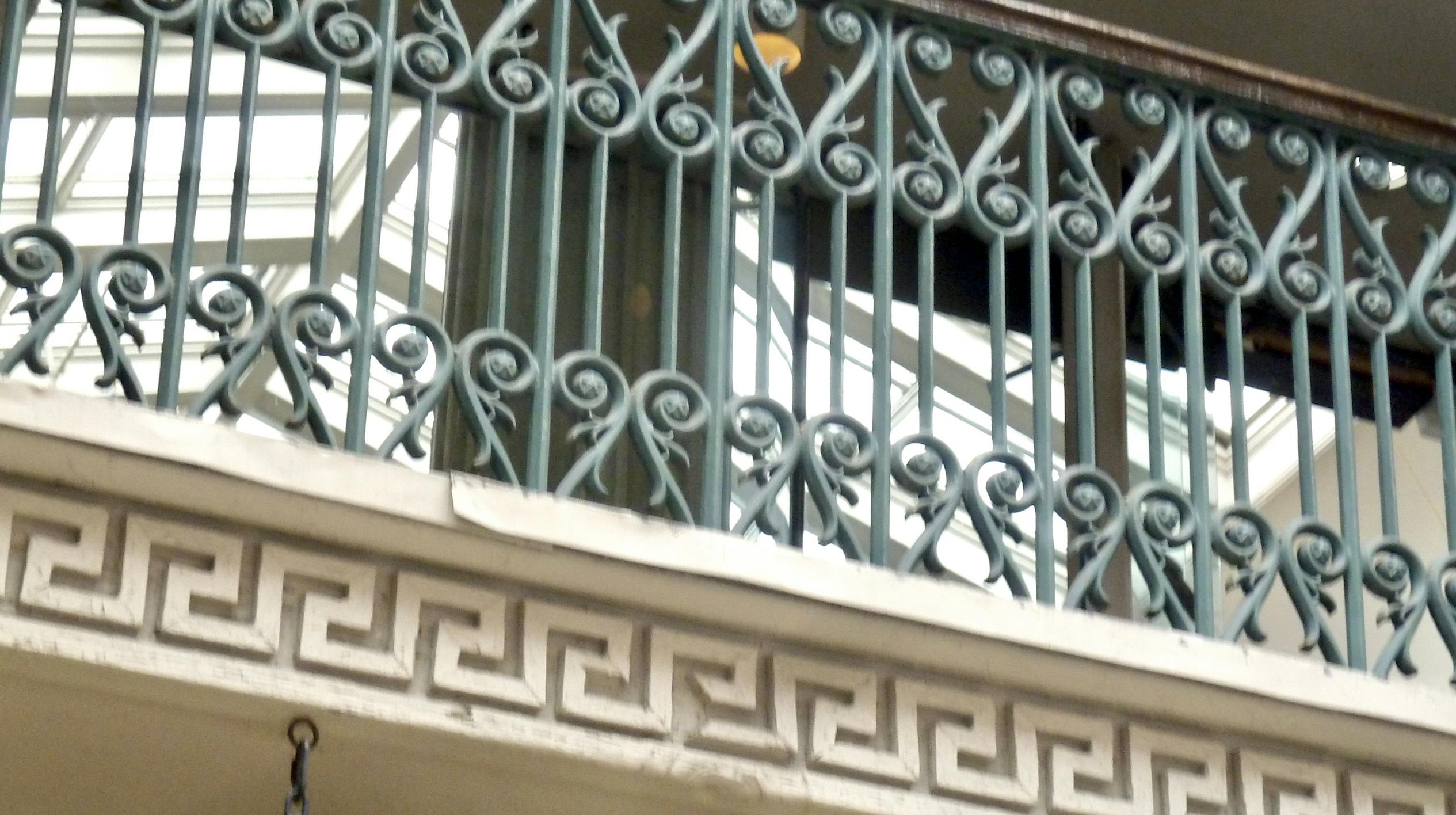
A Greek fret runs around the wall, while the railings fronting the interior walkways offer a delicate contrast to the massive stone columns outside.
With Granoff's development of the micro-lofts, the Arcade has fared better than ever before.
The projected condominium conversion may provide tenants additional incentive to commit to this glorious space.
The Providence Arcade has been blessed by a patron who has actively engaged with our history.
May his new plan offer even more stability, so that this treasure can continue to actively contribute to our architecturally rich downtown.