20 Politicians Owe $800,000 in Election Fines
Stephen Beale, GoLocalProv News Editor
20 Politicians Owe $800,000 in Election Fines
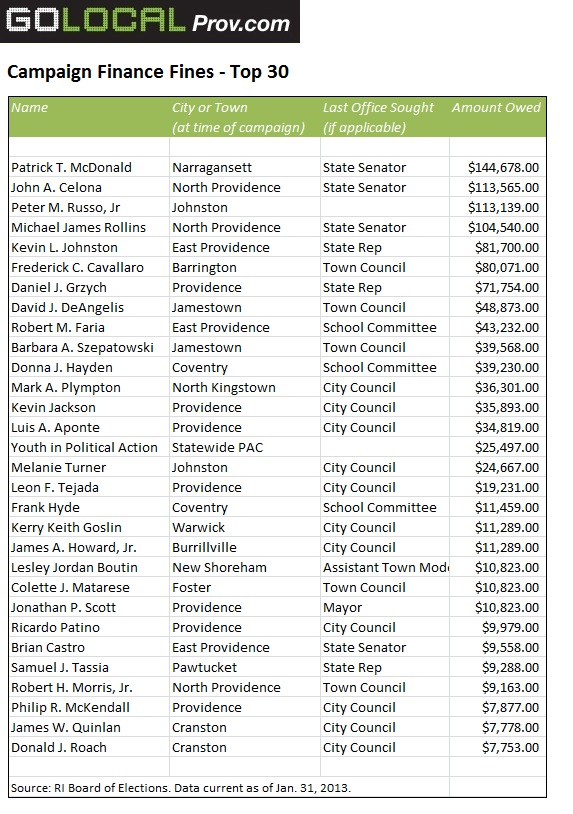
The top 20 list includes former state Senator John Celona, who was sentenced to state prison in 2007 for selling his votes, as well as several prominent city councilmen in Providence.
Top politician owes more than $100,000
GET THE LATEST BREAKING NEWS HERE -- SIGN UP FOR GOLOCAL FREE DAILY EBLASTOverall, nearly 250 candidates in elections across the state have built up $993,000 in fines as of last week, which is about half of the entire $1.8 million budget for the Board of Elections—although if collected that money would not go directly to the board but instead would be paid into the state general fund. Most of the delinquents are candidates for local office. Fewer ran for state rep or senator and none were candidates for one of the five statewide offices.
The fines approach nearly six figures for many of the top 20 politicians. At the top is former state Senate candidate Patrick McDonald, at about $103,924. Celona takes second with $78,095. The others range from $10,000 to $70,000. (See below chart for top 20 list.)
The sheer amount of the fines came as a surprise even to some of those in arrears.
“Wow, that’s pretty wild,” said Barbara Szepatowski, a Jamestown Town Council candidate in 2005 and 2007 who owes $29,569. Describing a reporter’s phone call as a wake-up call, she said she would drop by the Board of Elections right away.
Filing the campaign finance reports is critical for the public to be able to follow the money in the election process, said John Marion, executive director of Common Cause Rhode Island. The reports show both who is funding a candidate as well as how a candidate is spending that money. Without the reports, there really is no way for the public to know how money is influencing the process.
The fact that many of those on the list continue to serve in office yet fail to file timely reports, Marion said, undermines public confidence in the state campaign finance system. “If they’re not collecting the fines how can people have faith the Board of Elections is serving as a watchdog?” Marion said.
He said that watchdog role is all the more important in local and state races where candidates don’t face credible opponent who could raise the issue.
He said the Board of Elections needs tougher legal tools to do its job. One idea: prevent someone from filing papers to run for office again until they have caught up on all their late fees from past elections. Ric Thornton, the Director of Campaign Finance, said his office submitted legislation along those lines in a previous legislation session, but the bill never made it beyond the committee level.

Official: ‘We’re not here to make money’
The individual fines are modest: A flat late fee of $25 for being late with a report. A $2 daily late fee kicks in after a candidate fails to respond to a warning letter. Over time, with at least four quarterly reports due even in non-election years, those fines can accumulate rapidly, Thornton said.
“Sometimes [it’s] human nature,” Thornton said. “Rather than address a problem, you ignore it.”
Under the current process, a tardy report triggers a late notice, followed be a second letter, and then phone calls, Thornton said. In extreme cases, he said the Board of Elections can pursue civil actions against delinquent payers in Superior Court—something it has not done in several years.
Could fines in the tens of thousands of dollars taint the public image of a candidate? Political scientist Victor Profughi doesn’t think so. The most significant issue from a political perspective, he said, is that there are so many candidates who are either late with their finance reports, or are not filing them at all. For example, Celona has failed to file 29 reports, dating back to 2004.
Candidate: ‘They acted like jerks’
In interviews, candidates and elected officials offered varying explanations for why they had fallen behind—everything from a lack of awareness over the law in some cases to a condo fire for one candidate.
Providence City Councilman Kevin Jackson said he did not realize that he still needed to file the reports, even if he did not raise any money, which he did not do in the last election in which he ran unopposed. Jackson promised to rectify the situation. “It is my responsibility and I will take responsibility for it,” Jackson told GoLocalProv. “I’ll do my best to get it done and appeal it.”
A third candidate cited personal catastrophe as the original reason for his delinquency. Michael Rollins, who ran for town council in North Providence, said there was a fire in his condominium in October 2004, just days before one of his campaign finance reports was due.
“I was actually sitting down to work on it when the … fire alarm went off,” Rollins said.
His condo was spared serious damage, but he was shut out of it for a week, Rollin said. By the time he returned, he said finishing up the report wasn’t exactly at the top of his priority list. That may explain why he was late with that report—but what about the other 29 reports he has not filed since then?
Rollins said he stopped filing them in protest after the Board of Election refused to give him a month-long extension on the October 2004 report. (State law allows extensions of up to seven days.) “At that point, I stopped cooperating with them,” Rollins said. “They had their chance to be polite in ’04. They acted like jerks and I said, ‘Screw it.’”
He said he requested a jury trial on the case but never heard back from the state. “They’ve been sending me letters demanding money and I’ve given up on them apologizing for what they did to me in ’04,” he said.
The size of his fine—$67,756—did not seem to be a cause for much consternation. “It might as well be 10 times or 100 times as much. It’s ridiculous,” Rollins said.
If you valued this article, please LIKE GoLocalProv.com on Facebook by clicking HERE.