


Democrats, Labor Stack Hearing for PawSox Funding Scheme at RI State House
GoLocalProv News Team
Democrats, Labor Stack Hearing for PawSox Funding Scheme at RI State House
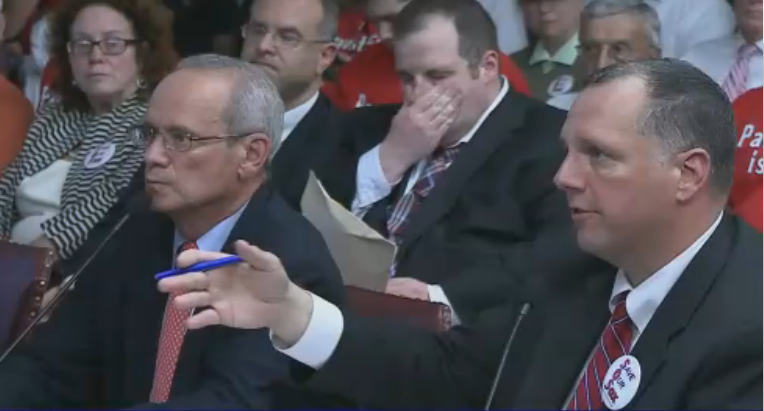
A plethora of Northern Rhode Island Democratic Mayors, union leaders, and Pawtucket business owners testified in support of the public financing scheme starting at 6 P.M, touting what they said would be a significant economic benefit to the region -- and state - until opponents started in at 10 p.m.
Slides: 7 Questions the PawSox Need to Answer at Hearings BELOW
GET THE LATEST BREAKING NEWS HERE -- SIGN UP FOR GOLOCAL FREE DAILY EBLAST"Someone asked me earlier how I prepared," said Pat Ford, Chair of the Libertarian Party of Rhode Island and critic of the PawSox ownership's attempts to secure public assistance. "I simply googled 'failed minor league baseball stadiums'."
The hearing Thursday marked the first of six public events in the several weeks for Rhode Islanders to weigh in on the legislative proposals for a new, $84 million ballpark on the location where the now defunct Apex Building currently stands.
Support, Dissent Aired
Elected officials and Paw Sox brass testified first, after both labor leaders and rank and file workers filled the State House rotunda and lined signs around the hearing room in support of the legislation - and the associated jobs that would come with approval.
"We welcome human and capital investments into our two communities. The impact will be immediate and reach deep into my city, which is just a short walk away," said Central Falls Mayor James Diossa. "The bottom line is that keeping the Paw Sox in Pawtucket, I believe it is a good deal for a Rhode Island. We shouldn't let the bitter aftertaste of past failures... limit our future."
Pawtucket Mayor Donald Grebien addressed concerns that the host city - which would backstop the bonds -- is not in a financial position to do so.
"Let me assure you there are no deficits, we've carried surpluses," Grebien told the committee. "This type of economic development will help us grow. The business community strongly supports this."
The Paw Sox were represented by Larry Lucchino, Dr. Charles Steinberg, and Mike Tamburro, among others -- including longtime Lucchino colleague and architect Janet Marie Smith.
"I'd be remiss without saying something, being in the shadow of Fenway Park," said Smith, of Pawtucket. "We want to make sure this side really, really counts. Our interest is sincere, studied, and achievable."
Opponents, however, questioned the deal's viability - and need for investment by Rhode Island taxpayers for a collective group of billionaire owners.
"Much is being made of the potential for ancillary development," said Ford. "Let me harken back to the Convention Center, which continues to hemorrhage millions, years later."
"Taxpayer subsidized facilities - the casino and McCoy Stadium or whatever its new name will be - will be a catalyst," said Ford. "For themselves."
Community activist Roland Gauvin raised questions about the deal.
"If the stadium is such a good investment, why do the millionaire and billionaire owners need our money?" quipped Gauvin. "Bob Kraft -- he was an entrepreneur he used his own money. That's the way stadiums should be built. If the owners don't have a stake, what prohibits them to pick up and leave any time they want?"
7 Questions the PawSox Need to Answer in Hearings

Who is responsible for the environmental clean-up costs?
As GoLocal exclusively reported in May, the owners of the Apex site in Pawtucket and the previous owners are battling in Superior Court over indemnification provisions from more than $6.4 million in environmental clean-up costs tied to the land being eyed for the new PawSox Stadium.
The two parties include Andrew Gates of Apex Development Company who purchased the property for $24 million and a number of members of the prominent Fain family, who previously had ownership interest in the property.
Gates’ entity purchased the property in December of 1998 according to city tax records and the property is now assessed at just under $4.3 million — a drop of nearly $20 million in value.

Who is on the hook for the public subsidy (and the entire Stadium cost)?
Critical to the proposal gaining approval by legislators and building public support is that financing costs are not backstopped by taxpayers. Presently, that is in question.
Seth Magaziner, RI's General Treasurer, has raised the red flag about the proposed legislation, “The debt study that we did, no surprise, the liabilities of the City of Pawtucket are pretty high. That being said, the legislation as introduced does suggest that there’s a state backstop.”
He made the comments in an interview with WPRI.

Why should a group of billionaires receive a public subsidy for their sports team?
The owners of the PawSox have a combined personal wealth that makes them among the most wealthy ownership groups in all of professional sports.
READ MORE ABOUT THE OWNERS HERE
Their fortunes are linked to CVS, Providence Equity, Fleet Bank, TJX, and the Boston Red Sox. Unlike the previous owner, the late Ben Mondor, this group has refused to meet the public or speak to the media.

Can Pawtucket support the debt obligation?
While bond rating agency Moody's ranks Pawtucket's future outlook as stable. Moody's flags factors:
Credit Challenges:
Large unfunded pension liability
High fixed costs (combined pension, OPEB costs and debt service)
Low wealth and income indicators
Increasing debt
Weak tax base growth

They Have Political Support - Will Raimondo Flip Again?
Proponents, including the ownership group, must feel that Rhode Island is moving quicksand. Governor Gina Raimondo supported the Providence stadium plan until she didn't.
She supported the initial financing structure for the Pawtucket location, negotiated by her Secretary of Commerce Stefan Pryor, then flipped on that proposal and announced her opposition.
Now, she is supportive of the pending stadium deal. Is she willing to bet her re-election on it?

38 Studios, St. Joseph Pension Fund Bankruptcy, and Wrong Track RI
There may only be one Rhode Islander who loves RI's inability to properly review critical financial deals -- Attorney Max Wistow who sued to recover 38 Studios assets and now has been engaged to investigate the largest pension fund (St. Joseph Health Services) collapse -- just three years after the RI Attorney General Peter Kilmartin gave the sale of St. Joseph's assets the green light.
The 38 Studios deal under minded confidence and now the recent failure of St. Joseph's bankruptcy has only fueled the concern that RI cannot properly review financial deals.

Opposition - can they be mollified?
From Libertarians to Republicans to Progressive Democrats -- there is a sweeping array of opponents to the proposed public subsidy. See VIDEO


