


PawSox Owners Not Registered to Lobby in Providence
Kate Nagle, GoLocal Contributor
PawSox Owners Not Registered to Lobby in Providence
The new owners of the PawSox asked in April that the City of Providence void tens of millions of dollars in property taxes as part of effort to move the team from Pawtucket to Providence.
Since the initial request, high level elected officials in the City of Providence tell GoLocal they have been repeatedly briefed by members of the new PawSox ownership group and they and their staff have been invited to travel on an expense paid trip with the team to North Carolina.
All of these activities fall under the City of Providence’s lobbying statute. But no members of the PawSox ownership group, their staff or their agents have registered as lobbyists with the City of Providence.
GET THE LATEST BREAKING NEWS HERE -- SIGN UP FOR GOLOCAL FREE DAILY EBLASTTheir failure to register appears to be in clear violation of the City’s lobbying ordinance. Violations are punishable by a $250 per day fine. It is unclear when the PawSox started discussions, but on April 15 the team announced publicly its request that Providence waive all property taxes for 30 years on the proposed $80 million stadium.
Meetings and Free Trip
According to the Mayor’s office and the leaders of the City Council, each has been contacted by the PawSox team with briefings and offers of a trip.
"I hear they're whittling down to some sort of deal," City Council President Luis Aponte told GoLocalProv. "Last I spoke with them was probably a couple of weeks ago, when they called around about the Durham trip -- they asked if anyone from our staff wanted to go. I begged out," said Aponte, noting that no Council staff would be attending. "The problem is when you take elected officials on those kind of things, there are major ethics ramifications to consider."
Similarly, City Councilman and Majority Leader Kevin Jackson said, “Have there have been discussions between council members and their team? Yes. There's been nothing in writing, it's all been verbal."
The Mayor and his team were also invited to travel with the PawSox to North Carolina, "The Mayor, Chief Operating Office, Economic Development Director and Deputy Economic Development Director were invited and are unable to attend,” said Evan England, Elorza’s Press Secretary.
According to the City of Providence’s ordinance, "The purpose of this ordinance is to create registration and disclosure requirements for individuals acting as municipal lobbyists. The registration will require lobbyists to provide pertinent information for the benefit of the general public, the mayor and the city council.”
To date in 2015, twenty-seven lobbyists have registered with the City including representatives from the American Heart/Stroke Association, Lifespan, union groups such as Unite Here and BuildRI as well as Fidelity Investment. In 2014, thirty-three lobbyists registered including the RI Coalition for the Homeless and Common Cause.
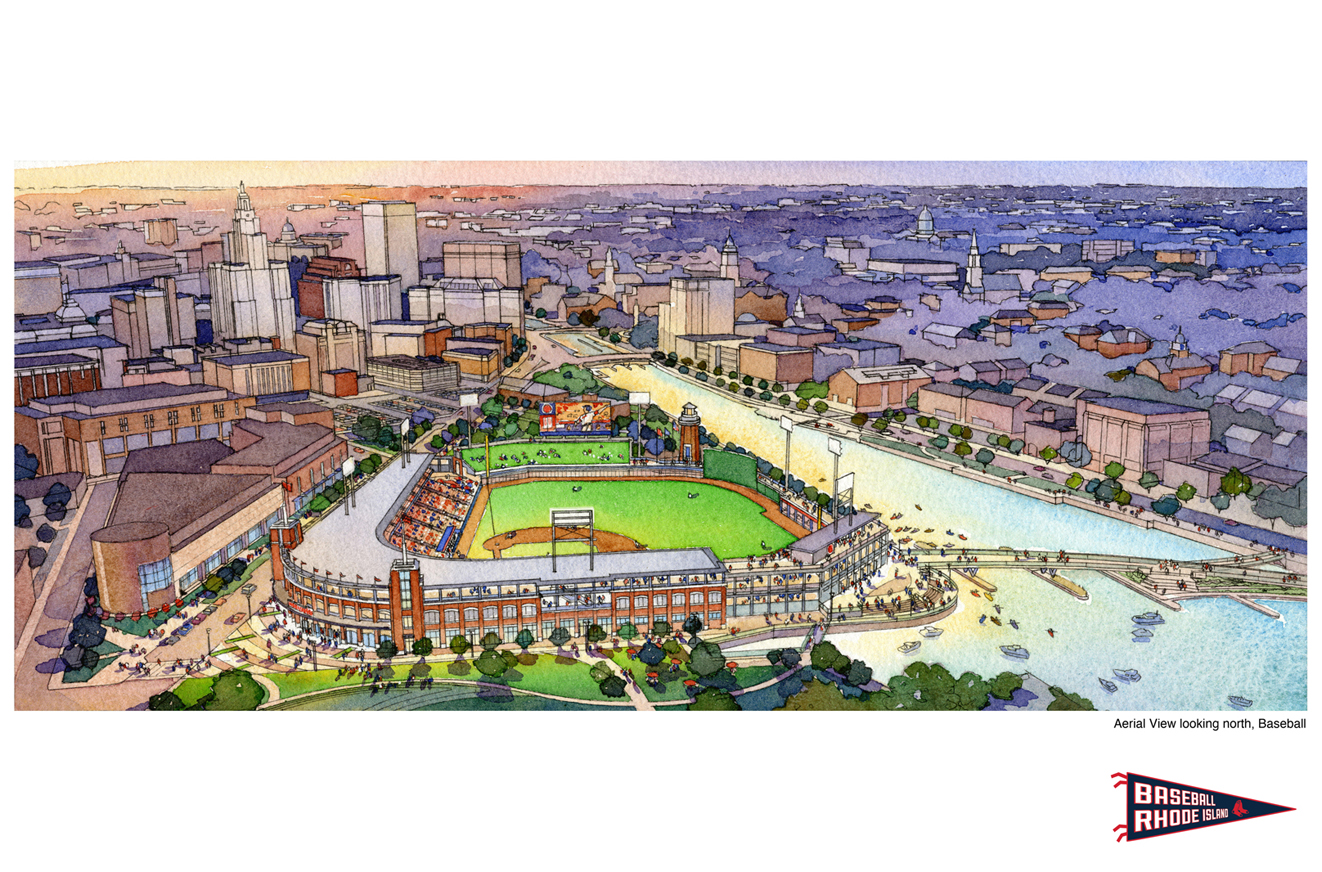
According to the City’s website, one report is required per lobbyist each quarter, with certain optional sections requiring multiple submissions dependent on lobbying activity if a lobbyist is serving multiple clients. Reports include the name of the lobbyist, the employer(s) or client(s), employer's address, telephone number, email address, and the amount of client salary or compensation related to lobbying. Reports must also detail the lobbyist's activities, including the city official(s) and municipal decision(s) concerned, as well as other information.
According to the statute, quarterly reports shall be filed for the periods of: January through March; April through June; July through September; and October through December.
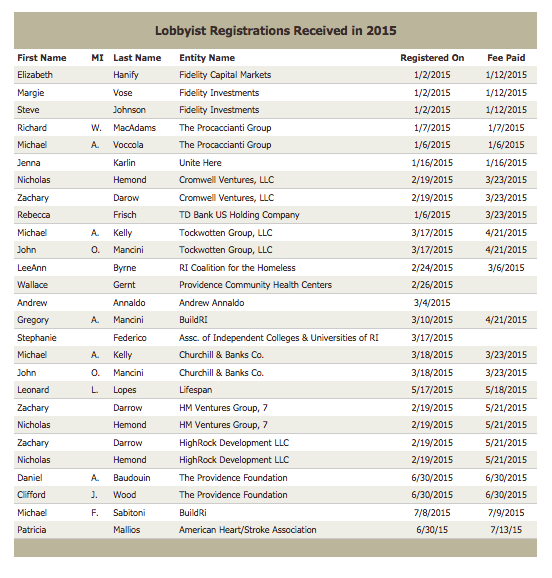
While the PawSox requested Providence waive taxes on the proposed $80 million stadium, a GoLocal review of Boston tax records showed that the PawSox parent company pays millions to Boston for properties of approximately the same value.
In the May 29th story GoLocal unveiled:
Boston Red Sox ownership group’s Fenway Park has an assessed value of more than $81 million dollars and pays the city of Boston more than $2.4 million in property taxes for the 1912 Fenway Park. In addition, the Boston Red Sox own three other major parcels that pay almost $1 million more in property taxes:
2 Yawkey Way with a $5,526,206 assessed value that pays $163,133.60
12 Lansdowne Street with a $16,557,902 assessed value that pays $488,789.80
Brookline Avenue parcel with a $5,992,000 assessed value that pays $176,883.84
And, Fenway Park with an assessed value of $81,413,223 and that pays $2,403,318.34
In total, the Boston Red Sox ownership pays more the City of Boston $3,232,125.58 per year according to City of Boston tax data.
Patti Doyle, spokesperson for the PawSox ownership group, did not response to inquiries.
As background:
In April, the City of Providence announced, “a framework to guide a collaborative, transparent review of today's proposal to construct the Red Sox' minor league baseball stadium in Providence.
Framework to Guide Review of AAA Red Sox Stadium Proposal
Use of Park Space - Review will ensure that a proposal to repurpose I- 195 land designated for public park space complies with federal requirements for the district.
Infrastructure Requirements - Review will evaluate the proposed project's impact on both on-site and off-site infrastructure, including utility infrastructure, existing and new public transit requirements and anticipated street closures, taking into account both cost and timeline for implementation.
Environmental Impact - Review will analyze a project's impact on the I-195 Master Environmental Permit and ensure compliance with storm-water and other environmental requirements of the Narragansett Bay Commission, the Rhode Island Coastal Resources Management Council, and the Rhode Island Department of Environmental Management.
Urban Design and Integration - Review will consider the impact a project will have on surrounding commercial, residential and recreational uses. Sight lines, street-scape, water access, Riverwalk and CityWalk access are factors that will be reviewed to ensure the project makes Providence and Rhode Island better places in which to work, live and do business in the long term. The review will also consider conformance with Providence's Zoning Ordinance, including building design standards.
Multi-Use Feasibility - Careful consideration will be given to the flexibility and alternate usage opportunities of the proposed project. This includes the feasibility of hosting various athletic events, as well as recreational, retail, performance and community uses. The review will also take into consideration the potential impact of competition with existing venues in the City and surrounding area.
Public Impact - Review will weigh a proposal's commitment to contribute to the community and seek to ensure that the project's proposed uses will serve the community well. Demonstrated support from local institutions and community partners will be well regarded.
Traffic Impact - Review will analyze a project's impact on overall and event-driven traffic including motor vehicle, alternative transit and pedestrian flow, as well as analyze increased demand for parking and its impact on existing nighttime parking facilities.
Economic Impact -Review will examine a project's immediate impact on City and State revenues and expenses, as well as the long- and short-term economic impacts of the project on the I-195 District, the City of Providence and the State of Rhode Island, including direct and indirect job creation.
Cost/Benefit Analysis - Review will consider a project's capital costs and any request for direct and indirect public investments to ensure a secure and sustainable ratio of public/private investment on capital and operations.
Pawsox Stadium Timeline

1938-1942
Depression Era Public Works
The stadium's construction was started in the midst of the Great Depression as a public works project.
The champion of the project was then-Mayor Thomas P. McCoy. After World War II the building was named in honor of McCoy.
PHOTO: RI Historical Society

1990s
Pawtucket Power Brokers Deliver Millions for Rehab
The demands for public money is not new. In the mid-1990’s, the PawSox under the ownership of Ben Mondor leveraged an offer by Massachusetts Governor Bill Weld to build a $40 million public stadium in Worcester, MA to lure the PawSox to central MA.
In response, then-Speaker of the House John Harwood and House Finance Chair Tony Pires — both of Pawtucket to realize a total rehab of about $18 million. Mondor provided a reported $4 million dollars to the project to rehab the state owned facility.

November 28, 2014
PawSox To Be Sold To Some Red Sox Owners.
According to a report in The Boston Globe, The Pawtucket Red Sox will be sold to part of the Red Sox ownership group. The price and names of the owners purchasing the minor league franchise is not yet known.
For the full story click here.

January 10, 2015
Leaders Make the Case for PawSox to Stay in Pawtucket
Support is mounting from city and local sports industry leaders to make a case for keeping the 2014 league champions at McCoy stadium, which it has called home for over 40 years.
For the full story click here.

January 12, 2015
Raimondo’s First Test, Keep The Pawsox in RI
Days into the Governorship of Gina Raimondo and she’s already tasked with a tall order—find a way to keep the Pawtucket Red Sox where they belong—in Pawtucket.
For the full story click here.

February 24, 2015
City Council President Aponte “Excited” at Prospect of PawSox Coming to Providence
City Council President Luis Aponte reacted with excitement Monday at the prospect of the Pawtucket Red Sox moving into Providence.
For the full story click here.

February 24, 2015
Pawtucket Mayor Says PawSox Move is “Devastating”
Pawtucket Mayor Donald Grebien confirmed to GoLocalProv that the new owners of the Pawtucket Red Sox plan to move the team out of the city.
For the full story click here.

February 24, 2015
New Owners Don’t Rule Out Public Funding For New Providence PawSox Stadium
The new ownership group of the Pawtucket Red Sox hasn’t ruled out using public financing to fund their proposed new stadium in downtown Providence, according to comments made by new principal owner and team president James Skeffington.
For the full story click here.

February 26, 2015
Jencunas: Providence PawSox Stadium - Boon or Bust?
GoLocal contributor Brian Jencunas writes, “the proposed move of the Pawtucket Red Sox to Providence is either the next Providence Place Mall or the next 38 Studios.”
For the full story click here.

March 2, 2015
The Ten Biggest Questions Facing the PawSox Coming to Providence (Slideshow)
If the new ownership of the Pawtucket Red Sox want to build a new stadium in Providence, a number of questions need to be answered. The potential for a major contruction project in the state's Capitial city touches upon a number of issues, from money, to politics, to jobs, and development.
For entire slideshow click here.

March 2, 2015
David Brussat, Dr. Downtown: The Red Sox and the PawSox
GoLocal contributor writes David Brussat writes that his “heart says stay, but “stay in Pawtucket” may mean “leave Rhode Island” unless it means “move to Providence.”
For the entire article click here.

March 2, 2015
Moore: Will PawSox Move be a Sweetheart, Insider Deal?
GoLocal contributor Russell Moore explains that, “if you think that the shrewd, savvy, group led by renowned Rhode Island political insider James Skeffington and Red Sox boss Larry Lucchino bought the Pawtucket Red Sox without the framework of a deal with the state in their back pocket, I've got a video game business idea I'd like to pitch to you.”
For the entire article click here.

March 4, 2015
City Councilors Make Pitch for PawSox to Come to Worcester
Worcester City Councilors Gary Rosen and Phil Palmieri proposed that the city of Worcester makes a pitch for the Pawtucket Red Sox, or another Major League Baseball-affiliated team, to move to Worcester.
For the entire article click here.

March 5, 2015
Bishop: Keeping the Pawtucket Red Sox Without Seeing More Red in Providence
The Speaker of the House seems to have rushed to judgment, favoring the move of the Pawtucket Red Sox to Providence and decrying critics as unduly pessimistic and unwilling to see us invest in ourselves.
For the full store click here.

March 10, 2015
RI GOP: $450 Million Spent on Convention Center Red Flag for PawSox Deal
Members of the Rhode Island House Republicans are warning about "lessons learned" from the Rhode Island Convention Center lease agreement that has cost the state nearly a half billion dollars over the last twenty years, as the new owners of the PawSox eye Providence for a new stadium.
For the full story click here.

April 8, 2015
Providence PawSox Proposal Asking For Greater Public Support
The new owners of the Pawtucket Red Sox are asking for more public support to finance moving the team to a parcel of land in downtown Providence on former I-195 land.
For the full story click here.

April 13, 2015
Is the PawSox move to Providence a distraction to growing real business?
Rhode Islanders look to a 43-year-old woman to lead the state out of one the worst economies in its history, and hope that Governor Gina Raimondo will begin the process of transforming the economy into a modern and functioning era.
For the full story click here.

April 16, 2015
PawSox Ask for More Than $100 Million in State and Local Aid
The Pawtucket Red Sox today unveiled their plan for a new ballpark in downtown Providence, which would cost taxpayers over $100 million.
For the full story click here.

April 17, 2015
PawSox Consultant’s Findings in Other Cities Often Very Rosy
A GoLocalProv review of reports written by consultants hired by the PawSox new ownership group finds similarities in the methodology and the findings of many of the reports that the consultants have delivered across the country.
For the full story click here.

April 17, 2015
PawSox Consultants Overestimated URI Ryan Center Attendance by Millions
The consulting group hired by the new ownership group of the Pawtucket Red Sox was the same one retained by the state to conduct the business plan for the University of Rhode Island's Ryan Center in 2000 -- and furnished attendance projections for the Center which proved to be overinflated by nearly 30% over the course of its first ten years.
For the full story click here.

April 20, 2015
Bill Introduced to Require Voter Approval for PawSox Stadium Deal
New legislation has been introduced that would require voters to “approve any financial arrangement that obligates the state to fund the debts of others with respect to a baseball stadium.”
For the full story click here.

April 20, 2015
John Loughlin: PawSox in Providence – A Counter Offer
Here is John Loughlin’s “counter-offer” to the new owners of the Pawtucket Red Sox.
Click here for the full story.

April 20, 2015
Moore: A Preposterous PawSox Proposal
After the jaw-dropping proposal from the Pawtucket Red Sox ownership, that would, among other things, force Rhode Islanders to pay the team $120 million for an $85 million stadium they'll build was released, former State Representative David Segal took to Facebook to ask a question: Why wouldn't the state just buy the team itself?
Click here for the full story.

April 20, 2015
Leaders’ Reactions Mixed to Providence Sox Stadium Proposal
The new owners of the Pawtucket Red Sox have announced their proposal to build a $85 million stadium in Providence -- and while many Rhode Island elected officials and leaders have taken a wait-and see approach, a number have voiced their outright opposition to the plan as presented.
Click here for the full story.

April 21, 2015
PawSox Owners Have Given Hundreds of Thousands in Political Contributions
The new ownership group of the Pawtucket Red Sox has given hundreds of thousands of dollars in political contributions to candidates and elected officials in Rhode Island -- and its lobbying and communications team have donated over six figures combined on top of that.
Click here for the full story.

April 26, 2015
Opposition Mounting Against Providence Sox Stadium Proposal
The 195 Commission reversed its decision to hold its meeting on the proposed Providence stadium Monday in closed session, announcing Friday it would now hold Monday's meeting open to the public, but public opposition to the proposed deal continues to grow.
For the full story click here.

April 27, 2015
Dr. Mazze - Asking the Right Questions Now on PawSox
The PawSox stadium proposal is on a fast-track to obtain financial support in one way or another from Rhode Island and the City of Providence. Various studies have been presented on the viability of a new stadium in Providence, and another study of about $150,000 has been commissioned.
For the full story click here.

April 27, 2015
New PawSox Stadium Location Emerges in Providence
A new stadium location in Providence has emerged as an alternative to the proposed 195 Commission land, GoLocalProv has exclusively learned.
For the full story click here.

April 29, 2015
Owners of Potential New PawSox Site Issue Statement As Alternative to 195 Land
The owners of the Victory Plating site that GoLocalProv unveiled as an alternative site on Sunday have issued a statement regarding their site as the potential new home of the PawSox.
For the entire story click here.

May 1, 2015
Dr. Mazze - New PawSox Stadium v. 38 Studios Lessons Unlearned
Dr. Mazze writes, “Bringing up 38 Studios as the discussion for public financing and tax forgiveness continues for a new PawSox stadium in Providence gets the immediate response……we have to move forward.”
For the full story click here.

May 1, 2015
RI GOP: Convention Center Contracts Warning Sign for PawSox Deal
The Rhode Island House Republican Policy Group continued their investigation into the state's spending on the Convention Center Authority (CCA) at a meeting on Thursday, releasing findings from an Auditor General report that showed massive contact cost overruns in the 1990s that they said serve as a warning sign.
For the full story click here.

May 11, 2015
Moore: Mattiello Must Leave Pawsox Fate Up To Voters
GoLocal contributor believes that “Rhode Islanders should be asked directly if they want to spend tens of millions to pay for a new stadium for the wealthy men who now own the Pawtucket Red Sox.”
For the full story click here.

May 12, 2015
PawSox Want $120M, South Carolina Lands Volvo for $200M in Incentives
The Pawtucket Red Sox new ownership is asking for $120 million in incentives from Rhode Island and a tax break from the City of Providence voiding property taxes for thirty years. The PawSox employ less than 30 full-time employees.
For the full story click here.

May 14, 2015
Economist Says PawSox Leverage Over RI is Overstated
Rhode Island House Speaker Nicholas Mattiello’s (D-Cranston) recent Pawtucket Red Sox talking points make it seem like the state of Massachusetts is waiting in the wings with financial incentives to lure the team away. Victor Matheson, a prominent economics professor from the College of the Holy Cross, poured cold water on that notion.
For full story click here.
May 18, 2015
PawSox President Jim Skeffington Dies
Jim Skeffington, the PawSox President and driving force behind the proposed move of the team to Providence, has died of a heart attack at age 73.
For the full story click here.

May 18, 2015
PawSox Release Statement on Jim Skeffington Passing Away
Pawtucket Red Sox President James Skeffington passed away of a heart attack early on the morning of May 18th. The Pawtucket Red Sox have released a statement regarding his passing.
For the full story click here.

May 19, 2015
What’s Next for the PawSox?
The passing of Pawtucket Red Sox President James Skeffington raises new questions about the future of a Providence stadium, as the ownership group was in the midst of negotiating a new deal with Governor Raimondo and state leaders -- and embarking on a community tour to hear from residents of the city, spearheaded by Skeffington.
For the full story click here.

May 26, 2015
Pawtucket Fights to Keep PawSox: Mayor Grebien’s Letter to Larry Lucchino
Just days after the passing of Pawtucket Red Sox owner James Skeffingon, Pawtucket Mayor Donald Grebien wrote a letter to Boston Red Sox owner Larry Lucchino.
For the full story click here.

June 5, 2015
Bill to Require Voter Approval for PawSox Stadium in House Finance
The Rhode Island House Finance Committee is hearing testimony Thursday afternoon on legislation to require voter approval for any financial agreement the State of Rhode Island may make with any professional sports franchise -- including any new PawSox stadium in Providence.
For the full story click here.

June 8, 2015
Tens of Thousands Sign Petitions Against PawSox Providence Stadium Deal
Petition signatures opposing the Pawtucket Red Sox moving to Providence have totaled over 10,000 signatures to date, with two petitions -- one to keep the Pawtucket Red Sox at McCoy Stadium and one to call for no financial aid from Providence -- slated to be delivered to leadership this week.
For the full story click here.

June 22, 2015
PawSox Stadium Opponents to Up Pressure at State House this Week
The Rhode Island General Assembly might be in the waning days of the 2015 session, but opponents to a Providence PawSox stadium are planning to ramp up their efforts to let lawmakers know they oppose a new deal if put forth -- or a special session to consider one.
For the full story click here.

June 26, 2015
PawSox Stadium Opponents Rally at RI State House
Opponents to a Providence stadium for the Pawtucket Red Sox rallied at the Rhode Island State House on Thursday, June 25th -- GoLocalTV was on location to get the scoop.
For video footage click here.

June 29, 2015
David Norton: PawSox Owners Trying to Buy Support
Why are the PawSox owners buying support with a catered dinner at a Salvation Army food pantry in South Providence?
For the full story click here.

June, 2016
Pawtucket and PawSox Hire a Consultant
The Pawtucket Red Sox along with the City of Pawtucket announced in the summer of 2016 that they issued a request-for-proposals for a McCoy stadium feasibility study.
The study was to "determine the needs, upgrades, improvements, and the associated costs, of McCoy Stadium, as called for within the existing lease between the Pawtucket Red Sox, the City of Pawtucket, and the State of Rhode Island."

Dec, 2016
ABC6’s “In The Arena” - Debate Subsidy for Billionaire PawSox Owners
The panel on this week's episode of ABC6's "In the Arena" debate the need to provide subsidies to the owners of the Pawtucket Red Sox.
Moderator Joe Paolino leads the discussion and former Governor Ed DiPrete, former Attorney General Arlene Violet, former State Representative Ray Rickman, and GoLocal CEO Josh Fenton appear this week.

Jan, 2017
National Stadium Expert: Public Should Not Subsidize PawSox to Stay in Pawtucket
A leading sports economist is saying that he would personally advise no public money be spent on rehabbing - or rebuilding - McCoy Stadium for the Pawtucket Red Sox, after a report released this week showed that it would cost $68 million to renovate McCoy, and at least $78 million to construct a new stadium.
“As an economist, I would personally advocate for no public money beyond a provision to infrastructure around the stadium to fans can get to the games,” said Victor Matheson, who is a Professor of Economics at Holy Cross, whose focus is on sports. “That being said, there are certainty sports fans who think that having a AAA team in town is a nice amenity for local residents so might be worth some public money. So, some level of ask might be able to get public support.”

March, 2017
Apex is the new favorite
The new preferred location is the Apex department store site in downtown Pawtucket. It has great highway access, has the potential to be an economic spark, but has numerous environmental issues.

March 2017
RI Commerce's Stefan Pryor Talks PawSox on GoLocal LIVE
Commerce Secretary Stefan Pryor talked with GoLocal about Commerce's role in facilitating development of the dormant Superman Building, how he feels about the ownership of the Pawtucket Red Sox looking for assistance with keeping the team in Pawtucket, and how Commerce increased its $1 million budget to $2 million to help businesses across the state with upkeep improvements.

April, 2017
PawSox’s President Steinberg Talks New Park Potential, Saturday Fireworks, and More on GoLocal LIVE
Pawtucket Red Sox President Dr. Charles Steinberg talked with GoLocal about the team's upcoming season, the recently announced Hall of Fame list, the prospects of the future of McCoy and whether the Apex building location presents a viable option.

April, 2017
PawSox Chair Lucchino: Vision is for “Public Park” in Pawtucket
Pawtucket Red Sox Chairman Larry Lucchino told a crowd of over 100 at Slater Mill on Monday that the ball club has a "strong preference" to stay in Pawtucket.
Lucchino's remarks came during a forum hosted by Pawtucket Mayor Don Grebien along with the Pawtucket Foundation, to discuss Pawtucket’s "20/20 downtown development vision" with local business and property owners to get their input.
“Pawtucket is experiencing a revitalization and a renewed sense of optimism. The commuter rail is on the horizon, new businesses are moving in, and our existing businesses are growing. Pawtucket is truly evolving,” said Grebien. “Now is Pawtucket’s time, and we want to align the efforts of the public and private sectors to capitalize on the momentum that these exciting projects are generating."


