


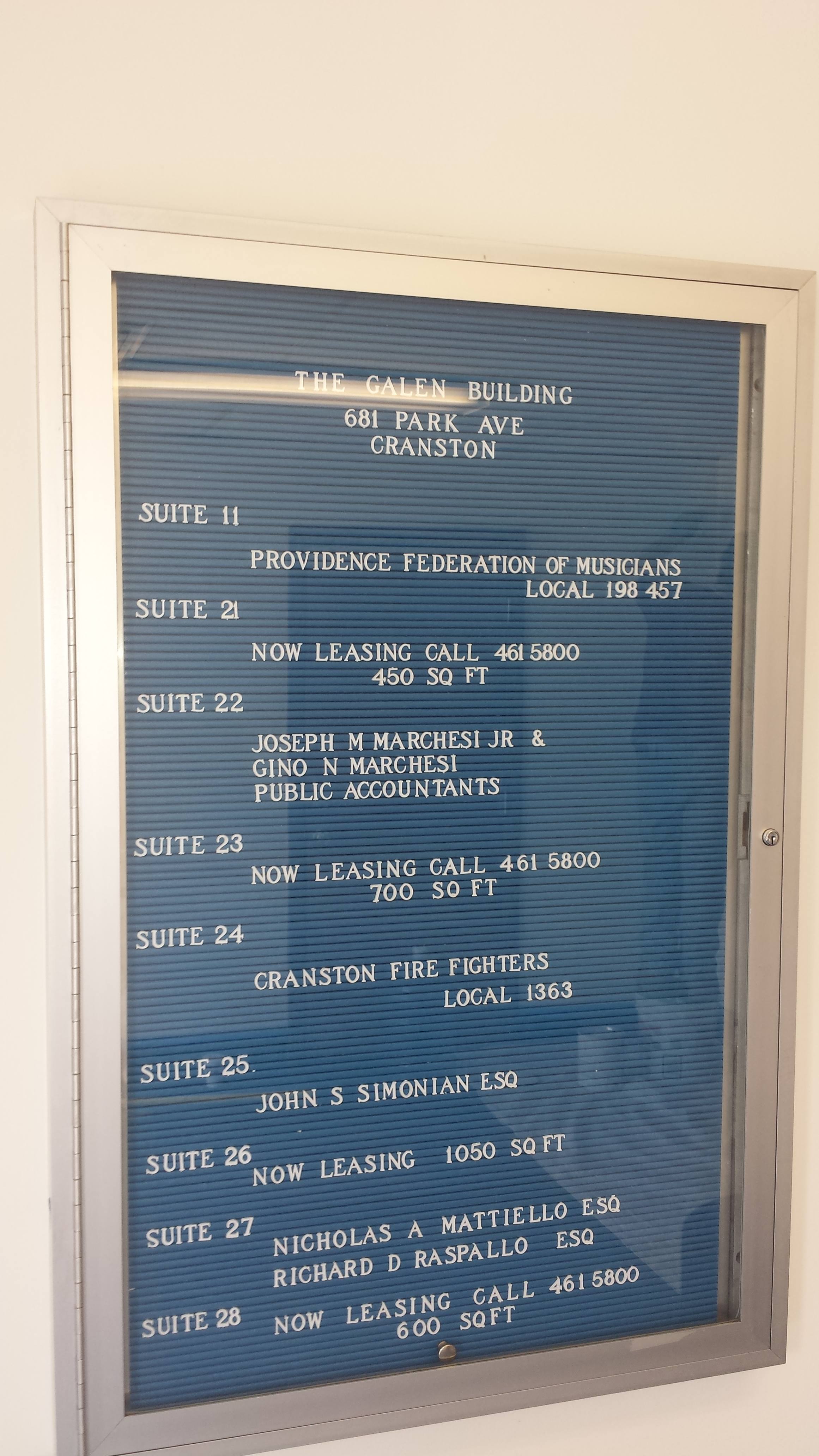
Speaker Mattiello is Fire Unions Landlord
Russ Moore, GoLocalProv Contributor
Speaker Mattiello is Fire Unions Landlord
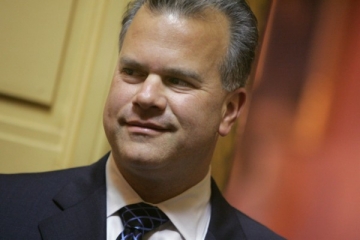
Mattiello tells GoLocalProv that there is nothing improper about the relationship and that he keeps his business interests and his votes in the state legislature separate.
Mattiello: No Conflict
GET THE LATEST BREAKING NEWS HERE -- SIGN UP FOR GOLOCAL FREE DAILY EBLASTMattiello issued a statement to the Rhode Island media after GoLocalProv requested answers to a series of questions regarding the Speaker’s ownership of the building.
For his part, Mattiello maintains that the business relationship he maintains with the Cranston Firefighters Union Local 1633 is completely separate from his votes in the state legislature. Mattiello wouldn’t say how much rent he and his brother receive from the union, other than that it is a “fair-market” value. Mattiello pointed out that he inherited the building several years ago, and the fire fighters were tenants of the property for roughly 5 years before he even became a State Representative, since 2002.
But some government watchdog groups and good government advocates question whether the Speaker can or should police himself.
“We are a part-time legislature and many of us are active in the business world. I am not going to give up a tenant because I was elected to the General Assembly. With the class exception, there is no conflict of interest in the rare votes that impact firefighters. In fact, the union leaders were extremely upset with me when I co-sponsored the landmark pension bill in 2011. But they understood that my business relationship as a landlord and my votes in the General Assembly are completely separate,” said Mattiello in a statement in response to a series of GoLocal’s questions.
Paul Valletta, the head of the Cranston Fire Fighters Union Local 1363, who is also the Rhode Island Association of Fire Fighters lobbyist at the statehouse, agreed with Mattiello’s assessment that the House of Representatives certainly hasn’t gone out of its way to help fire departments since he’s been Speaker.
“It sure didn’t give me any leverage with the biggest issue that will affect my people the most over the next decades to come—the pension issue,” said Valletta, noting that Mattiello helped spearhead the issue.
Further, Valletta said he hasn’t had much luck getting the bills he wanted passed over the last few years.
In any event, the class exemption Mattiello cites that allows him to vote on issues impacting fire departments, despite his business arrangement with one union, is a relatively vague concept that allows legislators and other lawmakers and policymakers in Rhode Island (council members, school committee members) to vote on issues that have an impact on their own finances so long as the decision benefits a large enough group or “class” of people.
For instance, it allows school teacher to serve on a school committee (as long as it’s not the same district they teach in) and vote for a teacher contract for that district, despite the fact that they are a teacher somewhere else in Rhode Island, because it impacts a large enough class of people.
However, a number of Rhode Island reformers and good government advocates said that the Mattiello’s argument is questionable at best.
Phil West, who served as Common Cause’s Executive Director for 18 years up until 2006, and is the author of the new book, “Secrets and Scandals, Reforming Rhode Island 1986-2006”, said that it’s clear that Mattiello is a “business associate” under Rhode Island General Law. Citing state statutes, West said Mattiello’s relationship with the union could become problematic, particularly if the Cranston Fire Fighters Union were to hold out on the pension negotiation.
West finds it ironic that Mattiello is opposed to passing a bill that would give the Rhode Island Ethics Commission jurisdiction over the General Assembly, because that power is needed specifically for situations like this.
That power was taken away in 2009 as a result of the William Irons case, in which the State Supreme Court ruled that legislators can’t be held accountable to the state code of ethics due to the “speech and debate clause.” A bill that would amend the constitution, by voter referendum, in order to give the ethics commission that power back, has been stalled in the House for several years.
“Mattiello has dug in his heels and repeated that he doesn’t see any reason to restore the Ethics Commission’s authority over legislators,” said West.
His successor at Common Cause, current director John Marion, agreed.
“Speaker Mattiello asserts that he doesn't need to recuse (himself) in matters affecting the Cranston Fire Fighters because any decision he makes will affect all Fire Fighters in the state equally, the so-called "class exception." He may be right, but it shouldn't be left up to the Speaker, or any other member of the Assembly, to decide if that's true,” said Marion.
“Speaker Mattiello has said that closing the loophole created by Irons isn't in the public's interest. This situation shows exactly why it's in the public interest to know whether or not one of the most powerful politicians in the state has a conflict of interest.”
Fire Protection Costs
Meanwhile, some Rhode Island government officials and citizens are wondering if their efforts to curtail fire department costs are hitting roadblocks for reasons other than the merits of their reforms.
Ken Block, who ran unsuccessfully for Governor in 2010 and in 2014, is now leading a charge to improve efficiency and reduce cost in fire safety in RI. Block questions why his recommendations to reduce fire protection costs have been dismissed by Mattiello.
Block said that when he released his report, Mattiello basically brushed it aside, and said that Block had “an agenda”. Block, upon learning of Mattiello’s business relationship with the Cranston Fire Fighter Union, said he couldn’t help but wonder if it’s the Speaker who has the agenda.
“The possibility and appearance of a conflict of interest is certainly there,” said Block.
Mattiello, for his part, said that he didn’t outright dismiss Block’s report.
“…I have not refused to consider his report. Although Ken Block is not an expert on fire administration or fire safety, I appreciate his input and I will consider it. I have voted to put fire department consolidations on the ballot in a few communities, and I have been urging the Coventry Town Council to take similar action.”
North Kingstown Matter
Block is concerned that a bill making its way through the House would allow prevent cities and towns from saving money on fire prevention. The bill would give firefighter unions in Rhode Island to the ability to bargain with communities on the basis of scheduling and number of platoons.
The bill arose out of a situation in North Kingstown in which the town unilaterally decided to switch from a four platoon system to a three platoon system and increased the hours in each shift. The result was a savings of $2.2 million that year. Block maintains that almost $100 million in local taxpayer dollars per year could be saved if this was initiated everywhere else in the state. Most communities in America, he said, have a similar system.
The union sued the town, and eventually lost the case at the RI Supreme Court level.
But now there’s a bill before the state legislature that would allow fire fighter unions to bargain for shift scheduling. Inevitably, that would bring matters before binding arbitration, where the unions tend to prevail.
(For their part, the fire fighters claim that the longer shifts could cause fatigue and endanger public safety. But others argue that the fire fighters can sleep during shifts.)
Michael Embury, who serves as North Kingstown’s Town Manager, who spearheaded the initiative, recently had a meeting with Mattiello, and said he was left with the impression that the bill will likely to pass.
Asked about the legislation’s prospects and whether it was on the fast track to passage on Friday, Mattiello responded by suggesting that it isn’t on the fast track. But he didn’t deny his support for the bill.
“This is a bill that is in the House Labor Committee and is being considered like all other bills,” Mattiello said.
The 10 Most Politically Powerful at RI State House

#10 - Sen. Da Ponte
The Senate Finance Chairman pushed hard in 2014 for corporate tax reform -- and combined reporting -- and was recently reappointed to his fourth term at the helm of the committee that vets the state's budget. With House Speaker Mattiello's talking about eliminating the state income tax on social security, a budget deficit and the prospect of diminishing gaming revenue, Da Ponte will have his work cut out for him chairing the powerful Senate committee.

#9 - Rep. DeSimone
One of the most powerful political players in Providence, the Majority leader wields his influence at the state house as part of Speaker Mattiello's team. Serving in the chamber since 1992, DeSimone rose to his current position with the ouster of former Speaker Gordon Fox in 2014. He will be a pivotal player at the State House for the City of Providence (and new Elorza administration), as the state grapples with a projected $200 million budget deficit, and Providence needs a strong advocate to appeal for what it can.

#8 - Bob Goldberg
The former Minority Leader continues his position as one of the state's top lobbyists, representing a wide range of clients that last year included Lifespan, GTech, Johnson and Wales, and CVS Health, to name a few. Year in, year out, Goldberg -- who is married to RI Supreme Court Justice Maureen McKenna Goldberg -- parlays his State House knowledge and connections for his well-funded clients, who in the past have included Twin River when it successfully pushed for table games on the ballot in 2012.
(Goldberg pictured at right.)

#7 - Bill Murphy
The former Speaker of the House continues to wield unparalleled influence as a lobbyist and behind-the-scenes king maker. While he last served as the state's most powerful elected official until 2010, Murphy's ability to exert control at the State House was evidenced by backing now-Speaker Mattiello when the battle to replace Gordon Fox took place. Murphy's lobbying clients range from the corrections officers to payday lending to Twin River.

#6 - Sen. Paiva Weed
The Senate President, who has been at the chamber's de facto top post since 2008, faced a strong challenge this past election season from Newport's Mike Smith, who had been an outspoken opponent against a table games expansion at Newport Grand -- a decision which Paiva-Weed ultimately came to following the rejection of a host agreement by the Newport City Council. Paiva Weed in her opening address of this year's General Assembly session promised to make jobs and the economy her top priorities, followed closely by education. With the school construction moratorium schedule to expire in May, watch to see how Paiva-Weed works with the House and Raimondo administration to address the burgeoning infrastructure needs.

#5 - Sen. Ruggerio
The Senate Majority leader was first elected to the chamber in 1984, after four years in the House, and was Senate majority whip from 2003 to 2010. An administrator for the New England Laborers Labor Management Co-op Trust, Ruggerio's labor ties have helped cement his position of power in the Senate. Despite two arrests, Ruggerio has emerged relatively unscathed, advancing the legislation establishing the I-195 Redevelopment Commission, and pushing for increased parking in downtown Providence by the Garrahy judicial complex

#4 - David Cruise
Governor Raimondo's newly chosen Legislative Director should prove to be much more than that. While Raimondo tapped former Maryland Governor Martin O'Malley staffer Stephen Neuman to be her Chief of Staff, the out-of-towner might bring in a fresh perspective, but Cruise knows the lay of the land. Having a Rhode Island political resume that includes serving as a State Senator, Governor Sundlun's Chief of Staff, and top roles at the RI Resource Recovery Corporation and as a traffic court magistrate, Cruise's policy role, while his official one, will be just one in his advisory capacity for the newly elected Governor.

#3 - Leo Skenyon
The Speaker of the Houses's Chief of Staff is the gatekeeper -- and like his predecessor before him, Frank Anzeveno (under former Speaker Gordon Fox), Skenyon is the key to access the Speaker. Skenyon, a former top aide to Governor Bruce Sundlun and U.S. Senator Claiborne Pell, had most recently been the Traffic Tribunal Clerk. The former Chief of Staff to Senate-Majority leader Jack Revens in the 1980s, Skenyon has been at the helm before in orchestrating the chamber's top office. Skenyon enters his first full session at the post along with Mattiello as the agent behind the state's biggest power broker.

#2 - Gov. Raimondo
The state's 75th governor -- and first woman at the helm -- marks the first return of a Democratic head-of-state since Governor Bruce Sundlun entered the office in the winter of 1991. Raimondo however won with just 40.7% of the vote, which gave her the plurality, but not a mandate. Bringing in a number of outsiders for key positions, and shaking up multiple Department directors, the Raimondo administration looks markedly unlike any in recent years. How successful Raimondo is in pushing through her agenda in the first six months will go a long way to determining how powerful she will be in the next four years.

#1 - Speaker Mattiello
The Speaker of the House has always wielded the most power in Rhode Island, and Speaker Mattiello is now the de facto head of state for the second -- and first full -- year. Mattiello emerged from the 2014 session earning plaudits from a wide range of supporters for pushing through a cut in the corporate income tax and changes to the estate tax. Now, as a new General Assembly has just gotten underway, Mattiello is eying eliminating the state income tax on social security, before the Governor has submitted her budget proposal. Look to see what the Speaker can -- and will -- accomplish in 2015.


