


Whitcomb: Reunion Confusions; Alaskan Deal; Housing Revolution; Public-Sector Stores
Robert Whitcomb, Columnist
Whitcomb: Reunion Confusions; Alaskan Deal; Housing Revolution; Public-Sector Stores

“Corners of both pockets, like a strict rhyme
Or a major chord. Prints, plaids, checks,
GET THE LATEST BREAKING NEWS HERE -- SIGN UP FOR GOLOCAL FREE DAILY EBLASTHoundstooth, Tattersall, Madras. The clan tartans
“Invented by mill-owners inspired by the hoax of Ossian,
To control their savage Scottish workers, tamed
By a fabricated heraldry: MacGregor….’’
-- From “Shirt,’’ by Robert Pinsky (born 1940), American poet and essayist
“God is a complex of ideas formed by the tribe, the nation, and humanity, which awake and organize social feelings and aim to link the individual to society and to bridle the zoological individualism.’’
-- Maxim Gorky (1868-1936), Russian-Soviet writer
“We don’t have the option of turning away from the future. No one gets to vote on whether technology is going to change our lives.’’
-- William Henry Gates III (born 1955), American technologist, businessman (Microsoft co-founder) and philanthropist

Meanwhile, an increasing number of young people can’t read a physical map. They can only follow directions from the likes of Google Maps. But in some situations, old-fashioned maps are more reliable.
And need those LED headlights, especially those on high-profile SUVs, be so blindingly bright?
Ah, progress!
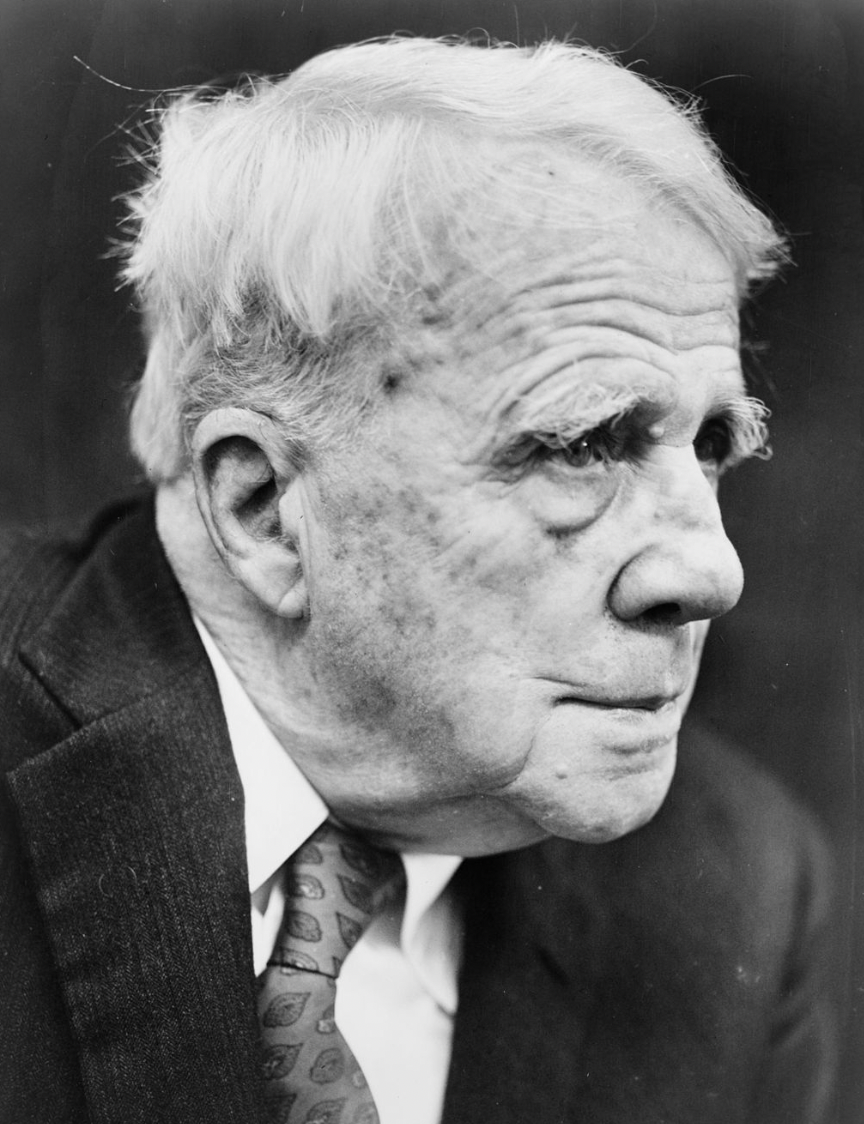
There was an amusing moment at a college reunion I attended the other week in New Hampshire, near the heart of what might be called Robert Frost Country. At one of the events, a class officer dragged in a reference to what is among the most famous poems in English, Frost’s “The Road Not Taken. This work is frequently quoted during graduations, reunions, and similar events. The MC/class officer, who rambled on far too long, gave it the meaning that we had bravely taken our own unique ways through life and probably come out fine.
But, as has been frequently noted, the poem is often grossly misinterpreted. (Frost himself warned that it’s “tricky.’’) So a college roommate of mine, now a retired cancer surgeon, yelped as the MC finished his reference: “No, no! You’ve got it wrong!’’
“The Road Not Taken’’ is, among other things, about anxiety and indecision, of which most of us old people at reunion had experienced plenty.
Of course, I didn’t recognize most of the several hundred people at the reunion. At the same time, I sometimes found myself being recognized as unsettling.
xxx
On the way back home, I stopped at one of the two Granite State service plazas in Hooksett to get a sandwich. Such places, which used to be rather sedate, now have loud, boring rock music – to appeal to younger customers? But maybe it will be younger people who lead a revolt against America’s inescapable culture of cacophony.
xxx
It’s nice to see so many people this summer letting their lawns grow higher. That’s good for pollinators, saves on water and cuts down on the noise from lawn mowers, most of which are still polluting gasoline-fueled ones.
More happy news: The Karen Read trial is over!
Senatorial Graft
The vote by Alaska Sen. Lisa Murkowski to approve Trump’s tax and spending bill while admitting that it would hurt millions of Americans was a nasty display of political graft. Getting this occasional Republican critic of the regime to vote for this gargantuan mess involved such Alaska-targeted carveouts as giving the state a pass on its high error rate in administering Food Stamps and a big tax break for ‘’Native Whalers.
So Murkowski voted against the interests of most Americans, including Alaskans, but gave herself at least temporary cover in her home state with the carveouts she was given in return for not killing the measure. The legislation passed 51-50, with J.D. Vance casting the tie vote.
The biggest damage from Trump’s “Big, Beautiful Bill’’ will be that it will rapidly swell the already vast national debt, with ominous long-term effects on interest rates and the economy in general. But that menace bores most Americans.

California’s “yes in my backyard” (YIMBY) movement has received a significant boost with new laws, generally sound, that would exempt some developers from complying with certain environmental laws. These laws have been used by NIMBY types, many of whom are affluent, to block the construction of new housing near them. This blockage has helped make housing costs in the Golden State among the nation’s highest. New England nimbyism has, as in California, tied up efforts to address the housing shortage and thus too-high housing prices.
The new law will tend to slow sprawl by encouraging more density, which in itself will be good for the environment. Permitting will be streamlined, and housing near mass transit will be particularly favored.
The new law will also exempt certain advanced manufacturing plants, such as for semiconductors, biotech and nanotechnology, from some environmental laws. These are the sort of plants that fit in well in New England, with its high-tech culture. Also exempt will be some passenger-rail and related facilities, another thing good for the environment because it would help get more people out of their cars.
Large parts of the California reforms should be replicated in places around the nation.
https://cayimby.org/legislation/
xxx
I hope that the Trump regime is not trying to simply stick it to Massachusetts in holding up delivery of parts made by Beijing-based CRRC Corp. for new MBTA trains, citing potential violations of the Uyghur Forced Labor Prevention Act, which bars U.S. companies from funding forced labor among ethnic minorities in China’s Xinjiang region. CRRC has denied any violations.
The Trump administration has never shown much interest in protecting human rights, at home and abroad. For that matter, it hasn’t shown much interest in public transit. After all, its leaders travel in limos, private jets and helicopters and Air Force One.
Let’s hope that the action doesn’t derail the $1 billion project to replace the agency’s old subway cars.
xxx
Some of the current anti-immigrant fervor recalls the nativist-based Immigration and Nationality Act of 1924, when the Ku Klux Klan was riding high. That was replaced by the too-liberal Immigration and Nationality Act of 1965. The quasi-racist 1924 law heavily favored people from northwest Europe. Many in the mostly white MAGA cult, including those whose parents and/or grandparents were immigrants, would like to go back to something like the 1924 law, but of course, it’s far too late.
The purpose of the 1924 act was "to preserve the ideal of U.S. homogeneity’’ and keep out people from what Trump has called “----hole countries.’’
Victory for Vlad
The Trump regime is pausing (and perhaps killing) congressionally authorized shipments of some crucially needed air-defense interceptors and other weapons to Ukraine even as Russia steps up its attacks, especially against its favorite targets – civilians. This weakens even further U.S. credibility, and not just regarding Ukraine, and will encourage even more barbarism by Russia.
The White House has promoted debunked assertions/lies about the effect of our help so far on our military readiness.
Here’s a good overview of the readiness issue:
Our Orange Oligarch, who envies dictators, doesn’t want to unduly irritate Vladimir Putin, with whom he has a, er, complex relationship out of a spy novel.
At the same time, North Korea, a Russian ally and fellow sadistic dictatorship, is sending thousands of additional troops to serve as cannon fodder for the Russian invaders. Such moves reinforce Western and Central European leaders’ desire for their countries to rearm as fast as politically possible; they know that a Putin victory in Ukraine would encourage him, or a successor, to invade other European countries. It’s existential. They do this knowing that the United States cannot be depended upon to defend the West and its values from aggression.

No, not wind turbines! Among the biggest manmade killers of birds are windows. Many birds don’t sense that windows are solid, and so they die by crashing into them. The mass deaths are particularly bad during migration seasons. Of course, tall buildings with lots of glass are the worst.
But there are solutions, such as that used at the Chicago skyscraper called Lakeside Center at McCormick Place, where the windows are overlaid with close, opaque dots. During last fall’s annual migration, deaths were down by about 95 percent compared with the two previous autumns, reports The New York Times.
Wherever you are, you can sharply reduce bird deaths by putting such markers as decals and tape on the glass, as well as using interior blinds or curtains to reduce reflections that lure birds.
xxx
Brown University prides itself on going green, but the other day I spotted its grounds crew using a shrieking, polluting gasoline-powered leaf blower at its Ladd Observatory.
Public Grocery Stores
Zohran Mamdani, the Democratic socialist candidate for New York City mayor, wants to create city-owned grocery stores to address food insecurity in that very expensive town. He has inevitably been accused of being a Commie for that and other positions. I don’t support him – he’s never run a large organization and his proposed programs are generally unrealistic, fiscally and otherwise -- but the store idea is interesting.
As CNN notes, there have long been government-owned or subsidized grocery stores, such as military commissaries, public retail markets that lease space to farmers and chefs, and actual city-owned stores in rural areas in, for example, deep-Red Kansas. “Atlanta is opening two municipal grocery stores later this year after struggling to draw a private grocery chain. Madison, Wisconsin, and rural Venice, Illinois, also plan to open municipally owned stores,’’ the news outlet reports.
John Catsimatidis, the owner of New York City-based supermarket chain Gristedes and a two-time candidate for the GOP mayoral nomination, has called Mamdani’s plan “Soviet style’’ and has threatened to close stores if Mamdani is elected.
(As a former New Yorker, my strongest memory of shopping at Gristedes is its high prices, narrow aisles and grouchy employees.)
You can understand Mr. Catsimatidis’s worry. Privately owned grocery stores run on a slim 1 to 3 percent profit margin, albeit on big revenues. Government stores presumably could offer low-cost groceries because they wouldn’t have to pay rent or property taxes.
Public ownership of enterprises can be found in unlikely places. Consider the state-owned Bank of North Dakota – that state, like Kansas, deep Red.
Some people on the East Side of Providence, a generally middle-and-upper-income area, would be happy to have any large new supermarket, government or corporate, since Stop & Shop closed its Eastside Marketplace last year and has refused to sell the space to another supermarket company lest the sale cut into business at other Stop & Shop stores a few miles away.
There are a couple of Whole Foods stores nearby but they’re expensive and crowded, and have tight, bumper-car parking lots.
xxx
Jimmy Swaggart (1935-2025) was a quintessentially American example of merging capitalism with religion, or at least with religion as lucrative entertainment. Calvin Coolidge famously said that “the business of America is business.’’ You might say of many Red State big-time evangelists, especially the televangelists, that “the business of religion is business.’’
And for more excitement, throw in the occasional sex scandal.
xxx
Two books worth reading for their timeliness:
Lament for a Nation: The Defeat of Canadian Nationalism (1965), by George Grant, about how our northern neighbor let itself become absorbed by the U.S. in important ways, and The Myth That Made Us: How False Beliefs About Racism and Meritocracy Broke Our Economy and How to Fix It, by Jeff Fuhrer.