


195 Commission: We Need Vision – Architecture Critic Morgan
William Morgan, Architecture Critic
195 Commission: We Need Vision – Architecture Critic Morgan

The I-195 Redevelopment District Commission’s Chair Marc Crisafulli and its Executive Director Carolyn Skuncik met with the Fox Point Neighborhood Association on Zoom recently.
GET THE LATEST BREAKING NEWS HERE -- SIGN UP FOR GOLOCAL FREE DAILY EBLAST
They reviewed the current state of development in their remit and addressed citizen concerns about traffic, noise, and general environmental degradation resulting from a variety of projects underway and planned.
In contrast to his imperious predecessor at the Commission, Crisafulli was smooth and seemingly forthcoming. GoLocal asked why almost all of the 195 projects were so mediocre in terms of architectural design.

Everyone understands that overseeing an undertaking on such a massive scale and in the current economic climate, not to mention Providence’s quirky politics, is a real challenge. And it is fraught with all sort of detours, traps, and quicksand. Nevertheless, the response to the issue of design mediocrity–a laundry list of obstacles, including money and materials–was reminiscent of the three university presidents testifying before Congress about antisemitism on their campuses. As Claudette Gay, the President of Harvard, legalistically and pathetically declared, “It all depends upon the context.”
Yet the context of the 195 Commission is arguably the most important urban makeover since the uncovering of the Providence River. The relocation of the intrusive interstate that cut through Fox Point and the Jewelry District was a bold and courageous act that identified a city willing to stand up to highway planning chaos and take chances. The most glorious development opportunity imaginable for a unified urban mosaic was revealed beneath all that steel and concrete: two river banks, open parks, College Hill, the Jewelry District, and downtown, all at the head of Narragansett Bay.
Instead of a grand unifying vision for this city-changing gift, however, the 195 land was divvied up into little chunks, with little relationship to each other or to the city around them (i.e., context). The usual response to the failure of design excellence is development economics: there’s not enough money, extra-city developers shy away from Providence, good architecture is too expensive, and so on. Nevertheless, with the possible exception of 225 Dyer Street, the result is an undistinguished set of anywhere-and-everywhere apartments, hotels, and commercial blocks. It is ironic to see what is unfolding in one of the most architecturally rich cities in America. People do not come to Providence to marvel at Trader Joe’s or the dreary apartment blocks that surround it.

This haphazard rush to mediocrity is illustrated by the four divergent schemes considered for Parcel 1A. It is difficult to understand how any smart urban planner or architect could not see the folly of developing this sliver of land between South Water Street and the river. High rises along this narrow strip will create a traffic canyon of the street, and block views to the river. One of the schemes, by the developer of 269 Wickenden Street, is almost laughable in its amateurishness. The phrase “placemaking” was thrown around in the meeting, yet ill-formed projects like this should more truthfully be called place razing.
In its December meeting, the Commission chose the seven-story Green Link Scheme by Riverside Partners. While not an unattractive block, suitable for Miami or Sao Paolo, the developers’ claims that this intrusive block will serve as an “Urban Lung” for Providence, while “honoring the historic and natural elements of Providence” are ludicrous. Even more flagrantly transparent, the argument for choosing this pile because it is a “diverse residential offering.” Do ten luxury condominiums really address the housing crisis?
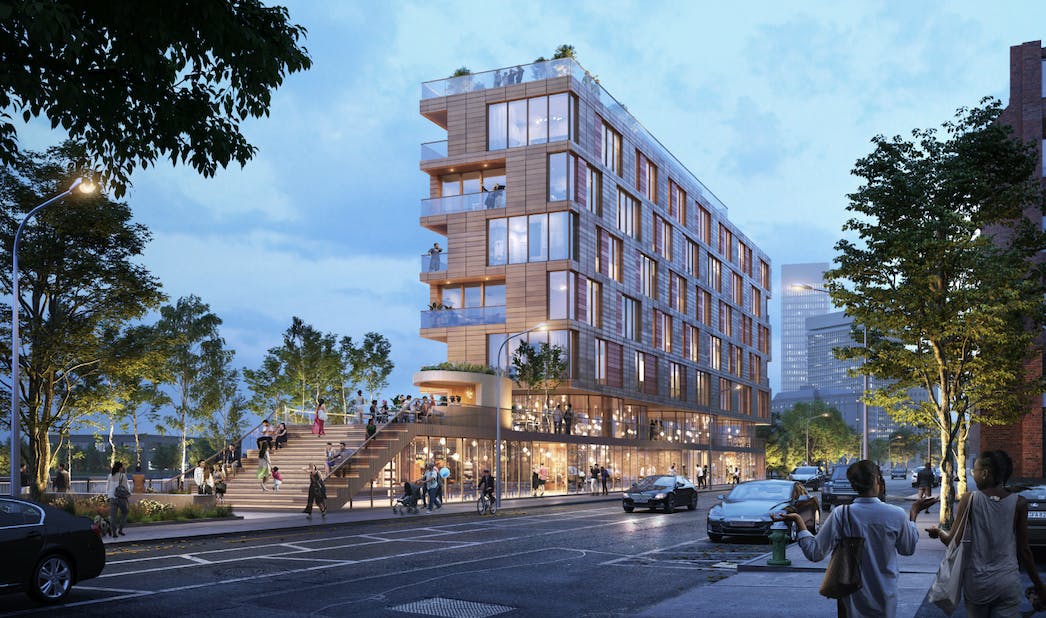
To be fair, the former Bally’s RI chairman inherited the dreary architectural landscape that is the 195 Plan completed so far. But now the destruction of an important piece of river bank suggests the chance do something really notable with the remaining undeveloped parcels will be squandered. Late, but not too late to turn away from the let’s-make-it-look-like-lowball-development-everywhere approach. Parcel 5, the large chunk of land below the Parcel 2/Urbanica block, is what the Commission Chair calls a “Signature Parcel.” After the debacle of Parcel 5 in 2018, we now have a second chance to make design amends. Crisafulli stated, “We have no ideal vision for Parcel 5 … mixed use, parking, condos, still in the early stages.” GoLocal suggested that the Commission hold an open international architectural competition for the site, an idea that was batted down as being too complicated.
Surely, with all of the resources in this creative city, we can figure out a way to have a stellar work of architecture, one that solves some of our urban issues, and that is not only financially viable, but an addition to Providence’s existing rich architectural patrimony. Crisafulli referred to as “not just money, but professional economic development.” If only.