


Less than 15% of Doctors Use RI Health Information Exchange
Kate Nagle, GoLocal Contributor
Less than 15% of Doctors Use RI Health Information Exchange

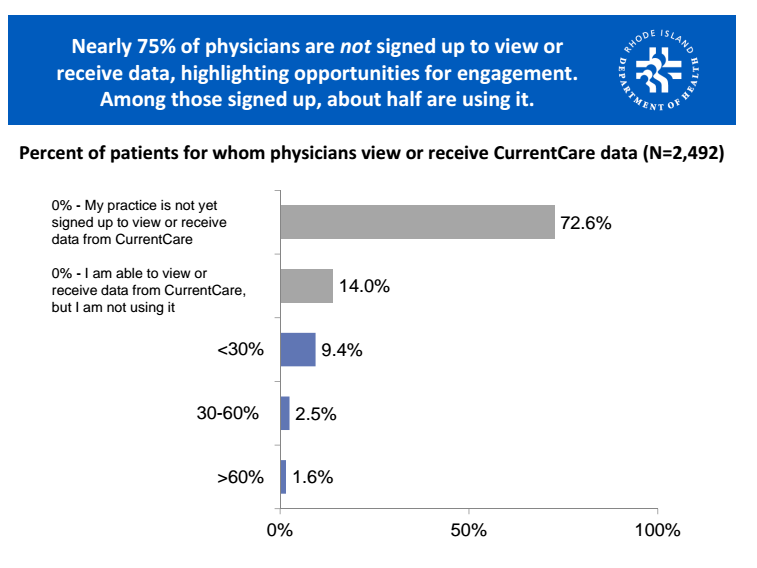
Billed as a tool for hospitals and physicians to manage and share electronic health records (EHR), CurrentCare garnered over $25 million in federal funding at its inception six years ago -- and millions from the state since then -- but the state's recent Health Information Technology survey conducted in 2014 showed that "nearly 75% of physicians [in Rhode Island] had not signed up to send or receive data" through the CurrentCare system-- and 14% of those who had, have never used it.
"It will make docs lives easier - eventually," said Rhode Island Medical Society Government Relations Director Steven DeToy, of EHRs. "But so far, its only made insurance companies and EHR companies happy."
GET THE LATEST BREAKING NEWS HERE -- SIGN UP FOR GOLOCAL FREE DAILY EBLASTREAD: RI Department of Health 2014 Health Information Technology SURVEY HERE
DeToy spoke to what he believed was behind the low utilization numbers.
"First, not every physician has a computer that they use for EHRs," said DeToy. "Second, some of those who do, have a system that isn't CurrentCare compatible as of right now, but hopefully will be. There have been some proprietary issues. Certain EHRs don't allow physicians to prescribe electronically. But now that Rhode Island Hospital is on board, having EPIC integrated should speed things along."
The Rhode Island Quality Institute, who manages CurrentCare, recently touted the addition of Lifespan and Care New England's "EPIC" EHR system to CurrentCare -- and last fall announced that CurrentCare enrollment topped 400,000 patients.
Data from the 990s for the nonprofit shows that RIQI, which oversees several other programs besides CurrentCare, had revenue streams between $11 million and $17 million over the past three years, with expenses ranging between $12 and $14 million yearly. The Center for Freedom and Prosperity's Open Gov state spending website show that the state alone paid over $2 million to RIQI since 2010.

"Government is simply less efficient than the free market system. While public ventures generally begin with good intentions, public funding too often results in lack of accountability. We are not aware of any built-in system that systematically reviews programs for efficacy nor provide any cost/benefit analysis," said Pam Gencarella wit taxpayer advocacy group OSTPA. "That is why RI government is bloated. We believe there should be such a system of review and it should apply to all government programs."
EHRs in the Spotlight
Senator Sheldon Whitehouse, who sits on the U.S. Senate Committee on Health, Education, Labor, and Pensions (HELP), was part of a recent hearing last week to explore how the federal government can improve the use of electronic health records (EHRs).
In release following the hearing, Whitehouse's office said that the Senator had recently "helped convene state health care leaders... [to]develop a series of recommendations for Governor Raimondo and the General Assembly to pursue, which included expanding incentives for EHR adoption and utilization targets."
The HIT survey reported that of responding physicians, despite agreeing EHR's improve many aspects of care, fewer than half of hospital and office-based physicians agree that EHRs improve job satisfaction.

"So doctors spent so much money on [EHRs] and never got the promised [return on investment]. They put the data in and can't get from everyone else. And yes, there are older generations who haven't taken to the change," continued DeToy. "I spoken with doctors who told me, 'I've spent $50,000 and it hasn't saved me any money, it's cost me money."
DeToy cautioned against reading into the survey responses, which represented 68% of physicians in the state.
"Remember that in this survey that they are relying on in self-reporting. As human beings we tend to be motivated to report when we're unhappy. If someone sends me a restaurant survey and I was relatively pleased, I probably won't respond," said DeToy. "There's a grain of salt, but it's the best we have to work with."
RI Taxpayers questioned however the amount of investment to date in CurrentCare, given its utilization numbers.
"In view of the fact that the ironically named "Affordable Care Act" (ObamaCare) has not led to more affordable healthcare choices, in fact, just the opposite, it has become crystal clear that more taxpayer or customer dollars is not the answer for our healthcare system," said Monique Chartier with RI Taxpayers. "As the return on investment from "CurrentCare" appears to be far worse than for ObamaCare, it's time to cut all public funding for it. Privatization might be an option, as long as it is not accompanied by a government mandate on physicians to participate or to pay an involuntary fee."
50 RI School Cafeterias with the Most Health Code Violations

#50
East Greenwich High School
Number of Violations: 11
Sample Violation:
Inspector Comments: The floor along the wall in the store room area has an accumulation of old mouse droppings. The physical facilities shall be cleaned as often as necessary to keep them clean.
300 Avenger Drive
East Greenwich, RI

#49
Curtis Corner Middle School
Number of Violations: 11
Sample Violation:
Inspector Comments: The presence of rodents and pests is not controlled as evidenced by the observation of mouse droppings, spider webs and spiders in the dry storage area.The presence of insects, rodents, and other pests must be controlled to minimize their presence on the premises by routinely inspecting the premises for evidence of pests, using acceptable methods to control pests, eliminating harborage conditions and routinely inspecting incoming shipments of food and supplies.
301 Curtis Corner Road
South Kingstown, RI

#48
Cranston Vocational Tech School
Number of Violations: 11
Sample Violation:
Inspector Comments: Deli slicer is not clean to sight. Unit cannot be used until properly cleaned.
100 Metropolitan Avenue
Cranston, RI

#47
Chariho High School
Number of Violations: 11
Sample Violation:
Inspector Comments: The blade of the robo-coupe had an accumulation of food and debris.The food contact surfaces of equipment must be clean to sight and touch.
453 Switch Road
Richmond, RI

#46
W Alton Jones Campus
Number of Violations: 12
Sample Violation:
Inspector Comments: Several raw animal foods were stored above ready-to-eat foods in the basement refrigerator such as raw chicken over raw beef. Raw animal foods must be separated from raw ready-to-eat food such as vegetables during storage.
401 Victory Highway West
West Greenwich, RI

#45
Thornton School
Number of Violations: 12
Sample Violation:
Inspector Comments: The ceiling over the 3-bay sink is covered with tiles that are not clean to sight. There are signs of water stains indicating a water leak. The materials for ceiling tiles must be durable and easily cleanable.
4 School Street
Johnston , RI

#44
Ferri Middle School
Number of Violations: 12
Sample Violation:
Inspector Comments: The can opener had an accumulation of food and debris. The food contact surfaces of equipment must be clean to sight and touch. Can opener placed through dishwasher during inspection.
10 Memorial Drive
Johnston, RI

#43
Eldredge School
Number of Violations: 12
Sample Violation:
Inspector Comments: The sneeze guard on the side bar is too high for the height of the children being served. The sneeze guard needs to be lowered or all fruits/vegetables must be wrapped.
101 1st Avenue
East Greenwich, RI

#42
Dunns Corner School
Number of Violations: 12
Sample Violation:
Inspector Comments: The American Cheese, located in the refrigerator, was not marked with the date of preparation. Ready-to-eat potentially hazardous food , prepared in the establishment and held for more than 24 hours, must be marked with the date of preparation.
8 1/2 Plateau Road
Westerly, RI

#41
Cumberland High School
Number of Violations: 12
Sample Violation:
Inspector Comments: Cheese, mayo, and other dressings were held at 47 degrees F on the grill line. Items were moved to the reach in to cool down. Ice bath did not reach the bottoms of the pans. More water and ice were added so that the product is submerged into the ice bath. Potentially hazardous food must be held at 41 degrees F or below except during preparation, cooking or cooling.
2600 Mendon Road
Cumberland, RI

#40
Captain Isaac Paine School
Number of Violations: 12
Sample Violation:
Inspector Comments: The cutting part of the can opener located in the kitchen area was not clean to sight.
160 Foster Center Road
Foster, RI

#39
Rhody Market at URI
Number of Violations: 13
Sample Violation:
Inspector Comments: Dirty pizza blade was stored in clean knife rack. Knife removed and sent to dishwasher.
Hope Commons
South Kingstown, RI

#38
Paul Cuffee School (Barton St.)
Number of Violations: 13
Sample Violation:
Inspector Comments: The food on display (salad, fruit, etc.) is not protected from contamination. The self-serve food is lacking a sneeze guard or protective barrier. Students observed dropping tongs into salad. Effective measures need to be in place to prevent contamination by BHC.
30 Barton Street
Providence, RI

#37
Mount St. Charles Academy/Compass Group
Number of Violations: 13
Sample Violation:
Inspector Comments: The establishment does not employ a full-time, on site manager certified in food safety. Each food establishment where potentially hazardous foods are prepared shall employ at least one (1) full-time , onsite manager certified in food safety who is at least eighteen (18) years of age.
800 Logee Street
Woonsocket, RI

#36
Bradford Elementary School
Number of Violations: 13
Sample Violation:
Inspector Comments: Raw hamburger stored over bread in the freezer. Ready to eat foods should be stored above raw items in a refrigerator and/or freezer.
15 Church Street
Westerly, RI

#35
Alan Shawn Feinstein Middle School
Number of Violations: 13
Sample Violation:
Inspector Comments: The ceiling in the walk in refrigerator is covered with dust and is pitted not making it easily cleanable and is now not durable. The walk in refrigerator door, door handle, door gasket and floor are in poor repair. The walk in freezer door handle is broken. Coving is missing in the dish washing room.
15 Foster Drive
Coventry, RI

#34
West Warwick High School
Number of Violations: 14
Sample Violation:
Inspector Comments: A tennis ball was observed on the top of the handle adjuster on the deli slicer. Per PIC, tennis ball was placed there to help prevent injury of staff walking by the deli slicer. Tennis balls are not smooth, durable or easily cleanable. Tennis ball to be removed.
1 Webster Knight Drive
West Warwick

#33
Snowden Dining Center (Johnson and Wales)
Number of Violations: 14
Sample Violation:
Inspector Comments: The presence of rodents is not controlled as evidenced by rodent droppings beneath storage shelves in store room. The presence of insects, rodents, and other pests must be controlled to minimize their presence on the premises by routinely inspecting the premises for evidence of pests, using acceptable methods to control pests, eliminating harborage conditions and routinely inspecting incoming shipments of food and supplies.
32 Page Street
Providence, RI

#32
Pleasant View School
Number of Violations: 14
Sample Violation:
Inspector Comments: The can opener had an accumulation of food and debris. The food contact surfaces of equipment must be clean to sight and touch. PIC placed can opener in 3 bay sink to be washed, rinsed and sanitized.
50 Obediah Brown Road
Providence, RI

#31
Narragansett High School
Number of Violations: 14
Sample Violation:
Inspector Comments: Deli slicer not clean to sight and touch. Slicer was re-washed, rinsed and sanitized during inspection. PIC must ensure that deli slicer is properly cleaned and sanitized at the appropriate times.
245 South Pier Road
Narragansett, RI

#30
Gilbert Stuart Elementary School
Number of Violations: 14
Sample Violation:
Inspector Comments: The water that is coming out from all of the water systems (3 bay sink, hand sink, food prep sinks, etc) is yellow and smells of waste/sewage water. Inspector observed PIC running water for over 45 minutes until water had eventually cleared up enough to be used for the food preparation. School administrator has been informed and will address conditions immediately. Invoice for resolved problem to be faxed.
188 Princeton Avenue
Providence, RI

#29
Exeter Job Corps Academy
Number of Violations: 14
Sample Violation:
Inspector Comments : Several raw animal foods were stored above ready-to-eat foods in the walk-in refrigerator (such as shell eggs over butter.) Raw animal foods must be separated from raw ready-to-eat food such as vegetables during storage.
162 Main Street
Exeter, RI

#28
Academy Cafe at Saint Rapheal Academy
Number of Violations: 14
Sample Violation:
Inspector Comment: An employee did not use soap while washing their hands. Food employees must use a cleaning compound(soap) as part of the hand cleaning procedure. An employee did not dry his hands after washing them. Food employees must thoroughly dry cleaned hands and arms. The proper handwashing procedure was not followed. A printout on handwashing was given and discussed.
123 Walcott Street
Pawtucket

#27
William M Davies Jr. Career & Tech High School
Number of Violations: 15
Sample Violation:
Inspector Comments: The presence of pests is not controlled as evidenced by observed ants, flies, and dead cockroaches. Establishment must contact pest control and monitor new activity. Fax pest control report to inspector. The presence of insects, rodents, and other pests must be controlled to minimize their presence on the premises by routinely inspecting the premises for evidence of pests, using acceptable methods to control pests, eliminating harborage conditions and routinely inspecting incoming shipments of food and supplies.
50 Jenckes Hill Road
Lincoln, RI

#26
Ocean Tides School (Providence Campus)
Number of Violations: 15
Sample Violation:
Inspector Comments: The chef's knife and hot hold steam table had an accumulation of food and debris. All equipment and utensils must be washed, rinsed, sanitized and air dried. The food contact surfaces of equipment must be clean to sight and touch.
260 Highland Avenue
Providence, RI

#25
Mary E Fogarty School
Number of Violations: 15
Sample Violation:
Inspector Comments: Under and behind equipment in the food prep area in the dishwashing machine area is an accumulation of (?) old/new rodent droppings, dust and debris. Areas in need of thorough sweeping and sanitizing. The screen and window over the 3 bay sink is in poor repair and needs replacing.
199 Oxford Street
Providence, RI

#24
Esek Hopkins Middle School
Number of Violations: 15
Sample Violation:
Inspector Comments: There is insufficient refrigeration equipment/capacity to maintain a temperature of 41 degrees or below. An additional refrigeration unit is needed for the kitchen.
480 Charles Street
Providence, RI

#23
Archie Cole Middle School
Number of Violations: 15
Sample Violation:
Inspector Comments: Staff were not wearing hair restraints properly. Food employees must wear hair restraints such as hats, hair coverings or nets that are worn to effectively keep their hair from contacting exposed food, clean equipment utensils, linens and unwrapped single-service and single-use articles.
100 Cedar Avenue
East Greenwich, RI

#22
SAGE at Providence Country Day School
Number of Violations: 16
Sample Violation:
Inspector Comments: The floors and walls of the perimeter of the kitchen area have an accumulation of soil residue and food debris. The physical facilities shall be cleaned as often as necessary to keep them clean.
660 Waterman Avenue
East Providence, RI

#21
Bucklin Production Kitchen
Number of Violations: 16
Sample Violation:
Inspector Comments: The slicer had an accumulation of food and debris. The ice machine had been cleaned by a cleaning company on 7/17/13, but had visible remains of mold and debris. The food contact surfaces of equipment must be clean to sight and touch. Manager has contacted service provider to return appropriately correct the problem.
249 Bucklin Street
Providence, RI

#20
Bishop Hendricken High School
Number of Violations: 16
Sample Violation:
Inspector Comments: Cheese and deli meats, located in the 2-door Traulsen refrigerator, were not marked with the date of preparation. Ready-to-eat potentially hazardous food, prepared in the establishment and held for more than 24 hours, must be marked with the date of preparation. Per PIC, deli meats and cheeses were prepared yesterday. Products were properly labeled during time of inspection.
2615 Warwick Avenue
Warwick

#19
Tollgate High School
Number of Violations: 17
Sample Violation:
Inspector Comments: The ice scoop had an accumulation of food and debris. The food contact surfaces of equipment must be clean to sight and touch.
575 Centerville Road
Warwick, RI

#18
The Prout School
Number Violations: 17
Sample Violation:
Inspector Comments: Inspector did find a few mouse droppings next to and behind side by side chest freezers. Per interview with PIC pest control (NEP) does do a monthly service for the facility. A recommended increase in service frequency until issue is under control and /or eliminated. Fax a copy of the invoice of service to RI DOH.
4640 Tower Hill Road
Wakefield, RI

#17
SAGE at St. George's School
Number of Violations: 18
Sample Violation:
Inspector Comments: Deli meat in the sandwich area and items in the salad bar were observed at 45-57 degreess. Items are held in units for less than 2 hours. These units must be corrected so that food can be held =/<41 degrees, it is not an acceptable practice to hold food out of temperature contol for service or display for service.
372 Purgatory Road
Middletown, RI

#16
Overbrook Academy
Number of Violations: 18
Sample Violation:
Inspector Comments: The walls and ceilings of the walk-in refrigeration units are in poor repair. Walls and ceilings were observed having peeling paint. Mold was observed along the seams of the walls in the right-hand walk-in. The physical facilities shall be serviced and cleaned as often as necessary to keep them clean and in good repair. PIC notified to submit correction schedule for approval to RI DOH. Contact information provided.
836 Warwick Neck Avenue
Warwick, RI

#15
Providence College/Raymond Hall
Number of Violations: 19
Sample Violation:
Inspector Comments: The presence of rodents and insects is not controlled as evidenced by rodent droppings beneath shelves in the basement storage area, and fruit flies in the basement produce area . The presence of insects, rodents, and other pests must be controlled to minimize their presence on the premises by routinely inspecting the premises for evidence of pests, using acceptable methods to control pests, eliminating harborage conditions and routinely inspecting incoming shipments of food and supplies.
549 River Avenue
Providence, RI

#14
Cranston West High School
Number of Violations: 19
Sample Violation:
Inspector Comments: The vent over the dish washer has an accumulation of dust. Ceiling paint is peeling throughout the kitchen. There is a hole in the ceiling of cage 1. The ceiling in cage 2 is in poor repair. The floor in the walk in refrigerator is in poor repair. The floor in the dish washing room is not clean to sight. The floor at the receiving door has broken tiles. Old mouse droppings need to be removed.
80 Metropolitan Ave
Cranston, RI

#13
North Kingstown Senior High School
Number of Violations: 20
Sample Violation:
Inspector Comments: Employees were observed changing gloves without washing their hands. Food employees must wash their hands before putting on gloves. Employee was notified of proper washing procedure and washed hands before moving on to next task.
100 Fairway Drive
North Kingstown, RI

#12
Roger Williams University Main Cafeteria
Number of Violations: 21
Sample Violation:
Inspector Comments: Vegetables and shrimp in the global foods area were not maintained at =/<41 degrees. Unit was adjusted, this unit must be re-evaluated so that items will maintain temperature control. Containers used to hold food are made of bamboo and the fill level may be too high to maintain food at the proper temperature. The small sandwich unit in the grill area and the sandwich unit in the pizza area had an ambient temperature of 43-44, these unit must be evaluated and/or adjusted. Pasta was held in walk-in refrigeration unit at 47-51 degrees. Pasta was disposed of.
1 Old Ferry Road
Bistol, RI

#11
Chariho Career & Technical School
Number of Violations: 21
Sample Violation:
Inspector Comments: The deli slicer, can opener and internal surfaces of the ice machine had an accumulation of food and debris.The food contact surfaces of equipment must be clean to sight and touch. Mold and gelatinous condensate was observed dripping onto ice. Voluntary disposal completed during time of inspection.
459 Switch Road
Richmond, RI

#10
Winman Jr. High School
Number of Violations: 23
Sample Violation:
Inspector Comments: The presence of flies is not controlled as evidenced by fly activity. The presence of insects, rodents, and other pests must be controlled to minimize their presence on the premises by routinely inspecting the premises for evidence of pests, using acceptable methods to control pests, eliminating harborage conditions and routinely inspecting incoming shipments of food and supplies.
575 Centerville Road
Warwick, RI

#9
Lincoln School for Girls
Number of Violations: 24
Sample Violation:
Inspector Notes: The ventilation system does not have the capacity to remove heat/odors/smoke. The fire alarm system was activated at time of inspection because the facility was cooking hamburgers and the smoke build up activated the fire alarm. Inspectors noticed a strong odor of cooking beef in the lunch room and hallway. Prov Fire Dept arrived on site because of the alarm being activated. PFD gave approval to establishment to resume activities.
301 Butler Ave
Providence, RI

#8
Ocean Tides School
Number of Viiolations: 25
Sample Violation:
Inspector Comments: Floors under equipement, ceiling and walls above the cook line and shelves in the dry storage area have an accumulation of dust, dirt, food debris and a few old mouse droppings. These areas should be kept free of such debris and must be cleaned on a regular basis.
635 Ocean Road
Narragansett, RI

#7
Regional Career Center at Coventry High School
Number of Violations: 26
Sample Violation:
Inspector Comments: An employee was observed preparing garnishes for plates with bare hands. Food employess must not touch exposed, ready-to-eat food with their bare hands and shall use suitable utensils such as deli tissue, spatulas, single use gloves or dispensing equipment. The garnishes were rewashed.
40 Reservoir Road
Coventry, RI
#6
Westerly Middle School
Number of Violations: 27
Sample Violation:
Inspector Comments: Boxes of apples were observed on the floor in walk-in Box A. Boxes of food were observed on the floor in the walk-in freezer. Per PIC, order had been received the previous day. Food must be stored at least 6 inches above the floor.
10 Sandy Hill Road
Westerly, RI

#5
London Bridge Learning Center
Number of Violations: 28
Sample Violation:
Inspector Comments: Cold food delivered at 10:10am, temperature of milk was between 50-60*F and cut melon was at 51*F. A disposal was completed by the catering company.
146 Duke Street
East Greenwich, RI

#4
Pilgrim High School
Number of Violations: 34
Sample Violation:
Inspector Comments: The deli slicer had an accumulation of food and oxidation/rust. The food contact surfaces of equipment must be clean to sight and touch.
111 Pilgrim Parkway
Warwick, RI

#3
Mount Pleasant High School
Number of Violations: 42
Sample Violation:
Inspector Comments: Observed numerous rodent burrows in the dumpster area and nearby vacant lot.
434 Mount Pleasant Ave
Providence, RI

#2
South Kingstown High School
Number of Violations: 43
Sample Violation:
Inspector Comments: Dead rodent observed in dry storage area. Rodent droppings also observed. Professional pest control is required for elimination/control. A letter from professional pest control stating the service provided, what the findings are and if pest issue has been eliminated or in under control is required. Facility must monitor are themselves and remove any dead pests immediately. Dead rodent removed at time of inspection.
25 Columbia Street
Wakefield, RI

#1
Westerly High School
Number of Violations: 52
Sample Violation:
Inspector Comments: Mice droppings were observed in the dry storage area.
23 Ward Ave
Westerly, RI


