


Is ProJo Cianci Coverage Biased?
GoLocalProv News Team and Kate Nagle
Is ProJo Cianci Coverage Biased?

"The one thing that put it over the top for me was the sports column comparing [Cianci] to Ray Rice," said 920 WHJJ News Radio host Ron St. Pierre, of Journal sports columnist Jim Donaldson's piece, "When it comes to Rice and Cianci, it's time we get our priorities straight," which ran this past weekend.
"It should be an embarrassment to the city of Providence to have Cianci in the mayor’s office," wrote Donaldson.
GET THE LATEST BREAKING NEWS HERE -- SIGN UP FOR GOLOCAL FREE DAILY EBLASTSLIDES: See Journal's Recent Coverage of Cianci BELOW
St. Pierre, who spoke Monday morning on air about the issue, said he found the scenario facing the two time former Providence Mayor -- and convicted felon-- to be "almost yellow journalism."
"It reminds me of the story of when [publisher William Randolph] Hearst dispatched a photographer to Cuba, and the photographer telegraphed back to Hurst, saying there was no war there. Hurst said, 'You supply the pictures, I'll supply the war'. That's what this is. It's at the point where it's laughable," said St. Pierre.
While the editorial staff of the Providence Journal has been consistently opposed to Cianci -- a two-time convicted felon -- winning the seat for a third time, following their endorsement of Jorge Elorza in August, the Journal has increased its anti-Cianci editorials, as well as critical Politifact columns.
"We've seen four anti-Cianci editorials in the span of seven days," said WPRO Morning News host and NBC 10 news anchor Gene Valicenti. "It seems more overkill than unfairness. Although the editorial board can spout their opinion and do whatever they want, they run the risk of engendering sympathy for Buddy, which is the opposite of what they're trying to accomplish."
"Even in Little League, there's a mercy rule," said Valicenti. Providence Journal editorial page editor Ed Achorn declined request for comment on Monday.
Role of "Legacy Media"?
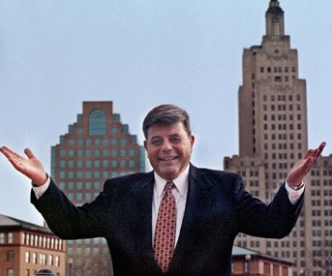
"The ProJo is legacy media, and they're entitled to revisit the legacy of Buddy Cianci. There's no pulling the wool over their eyes," said Scully. "Right now, [Cianci's] controlling the narrative, he's saying he's 'misunderstood." But the ProJo was there -- they know the story, and they know that people are buying what Buddy is saying."
"Legacy media has a long memory," said Scully. "They're entitled and should remind the public about it. However, they don't have the resources they once had, which is why Buddy is able to control the conversation."
Rhode Island College Professor of Political Communications Valerie Endress warned, however, as to implications of a concerted editorial effort, as it applied to the rest of the publication.
"In their role as the “fourth estate” news media possess the power to make or break political careers through intense reporting and investigative journalism. And, too, through its editorial page, a newspaper can focus readers’ attention on controversial issues of the day, and can endorse political candidates," said Endress.
Endress spoke to the potential not of carryover from the editorial page to reporting, but the perception of it by the reader.
"Overuse or abuse of the editorial page, however, may bring into question the unbiased nature of news reporting," said Endress. "There can be leakage, and readers may perceive bias in traditional forms of reporting where none exists. When does enough become too much on the editorial page? When the focus of attention turns to the newspaper itself rather than the subject of the editorials."
St. Pierre referred to how Journal articles consistently use the descriptor, "two-time convicted felon," whenever first referencing Cianci. "They're going to start running out of commas," said St. Pierre.
While several letters-to-the-editor by readers expressing their concern for the Journal's anti-Cianci tone and content have already been published, Endress questioned the role of the "editorial board," in the age of social media.
Broader Context
"We could say that this is the 'most the Journal has ever done,' but did the Journal handle [former Rhode Island Governor Edward] DiPrete the same way? They can agree that it is in fact a disproportionate number of editorials, but they could say that Cianci proposes a disproportionate threat to the public's well-being," said Valicenti.
"I welcome the editorials, which have been excellent. One of the most important things a paper can do is exercise its editorial voice," said former Journal political columnist Charlie Bakst. "And if the topic is as important as reminding voters of Cianci's past, his style, and his distant relationship with truth, the paper should not be reluctant to return to these issues time after time."
Alan Mutter, a former editor at the Chicago Daily News and City Editor of the Chicago Sun-Times, noted an editorial conundrum was nothing new -- and that any judgment ultimately rested with the reader.
"Thanks to the First Amendment, a newspaper can say anything it wants. The history of media is filled with examples of publishers or broadcasters like Fox News skewing coverage to help their friends and punish their designated enemies," said Mutter, who is adjunct faculty of the Graduate School of Journalism at the University of California at Berkeley. "In fact, is it was not until after the post-World War II years that most media companies abandoned (or subordinated) their political partisanship in the interests of attracting the largest number of readers and the most advertisers."
"Even in the era of the comparatively neutral press, some newspapers still embark on campaigns to right wrongs they think need to be righted. Is that bias or laudable community leadership? The judgment is in the eye of the beholder," said Mutter. "If a newspaper gets too out of sync with its audience and advertisers, it runs the risk of harming its business, so enlightened economic self-interest usually keeps them relatively honest."
Radio personality Jen Brien was one reader who expressed her disapproval over Facebook recently. "Dear Prov Journal," Brien wrote on September 28. "Your incessant hammering away at Buddy Cianci is so obnoxious and unappealing, I will no longer buy your rag of a newspaper."
Cianci's Coverage in the Providence Journal

Column - September 21
Taveras Adds Voice of Criticism
In an interview with the Providence Journal's Ed Fitzpatrick on Cianci, Providence Mayor Taveras said, "I'm not sure what city he was talking about. Facts are pesky things. Let's make sure, as we start looking at the old days, we realize just exactly what those old days involved."

Politifact - September 21
Cianci's Claim About the Deficit Not on Money
Cianci's claims were ruled "half-true" in a September 21 Politifact.
"...the ad implies that things were rosy under Cianci and went downhill after he left. That ignores the future problems he caused by underfunding the pension system, the effects of the Great Recession, and the strides Taveras made to bring the city back from bankruptcy," wrote Alex Kuffner.

Letter - September 22
Calling Cianci a Liar is Sensationalism
Paul J. Salesi wrote in a Letter to the Editor, "I find your September 17 editorial "Lying for votes" a case of the pot calling the kettle black. You accuse Vincent Cianci of lying when in fact he may have taken a statement out of context, something The Journal and the press in general do on a regular basis."

Letter - September 23
Editorials on Cianci are Risky for Journal
In a Letter to the Editor, William G. Touret of Providence called out the Journal on its perceived bias.
"Enough already. We get it. The Journal's decades-old crusade against former Mayor Vincent Cianci will never end, even if the Journal's ill-will, the origin of which I can only imagine, risks the Journal's further alienating and losing its subscriber base," wrote Touret

Article - September 23
Cianci Envisions Brighter Broad Street
John Hill reported that Cianci's plan to revitalize for Broad Street may be to snag minority votes.
"The city's heavily black and Latino south side is seen possibly up for grabs in the November election...but Cianci denied his plan's focus on Broad Street was a strategy to win votes there."

Editorial - September 23
Clubbing with Cianci
The Providence Journal Editorial Board weighed in on the claim that Cianci asked Elorza for his support.
The Editorial Board wrote, "That seems doubtful, since the recommendation of an ex-felon who went to federal prison for running City Hall as a criminal enterprise would hardly elevate the reputation of a candidate running on a platform of serving the public interest."

Letter - September 24
Cianci Went to Prison for a Very Good Reason
In a Letter to the Editor on September 24, Marvin Greenberg calls out the voters of Providence.
Greenberg wrote, "I can't vote in Providence, but how can the intelligent people who can vote think that things will be different if they reelect Vincent Cianci?"

Article - September 24
Police Union Gives Ex-Mayor Its Endorsement
Katie Mulvaney refered to Cianci's criminal record in a September 24 article on the Providence Police union endorsement.
"A twice convicted felon, Cianci previously served as Mayor of Providence from 1975 through 1984 and from 1991 to 2002," wrote Mulvaney.

Article - September 24
Cianci's Convictions on the Minds of Undecided Voters
John Hill cited a recent Providence Journal/WPRI-12 poll on September 24.
Hill writes, "Vincent A. Cianci Jr.'s criminal record could be a problem for him among undecided voters as he tries for a second comeback to City Hall, the results of a Providence Journal/WPRI-12 poll indicate."

Article - September 24
13-Year-Old Lawsuit Against Cianci Heard
On September 24, Richard Salit reported on a 13-year-old lawsuit against Cianci.
Salit wrote, "A state Supreme Court hearing on whether Vincent A. Cianci Jr. unlawfully ordered firefighters to participate in a 2001 gay-pride march gave the former Mayor an opportunity on Tuesday to tout his record of support for the gay community as he runs for his old seat."

Editorial - September 24
Cianci's Half-Truths
The Editorial Board of the Providence Journal calls out Cianci on his "half-truths".
"The twice convicted felon running for mayor has no qualms about telling half-truths and outright lies in his quest for power," the Board wrote.
Column - September 26
Candidate Elorza Must Say Why Cianci's Crimes Matter
Edward Fitzpatrick wrote in a September 26 column, "You know, if you've been convicted of two felonies, you might have a tough time getting a job running the Coolatta machine at Dunkin' Donuts."

Editorial - September 26
The Mayoral Poll
In reaction to the latest poll results, the Providence Journal Editorial Board wrote, "People who love Providence and want to see it move beyond its corrupt past can be forgiven for feeling discouraged by this week's Providence Journal/WPRI poll. Nearly 30 percent of registered voters indicated that Vincent Cianci's two felony convictions-including four years in federal prison for running City Hall as a criminal enterprise-were 'not at all' important in determining their vote."

Column - September 28
Come On Now, What's the Biggest Outrage Here?
Is it the article -- or the headline?
Jim Donaldson compared Cianci and Ray Rice in a September 28 column -- and it appears the headline was changed from above to "When it comes to Rice and Cianci, it's time we get our priorities straight" -- a kinder, gentler offering, perhaps?
"While 38 percent of voters, and even the Providence police union, think it's OK for a two-time felon with a conviction for racketeering to run a city, the nation is outraged over the thought of Ray Rice running with a football," wrote Donaldson.

Opinion Piece - September
Rise Up Everyone, and Keep a Crook Out of City Hall
Formal Journal reporter Brian C. Jones responded to the Providence police and firefighter unions endorsing Cianci.
"Should you call 911? Well, maybe. There is a crime in progress in the city of Providence: Vincent Cianci is running for mayor, and, as of last week, he was winning," Jones wrote.

Letter - September 28
Cianci's Half-Baked Vision for Providence
Jim Galkin of Cranston challenges Cianci's vision for Providence.
Galkin wrote in a Letter to the Editor, "Perhaps it is a "vision" if it does not succeed and a plan if it does. Hey, I have a plan and a vision: Call magician Mat Franco (winner of "America's Got Talent") and make all these politicians disappear."

Editorial - September 28
His Own Words
The Editorial Board of the Providence Journal suggested Cianci's biggest enemy is himself.
"There are many compelling arguments against letting Vincent Cianci, the twice-convicted felon running for Mayor of Providence anywhere near City Hall again. But it is fascinating that one of the strongest cases against his return has been made by one of his strongest supporters: Cianci himself."

Article - September 28
Providence Teachers Union Back Cianci
C. Euguene Emery Jr.'s article makes mention of Cianci's criminal record.
"The vote came four days after the city's police union also voted to endorse Cianci, a two-time felon, to run for the city again," wrote Emery Jr.

Politifact - September 28
Cianci's Pension Funding Claim is Overdrawn
In the September 28th Politifact, it is ruled that Cianci's claim that, "In 2001 and '02...we had the pension system funded at {the} 100 percent level in that year, and we did for two years at that point", is "half-true".


