


Groups Urge Barrington to Reject More Police in Schools, After Town Hit With Crimes With Teenagers
GoLocalProv News Team
Groups Urge Barrington to Reject More Police in Schools, After Town Hit With Crimes With Teenagers
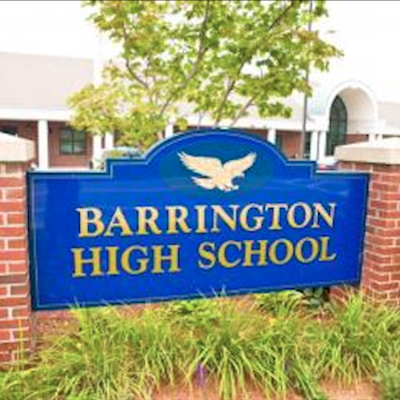
Citing the "school-to-prison" pipeline, and instances of other SROs in Rhode Island involved in "disturbing" incidents, the ACLU of RI, Black Lives Matter RI PAC, and more (see below) are urging Barrington to hire an additional social worker instead.
As GoLocal reported in May, "Barrington Hit With Series of High Profile Crimes Involving Teenagers:"
GET THE LATEST BREAKING NEWS HERE -- SIGN UP FOR GOLOCAL FREE DAILY EBLASTFor the affluent suburb of Barrington, incidents of juvenile violent crime are generally few and far between, but in the past couple of weeks, that norm has been shattered.
Barrington, which enjoys an average household income level of approximately $191,000 — nearly three times that of Providence — has proven it is not immune from violent crime, especially involving teenagers.
The incidents included assaults, as well as a large-scale response to a student with a knife.
In 2021, Barrington High School canceled in-person classes after a student wrote they were going to shoot up the school.
Barrington's Chief of Police and members of the school committee did not respond to request for comment at time of publication.
Groups Urge Rejection of More Police in Schools
The following was sent this week to the Barrington School Committee ahead of Thursday's meeting of the body.
Dear Members of the Barrington School Committee:
We understand that, at your meeting this week, you will be considering passage of a policy providing for the hiring of a second School Resource Officer (SRO) for the school district. As civil rights, community, and youth organizations dedicated to educational equity and to ensuring that all students in Rhode Island are able to access safe and enriching academic opportunities, we write to you today – as some of us did last year – to respectfully ask that you reject this proposed policy initiative.
We are cognizant of the school tragedies that have been taking place all too often across the nation, and we all support the goal of a protective and welcoming school environment. But the reality is that, for many students, police-focused approaches disrupt the educational atmosphere, fail to increase student safety, divert attention from the social and mental health resources that some students need, and encourage the school-to-prison pipeline.
SROs are, first and foremost, police officers. Even in the school setting, they are employed by and report to the police department, not the school. This inevitably colors their activities. Our groups are all too aware of incidents where minor infractions of school rules, which in any other circumstance would be dealt with administratively, turn into arrests for open-ended crimes like disorderly conduct when an SRO is present. Neither the child nor the school is well served when a student’s immature behavior is addressed by an official trained in criminality and arrest rather than getting to the root of a behavioral issue.
While some provisions in the MOU between your school district and the police department suggest that the interventionist role of the SRO should be limited to instances of potentially substantial harm to students or property, other provisions give the SRO wide-ranging authority to address any delinquent behavior and even undefined “social/emotional issues.”
We have no intent to paint all SROs with a broad brush, but one cannot ignore the publicly reported disturbing incidents of SRO misbehavior in Rhode Island that exemplify the enhanced risk to students that the presence of SROs presents. They can, among other disconcerting outcomes, unnecessarily subject students to troubling physical assaults and gratuitously introduce them to the criminal justice system.
We also believe that focusing on the hiring of SROs provides a false sense of security without fundamentally addressing legitimate fears about school violence. Any decision to increase the police presence in Barrington’s school system should, at the very least, be data-driven, but we are not aware of any data submitted to the school committee that supports it. There is no proof that SROs reduce school shootings, but there is substantial evidence that SROs increase “the use of suspensions, expulsions, police referrals, and arrests of students.”
These actions present an ongoing and tangible threat to student outcomes by promoting an overzealous introduction to the school-to-prison pipeline. This concern is only compounded when we consider that BIPOC students and students with disabilities are disproportionally affected by this approach.
Nor can the use of SROs contribute to the sorely needed social-emotional and behavioral support that more specialized personnel such as counselors, social workers, and mental health professionals are trained to provide. Research indicates that schools that employ more school-based mental health providers see improved attendance rates, lower rates of expulsion, suspension, and other disciplinary incidents, and an improved school climate. Hiring an additional social worker – something that we understand was proposed in a recent budget – rather than an SRO for the school district would, in our view, have a much more positive effect on the school environment and school safety.
In sum, while we respect, understand, and support efforts to better protect students, we strongly disagree that the increased use of law enforcement – and the collateral consequences that its presence can bring – is the appropriate method for doing so. There are many options that school districts can consider in deciding how to enhance security and promote student well-being. Hiring more SROs is not, and should not be, one of them. Please reject this proposal.
Thank you in advance for your consideration of our views.
Steven Brown - American Civil Liberties Union of Rhode Island
Harrison Tuttle - Black Lives Matter RI PAC
Keith Catone - Center for Youth & Community Leadership in Education (CYCLE)
Marcela Betancur - Latino Policy Institute
Ramona Santos Torres - Parents Leading for Educational Equity
Akeem Lloyd - A Peace Leadership
Denezia Fahie - Providence Student Union
Vanessa Flores-Maldonado - Providence Youth Student Movement
Jennifer Wood - Rhode Island Center for Justice
Paige Clausius-Parks -Rhode Island KIDS COUNT
Roberto Gonzalez - STEAM Box
Janie Seguí Rodríguez - Stop the Wait RI
Nick Lee - Students for Educational Equity
Pilar McCloud -A Sweet Creation Youth Org
Peter Chung - Young Voices
Elliot Rivera - Youth in Action
Rush Frazier - Youth Pride, Inc.