Rescue 1 Responding: Chapter 16, a Book by Michael Morse
Michael Morse, Author
Rescue 1 Responding: Chapter 16, a Book by Michael Morse
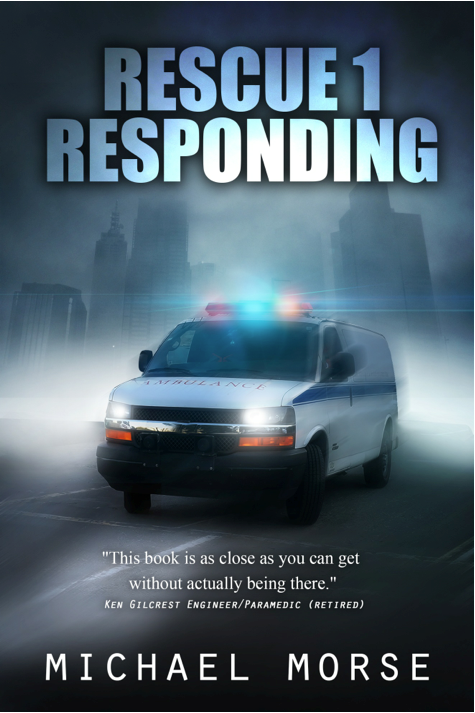
I’m glad I took the time to document what happens during a typical tour on an advanced life support rig in Rhode Island’s capitol city. Looking back, I can hardly believe I lived it. But I did, and now you can too. Many thanks to GoLocalProv.com for publishing the chapters of my books on a weekly basis from now until they are through. I hope that people come away from the experience with a better understanding of what their first responders do, who they are and how we do our best to hold it all together,
Enjoy the ride, and stay safe!
GET THE LATEST BREAKING NEWS HERE -- SIGN UP FOR GOLOCAL FREE DAILY EBLASTCaptain Michael Morse (ret.)
Providence Fire Department
The book is available at local bookstores and can be found HERE.
Note From Author
To the casual observer, worrying about shift change when there is a report of a person stabbed is inconceivable. At one time, the person responding to a stabbing an hour after shift change would never have given a second thought to not responding, even though the ambulance was barely put back together from the last call. One of the most horrific parts of an emergency responder’s job trajectory is the loss of innocence, the blurring of the lines between self preservation and commitment to the community and the erosion of our humanity. The things we see during a long career have a lasting effect on us, our desire to do the best job possible and our willingness to continue to be our best at all times. In Providence, we know that nobody is watching; there are no supervisors, no administration and no leadership.
Even at the time of this writing supervision of EMS at the street level was non-existent. Nobody is watching, and the only person who will notice if we avoid the call will likely die if we don’t dig deep and gather up the things that made us emergency responders in the first place. Observing how we act, who we have become and our ability to continue to provide the best care possible is a constant challenge. Staying human and holding on to our compassion, sense of duty and need to respond becomes all we have, even after twenty-four hours without a break with fourteen left to go. People depend on us, when we lose perspective, we have lost everything.
Chapter 16
We’re leaving the Woman and Infants parking lot when the radio transmits.
“Engine 13, respond with a Cranston rescue to the corner of Thurbers and Eddy for a woman unconscious with multiple stab wounds.”
Eddy and Thurbers is close to our location. I key the mic.
“Rescue 3 to fire alarm, we’re clearing Woman and Infants and can respond with Engine 13.”
“Roger, Rescue 3, at 1748.
Al’s shift should have been over forty-eight minutes ago and I have to get back to Rescue 1 to relieve Tim. A woman may be dying on the sidewalk. It is not her fault that the city has chosen to ignore the obvious need for more rescues. She is fortunate that she wasn’t stabbed ten minutes ago, we would not have been able to help. I’ll put Al in for an hour’s overtime, Tim will have to wait.
1748 hrs. (5:48 p.m.)
This is why we’re here. The girl we just brought to Women and Infants and the lady possibly dying from multiple stab wounds are what keep me going. All of the nonsense and free taxi rides to the hospital are forgotten when a real emergency comes in. When I was fighting fires I felt a similar adrenaline rush as we sped toward our destination. The lights and sirens let people know we’re coming through as we push our way through traffic to the aid of the injured woman.
“Engine 13 to fire alarm, we have a thirty year-old female semi-conscious with a stab wound to the upper chest and another to the lower abdomen, controlling bleeding and getting vitals.”
“Rescue 3, received and on the scene.”
A crowd of police, news reporters and curious bystanders has gathered around the wounded woman. Al pulls the truck as close to her as he can. She is lying on her back struggling with the members of Engine 13. The police are trying to get the crowd under control, there is a lot of yelling and finger pointing going on. Al gets the stretcher from the back of the truck, stopping to get a long board from the rear compartment. He puts it on top of the stretcher and we bring it next to the victim and lower it. Captain Healy gives me another report.
“She got into a fight with her friend who pulled out a four inch knife and stabbed her a couple of times. She says she can’t breath. We’re trying to get a collar on her but she’s fighting us.”
“Thanks. I need a driver and two of your guys in the back.”
“Let’s get her on the board,” I say to Al. Steve, Jay and Art from Engine 13 help him.
“What is your name?” I ask the patient.
“Tanisha. That bitch stabbed me,” she says, sounding more shocked than angry.
“She stabbed you twice actually. Tanisha, I have to put this collar around your neck in case your spine was injured okay?”
“Go ahead.”
“Thanks. Now we’re going to put you on this board. It’s a little uncomfortable, but that is what the hospital wants us to do.”
“I can’t breath.” She says as we move her onto the longboard and lift her onto the stretcher. She is still a little feisty but is running out of energy. Art has filled a non-rebreather from Engine 13’s portable 02 tank and puts the mask over Tanisha’s face. She immediately pulls it off and repeats,
“I can’t breath!”
“This is oxygen, give it a few seconds, it will help you,” I tell her. She settles down but her breathing is too rapid. We get her into the truck and get to work.
“I need a large bore IV, an EKG, vitals and we need to cut these clothes off.”
“You ain’t cuttin my clothes!” says Tanisha, ripping the oxygen mask from her face.
“Let’s go,” I say.
Jay and Steve are with me in the back of the truck, Art is driving and the Captain is following in Engine 13.
I pick up the truck’s cell phone and hit the automatic call for Rhode Island Hospital.
“Rhode Island ER.”
“Providence Rescue 3 calling.”
“Hello Providence, what have you got.”
“Thirty year-old female, unconscious with two stab wounds, one to the upper chest, the other to the lower left abdominal quadrant, diminished lung sounds on the left side, pulsox 89% with hi-flow 02, BP 110/60 with a pulse of 120. We’ll have an IV established when we get there in about a minute.”
“See you then.”
While I talked to the trauma nurse over the phone, Al established an IV and Steve got Tanisha’s vital signs. I placed a defibrillator pad over the chest wound and secured it on three sides allowing excessive intrathoracic pressure to escape, preventing a condition called tension pneumothorax. If this occurs, the patient is in a serious, life threatening condition and needs decompression, something I am not permitted to do. We have her immobilized, a cervical collar applied and placed on a backboard. I can feel from the bumps in the road that the ER is thirty seconds away. Seven minutes have elapsed since we arrived on scene.
A trauma team has assembled and is waiting for us in Trauma Room 2. We wheel Tanisha through the triage area and into trauma alley where she is transferred by us from our stretcher onto a trauma stretcher. The trauma team is waiting for my report.
“Thirty year old female, stab wound from a four inch knife to the upper left chest, diminished lung sounds, left side. Last pulsox 92% with fifteen liters, another stab wound from the same weapon lower left abdominal quadrant, abdomen feels hard on palpation, blood pressure initially 110/60, it was 98/60 upon arrival, IV access sixteen gauge, left AC.
The trauma team has heard what they need from me; I’m no longer necessary. The guys from Engine 13 are standing outside the door waiting to see the outcome. Al needs some help putting the truck back together so I go and help him. Later, I’ll find out how Tanisha made out. I’ll be here all night.
“What a finish,” says Al as we get the truck ready for the next run. He looks completely exhausted, but I know, like me he feels exhilarated. Tanisha was knocking on heavens door twenty minutes ago, and we played a huge part in saving her life.
“It’s not over yet, we still have to get back to Branch Avenue,” I say as we leave the hospital parking lot.
“Don’t jinx us,” says Al. We ride back in silence, satisfied.