


Whitcomb: Beach Back-Off; Be More Creative After Cutbacks; No Baby Boom Coming
Robert Whitcomb, Columnist
Whitcomb: Beach Back-Off; Be More Creative After Cutbacks; No Baby Boom Coming

“Summer wilderness, a blue light
twinkling in trees and water, but even
wilderness is deprived now…’’
-- From “The Loon on Forester’s Pond,’’ by Hayden Carruth (1921-2008), American poet, literary critic and anthologist. He lived for many years in northern Vermont.
“Freedom is not something that anybody can be given; freedom is something people take, and people are as free as they want to be.’’
-- James Baldwin (1925-1987), American novelist, essayist and civil-rights activist
“Humiliation is the beginning of sanctification.’’
-- John Donne (1572-1631), English poet
xxx
We’re heading into prime goldenrod season; the “invasive” (like most lifeforms) Purple Loosestrife waves in the southwest wind; cicadas and crickets are getting louder; obnoxious back-to-school ads proliferate, and we look at hurricane maps as we whirl through time and space.
xxx

It was sort of a snob thing for the big shots. And some factories would close for a week or two in July, the hottest month, for workers’ vacations and because many factories lacked air conditioning or had minimal A/C.
There’s a terrific book, by Steve Dunwell, titled The Run of the Mill: A Pictorial Narrative of the Expansion, Dominion, Decline and Enduring Impact of the New England Textile Industry. The New England side of my family were mostly in the shoe, machinery and shipping businesses, but these sectors shared some elements, in engineering, labor relations (sometimes nasty) and some other aspects. I saw the last few years of this culture.
It was often a gritty economic world, but less confusing and more honest than what we have now. And you dealt with much of it in physical ways, not on screens.
Beach Bathos
Well, the Trump regime is right about this.
It’s cancelling federal funds used for beach replenishment. As a GoLocal article noted, since 1996, Congress had appropriated $100 million to $200 million a year for projects that dredge sand and drop it on beaches after storms. Now the bills will be entirely for the states and localities to pay. Sounds fair.
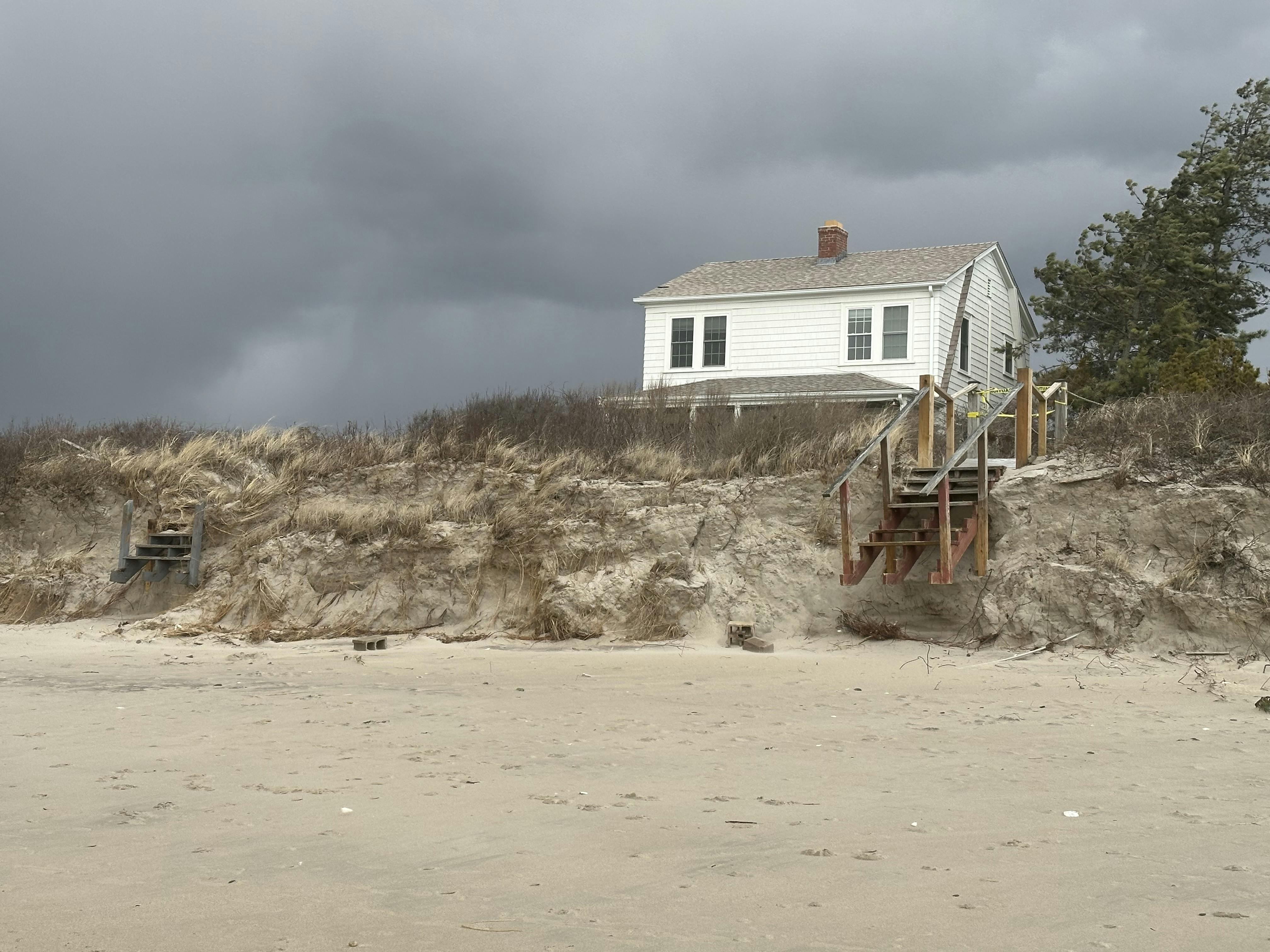
Of course, states and localities are under political and economic pressure to maintain beaches for summer people and locals who pay hefty property taxes to own land along the water. Then there are the tourists and vacationers who spend money in local eateries and hotels. However, Mother Nature will keep beach repairs temporary, and the beach-repair programs tend to put off what must be done in many places – move people back from the waterfront.
Harvest Canadian Wind?
Given local opposition to current and proposed wind-farm projects off southern New England and the Trump administration’s dislike of wind-power projects, and, indeed, of “green energy” in general, it’s perhaps not surprising that Massachusetts officials are sounding out Canada about getting power from planned offshore wind projects around Nova Scotia.
Of course, this would pose such challenges as the need to install extra transmission capacity to bring the power to southern New England and would undermine hopes for jobs in construction and maintenance for offshore wind projects in our region. And building a transmission line on land could face the sort of pushback from powerful groups and localities that has long delayed such projects as getting more hydroelectricity from Quebec into New England.
Of course, laying a mostly underwater line would be possible but would present problems, too, perhaps including complaints from fishermen.
And would Trump seek a way to put a tariff on that electricity?
We should bear in mind that Trump’s gyrational tariffs and his threats to take over what had been such a friendly ally have created long-term distrust and animosity there toward our crazy country, which over time will do considerable economic and geopolitical damage to the United States.
Meanwhile, visits by Canadians to New England, a region our northern neighbors have long favored, continue to fall because of Trump policies.
Be More Creative
As Trump’s “Big Beautiful Bill” sets in, local and state governments must find ways to maintain services in the face of federal funds being cut off.
They can do this by reducing regulatory layers and other red tape, making increasing use of artificial intelligence and giving managers more authority to implement changes. And states and localities must engage in more joint ventures.
They would do well to read my friend, the author/lawyer/civic leader Philip K. Howard’s books, such as The Death of Common Sense and The Rule of Nobody, for creative ways to respond to the fiscal challenges presented by the regime in Washington. (No, I don’t get kickbacks from the sale of his books.)
xxx

None of this is to say that many rich colleges and universities can’t spend money more wisely. That includes taking on their administrative bloat – e.g., the proliferation of highly paid deans.
xxx
The regime wants Americans to have more babies, but its slashing of social-service programs, hitting the poor and lower-middle class the hardest, will discourage them from doing so. At the same time, even some middle and upper-middle class people hesitate to have more kids because of the sky-high cost of education, child care and so on.
So the pro-natalism campaign of an administration run by very rich people is doomed. Since there are too many people now for the environment to handle, that’s not a bad thing.
xxx
The median price of a single-family home in Greater Boston has surpassed a record $1 million, reports the Greater Boston Association of Realtors! That represents two things – a lack of housing, partly caused by Nimbyism, in a densely populated area, and the region’s wealth, much of it fueled by the technology, investment-management and health-care sectors, all pumped up by the region’s world-famed higher-education institutions, some of them under attack by a spiteful Trump and his valets.
But I’d guess that these house prices will start to reverse soon as the economy slows.
Happily for some home seekers, condo prices have been falling, with the median price dropping 3.3 percent in the past year to a still stratospheric $725,000.
Anyway, albeit still too slowly, Massachusetts state government and some localities are pushing to encourage more housing construction, especially near mass transit. They have to be tough to do this. A lot of people don’t want more people near them.
Of course, some home seekers come to Rhode Island or southern New Hampshire looking for better deals, though prices here are too high for many middle-class, let alone low-income, folks. Some will continue to have to work in Greater Boston, which continues to be economically dynamic and offers higher wages than the Ocean State. The opening of the Pawtucket/Central Falls MBTA train station is a boon for some of them.
Catastrophe
“I and the public know
What all schoolchildren learn,
Those to whom evil is done
Do evil in return.’’
-- From “September 1, 1939,’’ by the Anglo-American poet W.H. Auden
There’s no doubt that the Israel-Hamas war that Hamas so brutally started on Oct. 7, 2023, has kept the very smart, corrupt and autocratic Israeli Prime Minister Benjamin Netanyahu in office. But his military’s relentless assault on the Palestinians in the Gaza Strip, killing tens of thousands of civilians, is poisoning chances for a long-term deal between Israel and the Palestinians. Netanyahu has created a revenge factory.
The Israeli military, armed to the teeth by America, has killed many desperate Gazans gathered at big food-and-water distribution centers, with the Israelis asserting, often with good reason, that Hamas fighters are nearby. If distribution of relief were provided at smaller and more widely distributed relief centers, there would be fewer civilian casualties from Israeli attacks.
So relentless have been Israeli attacks at relief-distribution centers that many Gazans risk starvation rather than going there.
The Trump administration hasn’t done much to dissuade Israel from its open-ended war in Gaza. But there’s no way that Israel can kill all the Hamas fighters hiding in the ruins.
Fragmented Media
Big staff cutbacks at PBS’s wonderful series The American Experience (produced at WGBH, in Boston) and elsewhere in public media suggest how mass media that had drawn a wide range of Americans into unifying viewing experiences are being superseded by an ever-more fragmented media landscape even as Trump tries to destroy public media. Streaming and social media are key parts of this change.
Trump’s evisceration of federal funding assistance to NPR and PBS won’t destroy large and well-endowed PBS and NPR stations in major markets. They’ll soldier on, though the quantity of their fresh programming will decline.
But our would-be dictator’s assaults will probably kill some NPR stations in small communities where people voted heavily for Trump. These stations have provided important public information, daily and in emergencies, much of it not otherwise easily available. It’s another case of people voting against their own interests because they want to believe a demagogue’s promises.
So, especially when compared to when there were only three huge national commercial TV networks – ABC, CBS, and NBC, supplemented in some places with nonprofit “educational TV” stations – outlets that offer broad frames of reference for looking at the world play smaller roles these days. That explains some of the divisiveness in American society now.
We’re all in our silos.
xxx
Given the Trump regime’s mobster aspects, it’s not hard to imagine his legal emissaries offering Ghislaine Maxwell a deal: Shut up about anything she knows about the Orange Oligarch’s close friendship with Jeffrey Epstein in the Manhattan moral cesspool they inhabited and she’ll get a pardon. Meanwhile, destruction and/or disappearance of certain documents related to the Epstein case can be expected.
A ‘Wise Man’
Engineer, scientist, inventor and administrator Vannevar Bush (1890-1974) probably had more influence on the rise of American science and technology in the 20th Century than anyone else. In his brilliant memoir, Pieces of the Action, published in 1970, he recounts a career that spanned the years from World War I to the space race. He discusses his roles in helping to start and manage big research and development programs, most famously during World War II (including the Manhattan Project), but before and after, too.
Few have explained so well the importance of cultivating science and technology to American security and prosperity. And few have described so well how governments address the challenge of coordinating military and civilian work in a democracy.
He became a member of a group that used to be called "The Wise Men" -- distinguished people, often former high-ranking government officials, military leaders, diplomats and chief executives of large corporations, asked by government leaders for advice on important national issues, especially during crises. We could use some now!
Mr. Bush’s book is primer on what constitutes good, bad and mediocre management within organizations and the important role of emotional intelligence. It would be a useful textbook for business schools and, for that matter, anyone working in, or planning to work in, large organizations. And his descriptions of the process of invention are entertaining because of a very accessible writing style, seasoned with wry humor and memorable anecdotes.
With some of American science under attack from an oft-nihilist regime, reading Mr. Bush’s book gives you a look at a better way.
xxx
I’m not distressed by the demise of Hulk Hogan and Ozzy Osbourne, princes of a polluted culture, though the relentlessness of their sleaze had a kind of grandeur. They’ll soon be forgotten amidst the other garbage coming down the stream.