Whitcomb: High-Level Leavings; Those Polls: Free-Rent Stores; Getting Richer in Government
Robert Whitcomb, Columnist
Whitcomb: High-Level Leavings; Those Polls: Free-Rent Stores; Getting Richer in Government

“In this extreme state of light
everything seems flawed: the streaked
GET THE LATEST BREAKING NEWS HERE -- SIGN UP FOR GOLOCAL FREE DAILY EBLASTpane, the forced bulbs on the sill
that refuse to bloom….”
-- From “Bright Light After Heavy Snow,’’ by Jane Kenyon (1947-1995), a New Hampshire-based poet
“That which can be asserted without evidence, can be dismissed without evidence.’’
-- Christopher Hitchens (1949-2011), Anglo-American writer on politics and culture
“Individuals like {Salesforce CEO Marc} Benioff had benefited from public goods financed by taxpayers — the schools that educated their employees; the Internet; roads, bridges and other infrastructure enabling commerce. Then they deployed lobbyists, accountants and lawyers to master legal forms of tax evasion that starved the system of resources. He and his fellow billionaires could crow about giving back in part because of how comprehensively they had taken.’’
-- Peter S. Goodman in “C.E.O’s Were Our Heroes…At Least According to Them,’’ in the Jan. 16 New York Times.
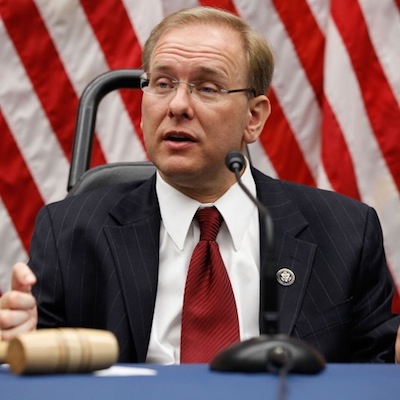
It’s impressive that Rhode Island Congressman James Langevin, 57, has been able to serve as long as he has – since 2001– in that office. Given that he’s a quadriplegic, daily life – getting dressed, etc. – must be very time-consuming and sometimes exhausting. Imagine dealing with that while serving in Congress.
No wonder that Mr. Langevin, a moderate Democrat, announced last week that he wouldn’t run for another term. Or maybe he decided to quit the institution because all too many Republicans are paralyzed by their terror of offending Trump and so refuse any compromise to get legislation passed.
In the face of this, he has performed his duties thoughtfully and calmly, and even managed to stake out a role as something of an expert (by congressional standards) in the increasingly important sector of cybersecurity.
While his congressional district usually votes Democratic, it has more than a few Republican voters, including fanatical Trump tribalists, in Rhode Island’s West Virginia – the rural and exurban towns along the Connecticut border. The GOP could win the district next November if they can find a candidate who could attract enough independent votes.
Moderate Republican Allan Fung, 51, a former highly successful mayor of Cranston, and now a lawyer in private practice would, I think, would have a good chance. He has has run complex organizations and are well-versed in local-state-federal relations are big assets.
xxx
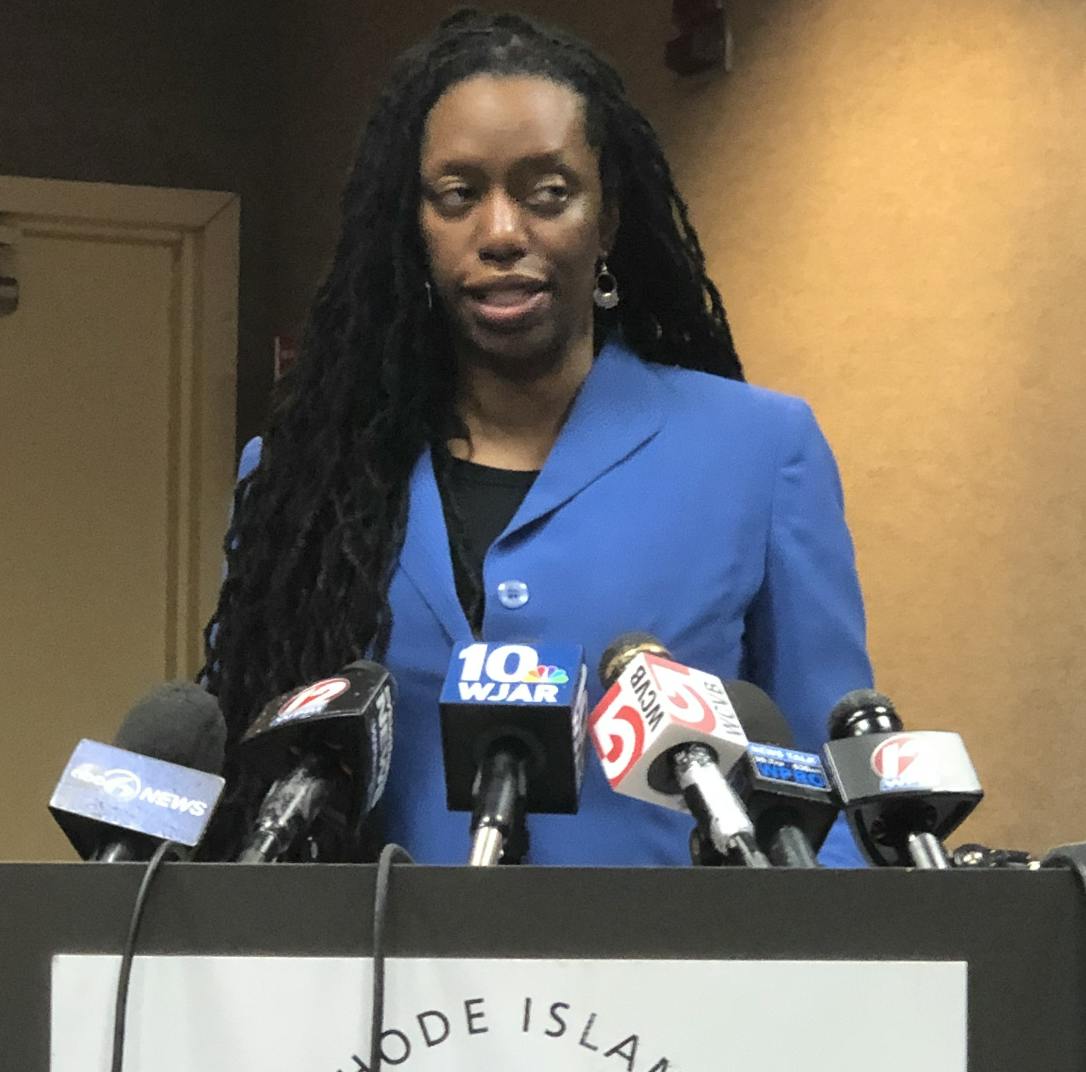
Since she gave only two weeks’ notice (but will be available as a consultant for three months after she leaves), I’m guessing that she may well have a job lined up. But you’d think that she’d want to take a long, long vacation first.
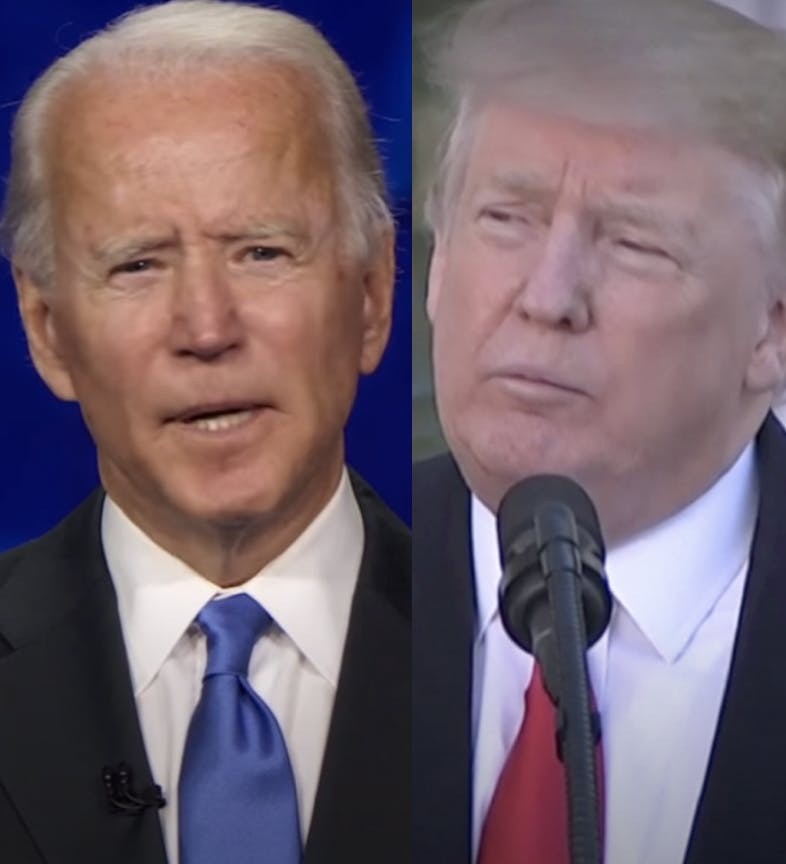
Biden’s biggest legislative successes in his first year in office: He got enacted a $1.9 trillion COVID-19 relief bill and a (hugely overdue) $1 trillion infrastructure bill. Up until COVID demanded immediate massive bipartisan spending in March 2020, in the form of the $2.2 trillion CARES Act, Trump’s only major legislative success was a $2.3 trillion tax-cut package enacted in December 2017 and especially designed to favor Trump (long a celebrated tax evader) and his very rich friends.
Biden has won confirmation for some 40 federal judges, more than any first-year president since Reagan, and twice as many as Donald Trump got confirmed in his first year when the caudillo had a 54-vote Senate majority. Biden has only 50 senators, plus the vice president to break a tie.
So it’s hard to call Biden’s first year a flop.
I think that his administration should have declared victory and put off its $2 trillion Build Back Better legislation to another day and let the economy digest the first two bills first. Or maybe it can still get some BBB fragments passed with its tiny congressional majorities, though with Republican determination to make Biden fail, maybe even that won’t work. The failure of voting-rights legislation is sad, but expected, given the nature of the present GOP, which in some ways has become a version of the old Southern Democrats (Dixiecrats).
I have no idea if Biden will regain some popularity or lose some more this year. Too many variables, and as the old saying goes, a week is an eternity in politics. Note that President Reagan’s Gallup Poll approval rating fell to 35 percent in January 1983, from 51 percent when he took office. Of course, he was re-elected in a landslide in 1984. Biden’s current approval has slipped from 57 percent when he took office to 40 percent now. (I’m sure that he won’t run for re-election.) President George H.W. Bush’s approval rating was 89 percent in February 1991. He lost his bid for re-election the next year.
The voters are very fickle, and especially nowadays with manic media that never let the facts get in the way of a good story (usually soon to be forgotten).
By the way, if you think Biden sometimes sounds incoherent, go back and listen to some of Reagan’s press conferences or Trump’s ravings!
The Washington Post’s late editor Ben Bradlee famously called journalism “history on the run.’’ It’s too bad that so few journalists these days know any history, beyond, maybe, last week, standing or running, to use for context. Maybe they don’t have time to learn any amidst the relentless Twittering and drama concoction that are job requirements because of the dominance of social media and cable “news.’’

Build It and Cash in Fast
I suppose we can mostly blame the pandemic, but revenue hasn’t looked all that rosy at the Worcester Red Sox’s new Polar Park, which, as with most such stadium projects, has received many millions in public dollars that benefit the investment group that owns the team. But then, even in pandemic-free times, rarely do such facilities pay off for the taxpayers, although pro sports fans and grandiose promises of local economic gains often overcome strenuous community opposition to these projects.
A campaign by the same group for a new, taxpayer-subsidized stadium in Pawtucket as a home for the now deceased PawSox failed, and considering what’s happening in Worcester, there may be many fresh sighs of relief in Rhode Island. That’s not to say that there are not psychic benefits from having a local baseball team. (We enjoyed taking guests from out of town, especially foreigners, to PawSox games.)
But wait! The WooSox owners may well sell the team sooner than you might think, and at a big profit. Call this welfare for the rich, or just the American Way!
xxx
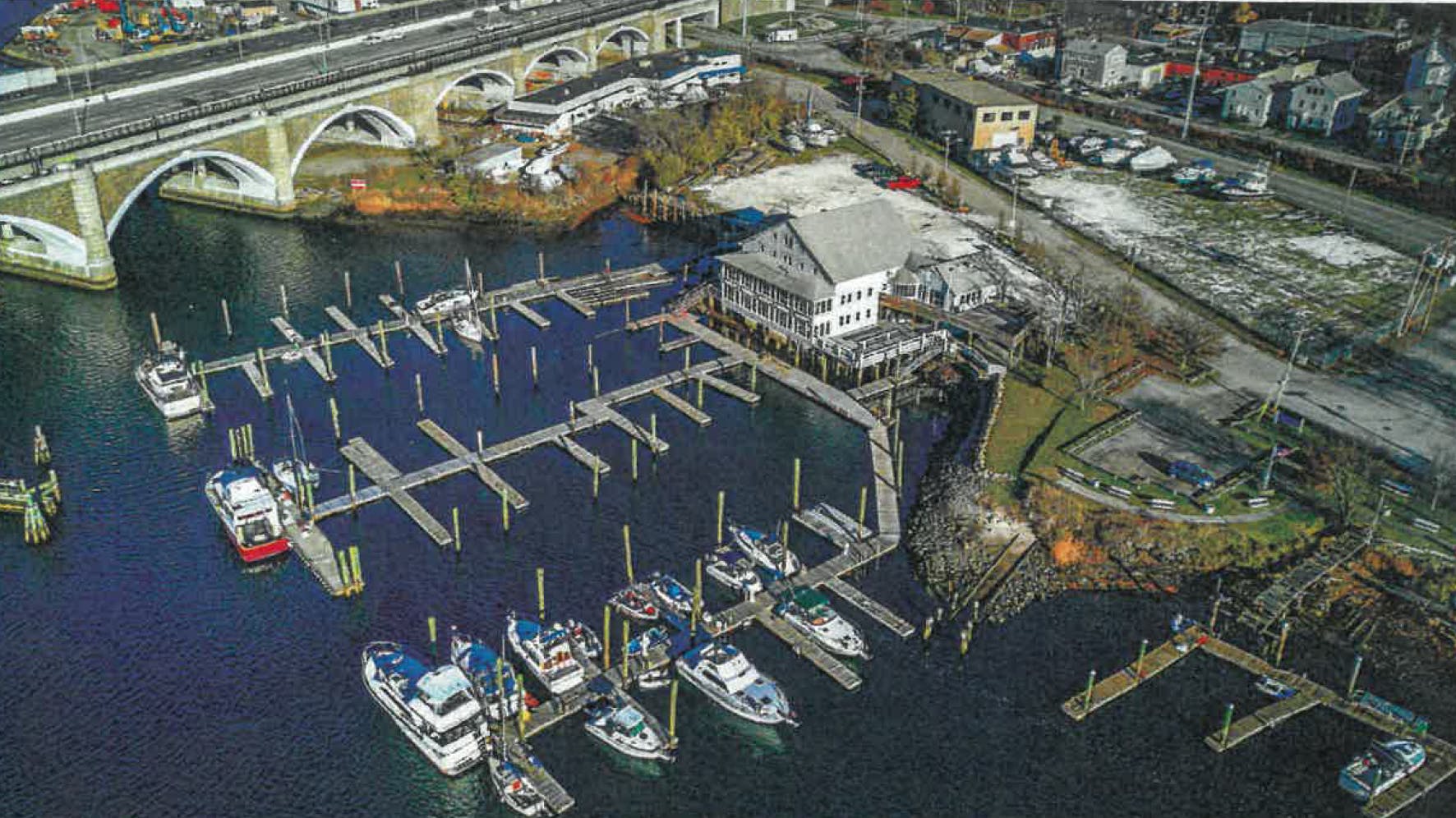
Perhaps because I’m slightly involved with a project in Maine to preserve working waterfronts, I noticed that one of Rhode Island Gov. Dan McKee’s projects in his state-of-the-state address on Jan. 18 was to boost seafood-processing facilities in the state so that more of the profit from that processing stays in or close to the state. A fine idea for the Ocean State.

“…{Although Putin varies his tactics, his longer-term goals have been very clear for a very long time. He might use disinformation one year, gas-pipeline blackmail another, bribery or violence the next, but the endgame is always the same: reinforce his autocracy, undermine democracies—all democracies—and push Russian political influence as far as it will go. Break up NATO. Destroy the European Union. Remove American influence from Europe and everywhere else.’’
-- Anne Applebaum, author of Twilight of Democracy: The Seductive Lure of Authoritarianism, in The Atlantic
Russian dictator Vladimir Putin is following an old tyrants’ playbook in planning “false flag” operations within Ukraine in which Russian operatives stage incidents against Russia’s proxy forces in eastern Ukraine as pretext for another, deeper invasion of that democracy. (Remember that he seized Crimea and invaded eastern Ukraine in 2014, launching a war that continues.) Putin’s operatives are trained in urban warfare and explosives.
Perhaps the best-known example of this is what Hitler’s forces did right before he launched the very bloody German invasion of Poland on Sept. 1, 1939, starting World War II.
Putin is scared that the model of a democratic, prosperous Ukraine next door would undermine his power.
The West urgently needs to rush much larger quantities of defensive weaponry now to help Ukraine (which wants to be part of the West and not Putin’s kleptocratic, expansionist police state) defend itself. (Kudos to the British for sending anti-tank weapons last week.)
The Biden administration must be much clearer and firmer on how it would punish further Russian aggression and do everything possible to more strongly unify the West against this thuggery. Any sign of weakness now will encourage this former KGB operative to widen his aggression and encourage similar aggression by other dictators.
Unfortunately, the financial sanctions imposed so far against the regime of the cold murderer running Russia (and its satellite Belarus) have had little effect on him. That’s because the vast, ill-gotten wealth possessed by Putin, his family and his entourage, including his mistress, has been left untouched.
An admirable new sanctions bill just introduced by congressional Republicans this week would go after Putin himself, every member of his cabinet, his family members and even his alleged longtime mistress, Alina Kabaeva. Putin and his mafia have stolen many billions of dollars from their own country and elsewhere.
South Carolina Congressman Joe Wilson told The Washington Post: “We need to go after Putin directly and his network of kleptocrats and oligarchs. Weakness is provocative. Without imposing real costs, we won’t deter Putin. We have been pushing for these sanctions for years; further delays will lead to {more} war.’’
I hope that by the time that you read this Putin hasn’t already launched a new invasion, animated by the belief the West won’t be rigorous in response to this threat to European security and democracy.
Meanwhile, I wonder if Ukraine might end up officially neutral, if psychologically and culturally Western, as Finland was in the Cold War.
There are continuing controversies about the susceptibility of the Rhode Island Coastal Resources Management Council to political and business pressures. CRMC are political appointees who aren’t required to have experience in coastal environmental matters.
So I ask yet again why it can’t just be abolished and all its powers granted to the (now understaffed) state Department of Environmental Management, whose employees include people with technical and scientific training, not political and business connections.
This becomes more important with the rising seas caused by global warming.
Save the Bay, the state’s leading environmental advocacy organization, has been denouncing state leaders for slashing the DEM’s staff, especially inspectors and enforcement officers.
“The Department of Environmental Management has seen its budget and staff cut dramatically over the past 20 years. These cuts have led to delays in permitting, reduced inspections of potential polluters, and lax enforcement of RI’s environmental laws and rules,” said Jed Thorp, advocacy coordinator of the organization.
Interim Way to Make Retail Roads Busy Again
What with so many stores and restaurants killed by the pandemic, which was preceded by the already accelerating pre-COVID move by many consumers to online purchases, some retail strips have become ghost towns.
One idea is to experiment with what some jurisdictions in Australia and elsewhere have tried:
Have property owners let commercial tenants use space for free – say on a three-or-six month basis -- except for utilities, maintenance and, maybe, taxes. That could bring much needed activity and energy to moribund streets, perhaps eventually enough to lure back regular, long-term tenants. After all, most of us like to get out of the house and see people and commerce. When COVID truly fades, I think you’ll see an upsurge of in-person retail.
The idea above beats those dreary local warehouses set up to distribute stuff to online purchasers -- interspersed with takeout-only eateries – that have been going into what had been stores and sit-down restaurants all over the place.
Of course, given the extreme supply-demand imbalance in housing, which has made “affordable housing’’ so difficult to find, the more abandoned store space that can be turned into housing the better.
Partly because of “snob zoning” and the preference given to single-family housing, America has been underbuilding housing for years. It will take years to catch up.
Making Insider Money Off Government
It’s past time for a real crackdown, including hefty fines and jail sentences, on insider trading of stocks and bonds by such high federal government officials as members of Congress and the Federal Reserve Board and their families. Some continue to use information hidden from the general public on government policies and actions that affect securities prices to enrich themselves.
A couple of fairly recent examples of what is still happening:
Then-Sen. Kelly Loeffler (R.-Ga.) and current Senators Richard Burr, (R-N.C.), Dianne Feinstein (D.-Calif.), and James Inhofe (R.-Okla.) all made lots of money in the winter of 2020 trading on confidential government information on the new COVID-19 outbreak.
An anti-insider-trading law for members of Congress is hardly enforced.
Then there’s soon-to-be ex-Federal Reserve Board Vice Chairman Richard Clarida’s purchase on Feb. 27, 2020, in a stock investment fund— one day before Fed Chairman Jerome H. Powell announced that the central bank stood ready to boost the nervous economy by printing trillions of dollars as the pandemic set in. The transaction drew an outcry because it put Mr. Clarida in a position to benefit as the Fed pumped up market confidence and thus securities prices.
A smoking gun: He belatedly amended a financial-disclosure document that showed that he had sold that same stock fund on Feb. 24 when financial markets were plunging amid fears of the virus. His term is finished at the end of this month.
Further, two of the Fed’s 12 regional presidents — Robert S. Kaplan, of the Federal Reserve Bank of Dallas, and Eric S. Rosengren, of the Federal Reserve Bank of Boston -- have also engaged in transactions that smell like insider trading. They resigned last year after their trades were questioned.
The weak monitoring of high federal officials taking advantage of their positions is irritating because not only is it unfair to other investors but because most of these officials were very affluent before taking office. Their positions, because of the self-promotional visibility, contacts, and insider information they afford them, are helpful in making them richer even before their exit from office lets them much more openly expand their wealth.
All high federal officials’ investments should be in blind trusts while they’re in office. This should be obvious.
xxx
A New Hampshire state representative (of course a Republican) wants the Granite State to secede from the United States. Avoid those pesky federal taxes and regulations! When I lived in that state in the late ‘60s, I sometimes heard such ideas applauded in small-town general stores.
I wouldn’t be surprised (except I’ll be dead!) if the U.S. breaks up in the next few decades, so wide are the cultural, economic, and political differences between its states and regions. Maybe that would be a good thing.
What to divest
I throw out old stuff in fits and starts. It’s sometimes a tad painful. For instance, I had a quaint old map -- sort of a high-end tourist thing – of the environs of Brunswick, Ga., that my father (1917-1975) must have bought during World War II, when he was briefly stationed there. I wish I had asked him about it. A Navy officer and combat veteran, he very rarely discussed what he did in what we called “The War”.
I’ve visited that marshy and aromatic area myself, back in the ‘60s.
I liked having the map around but we have far too much old stuff, and I always ask myself: Would my children keep this or that memento after I go on to the next realm or to nothinghness? The answer is almost always no!
xxx