


Whitcomb: Lessons of History; Old-Small-Town Energy; ‘Big Haul From Millionaires’ Tax’
Robert Whitcomb, Columnist
Whitcomb: Lessons of History; Old-Small-Town Energy; ‘Big Haul From Millionaires’ Tax’

“Upon our heads
The oak leaves fall
Like silent benedictions
Closing Autumn's gorgeous ritual....’’
From "November Afternoon," by Marjorie Allen Seiffert (1885-1970), American poet. Here’s the whole poem:
“I had so often run down to these shores to stare out
If I took an island for a lover and Atlantic for my sheet
There was no one to tell me that loving across distance would turn about
And make the here and now an elsewhere of defeat.’’
--“Even the Gulls of the Cool Atlantic,’’ by Joan Murray (1917-1942), Canadian-American poet
“Time, when it is left to itself and no definite demands are made on it, cannot be trusted to move at any recognized pace. Usually it loiters, but just when one has come to count upon its slowness, it may suddenly break into a wild irrational gallop.’’
-- Edith Wharton (1862-1937), American novelist
‘’Secrets define us, they mark us, they set us apart from all the others. The secrets which we preserve provide a key to who we are, deep down.’’
-- Nuruddin Farah (born 1945), Somali novelist
xxx
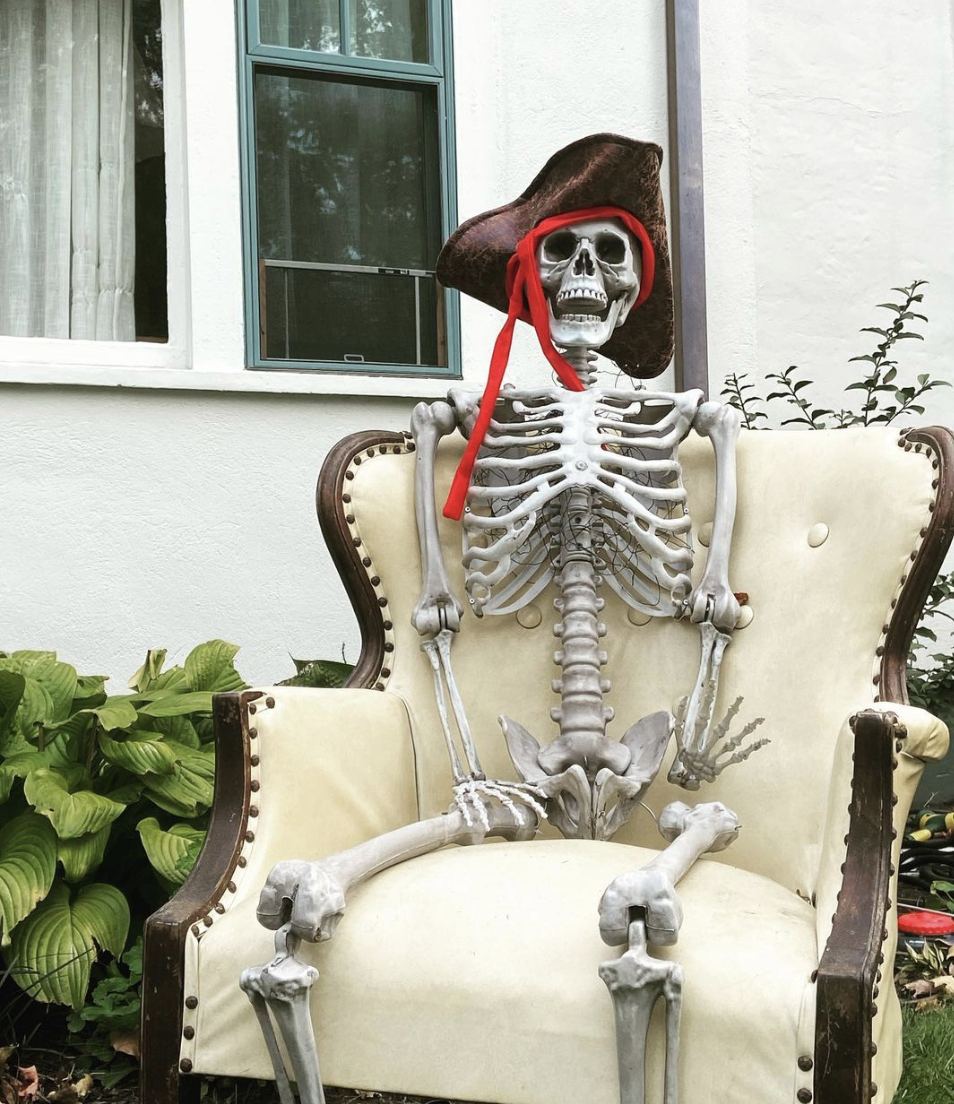
What has become the most American of “holidays’’ – Halloween -- provides lessons in transience in our relatively stable and cozy neighborhood. You see the little kids taken by hand by their parents to collect candy, then within several years, they come by on their own to your door. Then you don’t see them anymore except in cars or at Christmas or Thanksgiving.
And their middle-aged parents become old and then disappear.
xxx
On Oct. 16-17, I was in the Hudson Valley at a conference at bucolic Bard College, in Annandale-on-Hudson. There, the Hannah Arendt Center for Politics and Humanities ran a conference called “JOY: Loving the World in Dark Times,’’ aimed at making people more aware of the historical context and possibilities of a world in which tyranny and corruption are surging, most alarmingly for the future of democracy in the United States, but also of reasons for hope. Just that the weather was so beautiful on those days raised spirits.
Our freedoms are always fragile.
“History will teach us that...of those men who have overturned the liberties of republics, the greatest number have begun their career by paying an obsequious court to the people; commencing demagogues, and ending tyrants."
-- Alexander Hamilton
“He {a demagogue} will pretend false votes, foul play, hold possession of the reins of government, be supported by the states voting for him.’’ {Sound familiar?}
-- Thomas Jefferson in letter to James Madison
But do most Americans really care all that much about democracy, though they’d sorely miss it if it disappeared? I doubt it. They naturally care most about their immediate economic circumstances and are also heavily animated by social resentments and fears, which adept politicians fan. And the brazen corruption of the Trump regime doesn’t seem to bother all that many people, even though it involves stealing taxpayer money. But then, many Americans are corrupt, and would gladly partake of the public thievery if they could get away with it.
Sadly for them, they didn’t have the foundation for wealth and power that Trump got from the hundreds of millions of dollars he got from his crooked and racist developer father.
Hannah Arendt (1906-1975), a historian and political philosopher, was a German Jewish refugee who ended up in America after fleeing Hitler’s Germany. She became famous for, among other things, her writings on revolution and dictatorship. Her most famous quote, often misinterpreted, is about “the banality of evil’’ representing what she heard in the trial of the Nazi bureaucrat Adolf Eichmann, one of the major organizers of the Holocaust. Now she’s seen as something of a secular saint.
The program, which featured various species of speakers, including book authors, essayists, poets, novelists and a playwright, as well as musicians and a dancer, provided an intellectual and emotional overview of where we are now, albeit not in ways that MAGA shock troops would relate to. Of course, I didn’t agree with everything said at the conference, which was packed with highly informed comment, but it was a rich brew well worth going back to from time to time.
More than a few events reminded me of the “Jewish intellectual” culture of Manhattan’s Upper West Side, which I remember vividly from living there more than half a century ago.
I particularly recommend reading Arendt’s book On Revolution, especially about how and why the American and French revolutions took such very different courses.
xxx
As much as I dislike driving these days, I found the Hudson Valley and the Bard campus gorgeous amidst the fall foliage. The river, of course, is spectacular, and some of the little towns lovely, though parts of old industrialized places in the likes of Kingston, with its strip malls, are depressing. You get the feeling that the valley’s economic heyday ended long ago. On the other hand, the river is much cleaner than it was in the ‘60s and before, when General Electric, etc., blithely dumped cancer-causing chemicals into the Hudson. The Catskills looked higher than I remembered from back in the late ‘60s, when I last spent more than a few hours there. For some reason, my boyhood reading of Washington Irving’s tales about the region, such as “The Legend of Sleepy Hollow’’ and “Rip Van Winkle,’’ etc., is still vivid to me.
xxx

xxx
Even as cars improve and get ever more expensive, the drivers get worse. So it was good to see that Massachusetts highway mavens have put up signs telling folks not to pass on the right, which far too many people do, and while speeding – a wonderfully efficient way to cause accidents. But a complaint: In too-long stretches where road work is underway, the painted lane lines are very worn down, or nonexistent, making crashes, especially at night, more likely. I was on a hair-raising stretch of this on the Mass Pike on my way back home from the Hudson Valley on the evening of Oct. 17.
Small-Town Virtues
My other recent road trip was to Falmouth, Mass., on the Cape, where I did a little more historical research, mostly about the 19th Century in that town, where many of my ancestors lived. I was struck again by the energy of town leaders, then, in business and civic life. They’d start up a wide range of businesses, from salt collection, to guano processing (for fertilizers), to boat building, to raising sheep for wool, a major sector in New England at the time as textile mills popped up. When one business didn’t pan out they’d go on to the next at a good clip. They were remarkably handy at fixing things, both business plans and equipment. And they did this at a time when transportation was much more difficult than it is now.
Consider that members of the local Butler family who owned the town’s monopolistic town general store, found it easier to ship by boat from New York City some stuff to provision the store than to get it from the much closer Boston area, which often required, before the trains came in, transporting stuff via the sometimes perilous route around Cape Cod in pre-canal days.
While being energetic small-town capitalists, many Falmouth folks were notably civic-minded, of course sometimes out of enlightened self-interest. There seemed to be no dearth of men (in those pre-women’s suffrage days) willing to run for selectman, state representative or other political posts and to promote the construction of schools and other public facilities, as well as churches. And they’d get into such heated issues as abolishing slavery – signing petitions and so on.
Still, mixed with all this, as I can tell from their letters, were fatalism and melancholy, which they seem to have passed on to their descendants.
It was a very different world, of course, but there are some lessons to be learned about building successful communities from Falmouth.
I was struck by how busy downtown Falmouth seemed last week, even though the prime summer people and tourist season ended weeks ago. Half a century ago, it would have been much quieter at this time of year. Maybe that autumns are getting warmer has something to do with it.
And, oh dear!
The Trump regime, whose greatest enthusiasm seems to be to stick it to its real or perceived adversaries, has paused $11 billion in funding for infrastructure projects in some Democratic Party-led cities, including Boston, and put into some doubt the $600 million that the Feds had pledged to help pay to replace the two decaying highway bridges over the Cape Cod Canal, which were built the ‘30’s.
Meanwhile, $172 million in taxpayer money will go to buy two Gulfstream jets for the use of Homeland Security Secretary Kristi Noem and her top assistants.

Trump, a convicted criminal, demands that we pay him $230 million for “compensation” for the Justice Department’s investigation into his ties with Russia (ties that are still obvious in his current, erratic and often bizarre relations with Vladimir Putin, whom he fears and envies) and the FBI raid over his retention of classified documents at Mar-a-Lago after his first term ended.
The new economic sanctions (if they can even be enforced) won’t stop Putin’s war on Ukraine. Only more and better weapons for Ukraine, especially long-range missiles, will get the tyrant’s full attention.
Anyway, the public be damned! Some $300 million is being spent to illegally demolish the East Wing of the White House and rebuild it for a huge ballroom where the Orange Oligarch can hold court. But don’t worry, the money is coming from private donors. You can bet that most of them seek special access to the king.
xxx
I think more and more that congressional Democrats should go along with ending the government shutdown and let the Republicans proceed with their slashing of health care and other programs so that voters and nonvoters (who vote by not voting) feel the pain and learn something, such as that elections have consequences, etc.
Mass. Millionaires’ Tax
A couple of years ago, the Bay State started charging a 4 percent surtax on incomes of over $1 million. The law has generated $3 billion more in revenue than projected, and so far have created a $5.7 billion fund! The money is being allocated to transportation and education.
Of course, a few rich folks, including business execs, have fled, with considerable fanfare, to places run by, and favored by, the very wealthy, particularly to corrupt, boring and far-right Florida, which has no income or estate tax, and whose overall tax structure is regressive: The bottom 20 percent of income earners must pay some of America’s highest state and local tax rates, through sales and excise taxes, and insurance rates are also very high.
But I’d guess that most Massachusetts rich folks will stay put because, in large part, of the very things that the state’s tax system helps pay for, and are good for business: among the nation’s best public-education and health systems and dense (for America) public-transit networks, along with low crime. And lots of people like having four distinct seasons, despite the complaints that come in February.
Much of America’s tax structure has long favored the rich, particularly that capital gains are taxed at a lower rate than earned income. And some of this is based on the assertion that goodies for the very rich will “trickle down’’ to people below. Many Americans would be hard put to see how they benefit from this approach, which really got going in the Reagan administration.
Massachusetts officials’ challenge is to spend the “millionaires’ tax” windfall in transparent ways that the public sees as clearly strengthening the state for the long term, and benefiting all income classes. Within a couple of years, we’ll have a much clearer picture of how this is working.
That Trump is very specifically targeting “Democrat” places for massive federal aid cuts, and more broadly wants to have states in general pay for more programs that the Feds have been partially or totally paying for, is another reason for rich states such as Massachusetts to set aside more money for key projects. (By the way, it’s the Democratic Party, not the Democrat Party. The juvenile Trump and his lackeys like to say the latter because they think it sounds harsher.)
It will be interesting to see how Red States, especially the poor former Slave States, with their lousy public services and high poverty rates, deal with federal cutbacks.
Of course, federal income taxes should be raised to pay for services that the public demands and to address the exploding national debt. But apparently, only an international bond market disaster of biblical proportions will make that happen.
xxx
In a move similar to Massachusetts’s, California Gov. Gavin Newsom has signed into law a bill that promotes denser housing development near the state’s busiest public transit stations. This is aimed at addressing the sky-high cost of housing, particularly in Southern California and the Bay Area, while reducing sprawl and air pollution. This is a very good, if overdue, advance, though the not-in-my-backyard crowd, especially in some affluent communities, will continue to complain and file lawsuits. California’s size will make it the model.
Localities are, legally speaking, children of the state, and state officials are obligated to make the overall health of their states their priority.
xxx
Kudos to HavocAI, based in Providence, which has recently raised $85 million in new capital! It seems perfect for maritime Rhode Island. The company specializes in making small, uncrewed surface vessels and autonomous systems for both defense and commercial use.
xxx
It was also good news that Apple Cinemas will take over the movie theaters at the Providence Place mall, helping to ensure a flow of people to the mall, which has been under receivership.
xxx
Go Blue Jays!
Outraged about gambling in pro sports? But isn’t that one of the main drivers of this swelling sector?