


Whitcomb: Evictions; They Stay, Taxes and All; Rearranging Cities; Amazonian Mall Invasion
Robert Whitcomb, Columnist
Whitcomb: Evictions; They Stay, Taxes and All; Rearranging Cities; Amazonian Mall Invasion

the garden would burst and a trout waits
beneath the moving river surface….
GET THE LATEST BREAKING NEWS HERE -- SIGN UP FOR GOLOCAL FREE DAILY EBLASTas in a dream of shadows a black bear circles
beneath trees ten thousand shades of green.’’
-- From “The Nature of Yearning,’’ by David Huddle, a Vermont-based poet and teacher
“I am not in the least concerned as to whether I will have any place in history.… It does not seem to me that after a man is dead it matters very much whether it is a little longer or a little shorter before the inevitable oblivion, steadily flooding the sands of time, effaces the scratches on the sand which we call history. As the ages roll by in the life of this globe, small indeed does the difference seem between the few weeks’ remembrance of the average hard-working, clean-living citizen, and the few years, or few hundreds of years, or few thousands of years, before the memory of the mighty fades into the dim gray of time and then vanishes into the blackness of eternity.’’
--Theodore Roosevelt (1858-1919) during his presidency (1901-09)
Many landlords are small-business people, for whom the loss of rent can be devastating, enough to drive many of them out of business. When that happens, the effect may be to decrease the available housing and drive up rental prices.
And while the image of landlords, at least to many people, may be negative, most are honest people trying to balance making a profit and being responsive to their tenants.
Being a landlord can be pretty unpleasant. Some tenants are irresponsible or worse, blithely damaging property, delaying their rent payments even if they have the income to pay, having loud parties and otherwise being a pain in the neck.
After my wife and I moved out of our old (built 1835) two-family house in a then rather marginal part of Providence to work abroad, we rented out the place for a few years. In that time, we saw a pretty wide range of tenant behavior, from highly responsible custodians to deeply irresponsible and selfish ones, including somebody who sawed through an antique door to create a cat entrance. We eventually moved back to the house, taking all of it over, but then, after a couple of years, moved a dozen blocks away to a single-family house because there was too much drug-related crime in the neighborhood at the time. (It’s much better now.)
Anyway, in the current public-health and economic anxiety, let’s not demonize whole economic classes, though I might make an exception when it comes to private-equity billionaires….
“Many are saying that remote working is making people reprioritize where they choose to live and work. It’s too early to say if we’re seeing a trend of people flocking to Rhode Island because it’s less expensive, more rural, has great amenities or a combination of all three, but it’s definitely something we’re studying. Rhode Island has always been a well-kept secret in terms of value, now perhaps, it’s not as much of a secret anymore.’’
-- Shannon Buss, president of the Rhode Island Association of Realtors, in GoLocalProv.com on people moving to Rhode Island since the pandemic began.
I have always thought that the assertions that Rhode Island state and local government retirees flee in large numbers to lower-tax states were grossly exaggerated. People decide to move to, or stay in, places for many reasons, such as job options and weather, but most importantly because of their family and friends connections, and those are tight in the old and compact Ocean State. Now, The Boston Globe reports, Watchdog RI, a nonprofit founded by former Moderate and Republican Party candidate gubernatorial candidate Ken Block, who has often complained about public pensions and other things about this liberal state, has found that of 31,762 retired state and municipal retirees studied by the group, 80.3 percent retired in Rhode Island.
Mr. Block, a wizard at numbers, told the paper that he had expected twice as many of these public-sector retirees to be living out of state. “Certainly, the myth is that a lot of government employees retire and get out of Dodge,” he said. “That is clearly not the case.”
Even so, he told The Globe, $222 million in pension payments is being shipped out of state to these retirees each year, and he said, “That’s money that would be really nice to keep in state, if we could.” (It would be useful to get the numbers on what percentage of public-sector retirees leave other New England states.) GoLocal broke down these numbers for 2011 and for Providence in 2012.
The list of the states where the largest numbers of the aforementioned Rhode Island retirees move to, as reported by Watchdog RI, are:
· Florida: 3,017
· Massachusetts: 1,195
· Connecticut: 237
· New Hampshire: 226
· South Carolina: 198
· North Carolina: 167
· Maine: 136
· Arizona: 118
· Texas: 88
· Georgia, Virginia (tied): 84
Interestingly, two of those states are, by national standards, high-tax when you combine state and local taxes – Connecticut and Maine; Massachusetts is in the middle, with New Hampshire a tad under the median. Generally, higher state and local taxes mean more, if not always better, public services, especially for that high-voting cohort called old people. State-by-state tax-burden comparisons are difficult because state and local tax systems vary widely, especially when you consider business taxes and what sort of purchases are covered by sales taxes.
You’d expect Florida, with its warm winter weather and generally low taxes, to lead in grabbing emigres from other states. (I wonder if that will continue after the COVID crisis there.)
Hit this link for some national tax comparisons:
Hit this link for the Watchdog RI site:
Besides their human connections, many retirees stay in Rhode Island because much of it is beautiful and there are lots of services within short distances. Not much driving required.
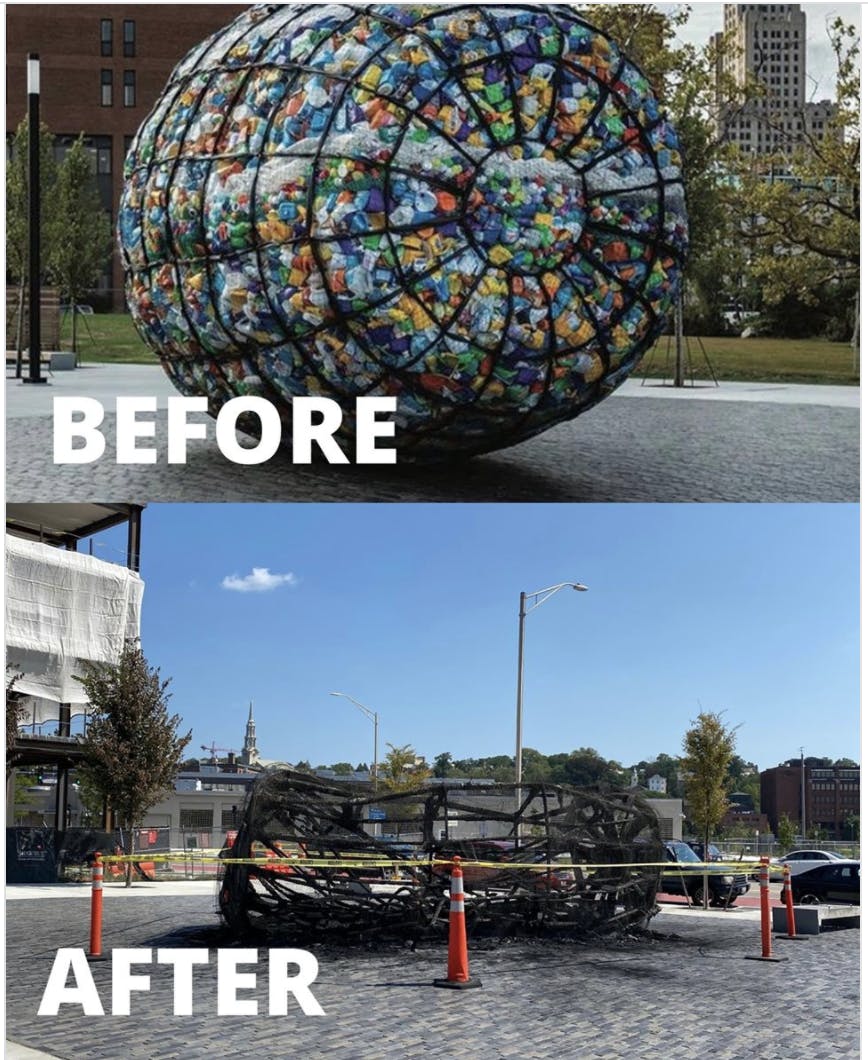
The arson that destroyed a large piece of public art outside the Wexford Innovation Center, in downtown Providence, early on Aug. 10 raises the question of whether there are adequate 24/7 security patrols – public and private -- of the area. This fire would have been hard to miss.
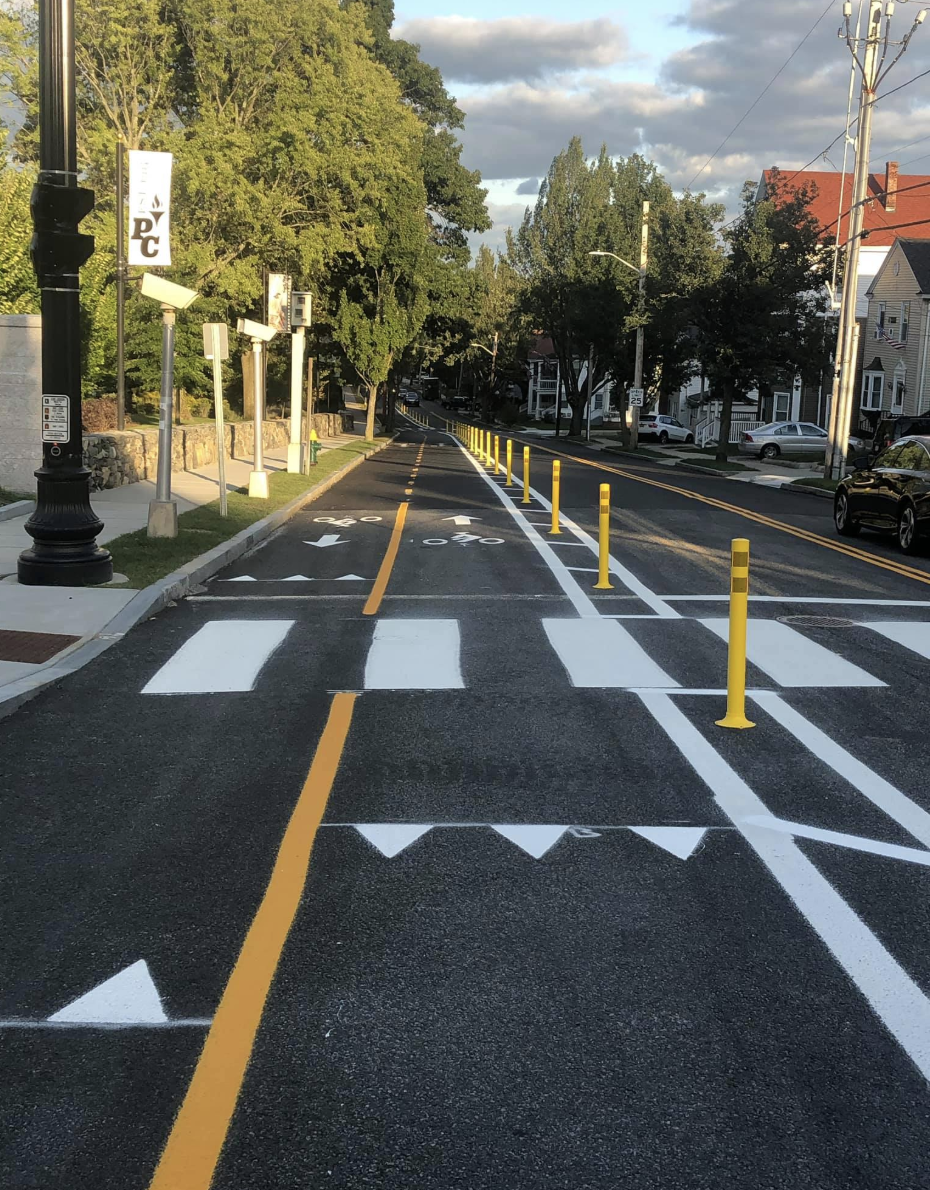
Boston is starting to implement new street-narrowing, traffic-calming, bike-lane creation and sidewalk-widening plans that will make parts of the city’s very dense urban core more pleasant.
Mass.streets.blog.org summarized the program in May, when it reported:
“The initial plans include a network of new protected bike lanes across downtown Boston and around the Public Garden, expanded bus stop waiting areas, and processes to let restaurants expand their outdoor seating areas on sidewalks and on-street parking lanes.’’
The new bike lanes are already being set up, albeit not yet permanently; cones are being used, not concrete or metal barriers.
Some of these plans were in the works before COVID-19, but the pandemic has jump-started some of them to encourage social distancing and boost walking and bike riding by COVID-cautious people worried about taking public transportation (though those concerns have been found to be exaggerated).
Sidewalks in most American cities are too narrow. Widening them for restaurants, outdoor retail stores and other functions will add to cities’ liveability.
Anything that discourages car traffic and encourages walking and bike riding and, yes, a return to public transportation in center cities, will improve their quality of life and help lure back residents, businesses and tourists who fled because of the virus.
It should be said, by the way, that density per se does not present a COVID-19 peril. Consider how well Hong Kong, Singapore and Taipei have kept virus cases down to a handful. That’s probably in part because of lessons from the East Asian-based SARS epidemic, in 2002-04
And note that virus cases are much lower in densely populated and affluent downtown Boston than in neighborhoods a little further out with more poor people. To reduce your chances of getting sick with COVID, live in a rich, orderly neighborhood where people follow mask and social-distancing guidelines and lose weight while you’re at it. But back to reality….
Of course, it’s easier for rich folks to leave town in pandemics and to avoid crowded places.
To read more, please hit this link:
xxx
Another lesson from Boston: The importance of fountains where kids (and adults) can cool off, especially in this very hot and claustrophobic summer. The fountains in the Rose Kennedy Greenway, which snakes through downtown, are particularly appreciated.
Back in the ‘30s, lots of fountains were built in the WPA period but many, probably most, have, disappeared, a sad loss of a public amenity good for residents’ physical and mental health. They may even help reduce summer crime.

“We are in great haste to construct a magnetic telegraph from Maine to Texas, but Maine and Texas, it may be, have nothing important to communicate.”
-- Henry David Thoreau (1817-1862)
A lot of those empty malls and/or large parts of them (such as dead anchor stores) may soon become fulfillment centers for the likes of Amazon as COVID-19 serves as the nail in the coffin of much brick-and-mortar retailing. To some, this development would be good for cities: It would speed up, and perhaps make more reliable, delivery of stuff there. (I have long been bemused by Americans’ obsession with speedy delivery of everything, no matter how unimportant -- speed for the sake of speed.)
On the other hand, turning these big spaces, such as the Providence Place mall, into distribution factories would make towns and cities less interesting. Amazon, etc., will turn shopping centers into boring, sterile places with low-paid, highly pressured workers.
Hotels to Dorms and Then To…?
The COVID crisis has also hit hotels hard. But there may be substantial short-term relief from colleges that plan to partly or fully open to in-person classes. Colleges’ need for more spacious and/or segmented dorm space because of the demands of social distancing is leading some – Suffolk University, in Boston, is one – to rent hotel space to house students, at least for the next few months. Still, the pandemic and accompanying depression will kill a lot of hotels and colleges.
It wasn’t that long ago that Providence, Worcester, and Boston economic-development experts were warning that a shortage of hotel rooms could hold back those cities. That was then!
xxx
The ground has been so dry and the air so wet this summer!

Joe Biden may have chosen the strongest vice-presidential running mate he could get in picking California Sen. Kamala Harris, although I always prefer current or former governors – the experience most similar to serving as president.
Senator Harris is very tough and has run the very big California Justice Department, where she built a record of generally being hard on crime (too hard for some Democrats). She’s about in the middle of the Democratic Party policywise. She’s also “charismatic’’ and learned a lot about national campaigning in her run for the presidential nomination.
Perhaps most useful in this nasty campaign will be her prosecutorial skills, very important in taking on the most corrupt and vicious president in American history. And that she’s 55, compared to Mr. Biden’s 77, is a very important selling point, too. Trump (age 74) and his surrogates will seek to sabotage the U.S. Postal Service (led by a big Orange Caudillo campaign contributor who will do anything he asks) in order to reduce mail-in voting; will try to close voting places serving large numbers of minorities; will assign menacing “election monitors,’’ etc., etc. By the way, Trump and most of his senior minions, and military personnel, use mail-in ballots.
But Joe Biden might still win though I wouldn’t bet on it. If he does, then I predict that he’d only serve one (or less) term, making his vice-presidential choice very, very important.
The old story is that vice-presidential candidates don’t have much impact, but that isn’t always true. The late Sen. John McCain in 2008 lost a lot of votes as a result of choosing, after bad advice, the demagogue/ignoramus Sarah Palin, although the financial crisis caused in part by the incumbent GOP administration’s deregulatory and other irresponsible policies was key to the Obama-Biden ticket’s resounding victory that year. And back in 1960, John F. Kennedy may have won the very close (and perhaps stolen) election because putting Lyndon Johnson on the ticket helped win some Southern states, most importantly, Johnson’s Texas, that the Massachusetts Catholic might have otherwise not won.
As with virtually all politicians at her level, Senator Harris will be accused of hypocrisy for changing some of her positions over the years. And, as a woman, she’ll be lambasted for her powerful ambition. Men are rarely accused of being too ambitious while ambitious woman are called bitches.
The senator has been thoroughly vetted but there are always as-yet-undisclosed skeletons in everyone’s closet.
xxx
The cancer of fanaticism, 100 percent-lie-filled conspiracy theories and threats of violence growing within parts of the Republican Party can be seen in the rise of the very far-right QAnon movement. Consider that Georgia Republican congressional candidate Marjorie Taylor Greene is now her party’s nominee for Congress after winning a primary campaign against another Trump worshipper.
She embraces QAnon, which asserts, among other things, that our Dear Leader is bravely fighting "the {mythological} deep state” (mostly career public officials) and denounces (mythological) Satan-worshipping saboteurs who traffic children for sex and of course are connected with the Clintons, George Soros and other members of a nebulous but evil global “elite.’’
Ms. Greene has posted online anti-Semitic, anti-Muslim and racist stuff.
Trump enthusiastically congratulated her, calling her a “future Republican star.’’
Greene is but one of the QAnon supporters who have won Republican primaries this year, such as the GOP’s party’s nominee for U.S. Senate in Oregon and House nominees in Arizona, California, Colorado, Illinois, Nevada, New Jersey, Ohio, and Texas. QAnon supporters believe that Trump is a messianic figure. Impressive progress for a gangster and traitor from Queens!
Trump’s older sons, Donald Jr. and Eric, have been big promoters of QAnon as they go all out to keep their crime family in lucrative power.
xxx
Serving Time; Training in China
Falconer, the 1977 novel by John Cheever, mostly set in a New York state prison, is a wild ride. I had never before read it all, having just skimmed it when it came out; I remembered its famous last line. This time I read it closely, maybe because many of us feel that we’re sort of imprisoned these days.
The novel’s protagonist is Ezekiel Farragut, a university professor and drug addict serving time in Falconer State Prison for murdering his brother. (Much of Cheever’s work is about brothers.) The book is about confinement and freedom, insanity, the bearing of guilt, the tricks of memory, family fabrications, manufactured New England pasts, sex (hetero and homo), the weather and even the joys and confusions of foreign travel.
It’s also a fascinating, funny and sad look at prison life. Cheever, an addict himself for years – to booze, which he got off very late in life -- taught convicts for a time in the New York state prison at Ossining called Sing-Sing, close to his home. But his story is also informed by the bloody uprising, in 1972, at the New York state prison at Attica.
Critics called the book “A Great American Novel” when it was published. Some of it is overwritten and much of it is gorgeous. In any case, you won’t forget it. When Cheever was full on, few major American writers could equal his lyricism, emotional honesty and sometimes deeply bizarre inventiveness in character and plot.
xxx
The fine memoirist and travel writer Matthew Stevenson has come up with another nifty little book, albeit with a big name: The Revolution as a Dinner Party: Across China With Edgar Snow, Mao Tse-tung, Joseph Stillwell, Chiang Kai-shek and Sun Yat-sen.
The widely-read Mr. Stevenson’s tour of China, mostly by his favorite transport, trains, retraces the comings and goings of these big figures in 20th Century China and makes it clear how little Americans have understood that vast land.