


Whitcomb: Education in Your Dorm; Baker-Raimondo MBTA; RI Work Problem; Small-Headquarters Town
Robert Whitcomb, Columnist
Whitcomb: Education in Your Dorm; Baker-Raimondo MBTA; RI Work Problem; Small-Headquarters Town

“She is saying it’s time that the swinging were done with,
time that the creaking and pinging and popping
GET THE LATEST BREAKING NEWS HERE -- SIGN UP FOR GOLOCAL FREE DAILY EBLASTthat sang through the ceiling were past,
time now for the soft vibrations of moths….’’
-- “From Porch Swing in September,’’ by Ted Kooser, a former U.S. poet laureate
“If all the cars in the United States were placed end to end, it would probably be Labor Day Weekend.’’
– Doug Larson (1926-2017, Wisconsin columnist and editor)
“Unlike {what’s been said in} much of the current debate, the ‘white working class’ — concentrated in the low-education/low-income sector of the white population — is not the category that has most ardently realigned toward Republicans. It’s higher income/low education whites who are currently still doing well, but fear that in the Knowledge Society their life chances are shrinking as higher education becomes increasingly the ticket to economic and social success.’’
From “Secular Partisan Realignment in the United States: The Socioeconomic Reconfiguration of White Partisan Support since the New Deal Era,‘’ by Herbert P. Kitschelt and Philipp Rehm, in Sage Journals: Politics & Society.
To read their study, please hit this link:
Roommate Roulette
September song: Many college freshmen (or is it freshpersons or first-year students?) are understandably nervous about rooming with people they never knew before. But there’s much to be said for many colleges’ policy of not letting them choose dorm roommates their first year. Rather, these schools diversify dorm and room assignments to encourage students to get to know people with very different backgrounds. They strive to mix it up. The idea is to promote American higher education’s democratic mission of expanding students’ understanding of the wider society. Without the mixing policy, most rich preppy kids might mostly just choose to room with rich preppy kids, jocks with jocks, people of the same ethnicity with people who look like them, and so on, at least in the first year.
The dorm-diversification approach seems to work pretty well, with polls showing that college students appreciate learning about the experiences and perspectives of people who perhaps have had lives beyond their imaginations. Many choose to stay roommates of those whom their colleges had initially chosen for them. The research firm Skyfactor found in a 2015-2016 school-year survey of 20,000 students at 15 institutions that more than half were content with the first-year roommates the college had assigned them and only 10 percent asked for a roommate replacement that year.
Economist Bruce Sacerdote wrote last year: “Natural instincts do not always benefit us in the long run….As human beings we naturally gravitate towards our comfort zone and find peers who look a lot like ourselves.’’ But we get stronger if we’re put into situations where we connect with people and ideas that we’re not used to.
To read the Skyfactor survey, please hit this link:
To read Mr. Sacerdote’s study, please hit this link:
My own college roommate experience was fairly varied – for that less “diverse’’ time. I roomed one year with a “Latin lover’’ (from Venezuela) who “sexiled’’ me as he spent many nights with girlfriends in our room, forcing me to seek other accommodations. Others included two future physicians, one whose father was an AT&T executive, the other whose father was quartermaster general of the Marines. Then there was the plainspoken fellow from a small New Hampshire town, another from a small Illinois town and a Norwegian (in my fraternity, where I lived during my junior year). I learned something from all of them, though the only one I’ve kept in fairly frequent contact is one of the physicians, now a cancer surgeon in New York about to retire.
I am grateful that none of my roommates were heavy drinkers, well not after freshman year. They learned.
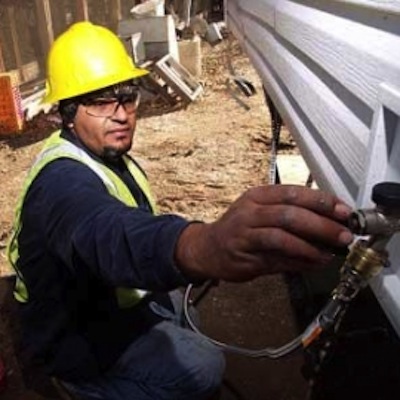
I’m not sure what a recent study by WalletHub seeming to rank Rhode Island 49th state in the country (with West Virginia 50th) in hard work means. (GoLocal ran a story on this on Aug. 26.) Does this mostly reflect the Ocean State’s aging population, its too slow transition from the old mill culture or its ancient and well-known negativity and surliness (see Facebook’s usual Tea Party-style comments below this column) or most likely a mix of them and many other factors, despite Rhode Island’s many beauties.
The survey includes as work time annual volunteer hours for charities, etc.
On that, I’ve long noticed close up the state’s low level of participation in nonprofit civic organizations and in charitable giving (in a state-ranked around 19th in per-capita income). I have served on several nonprofit boards over the years in Rhode Island and on several elsewhere. (I’ve lived and/or worked in Massachusetts, Connecticut, New Hampshire, New York, Pennsylvania, Delaware and France, and seen more volunteerism there than here.) Given the state’s compactness, dense population and all-around intimacy, this dearth of volunteerism in Rhode Island has always surprised me.
Comparative surveys are fun to read but there’s often less to them than meets the eye. I noted that very rich Massachusetts was ranked lazy, at 38th, and very rich Connecticut, even lazier, at 44th. Greater Boston and much of Connecticut are known for their work ethic – an ethic that has helped make them rich. North Dakota, heavy into oil and gas production and agribusiness was ranked the most hard-working.
To read the GoLocal story, please hit this link:
False Economy
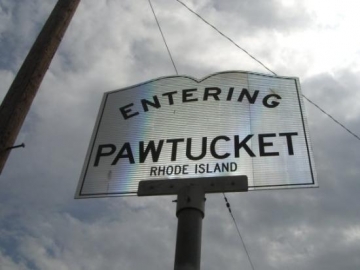
It’s too bad that the Rhode Island Department of Transportation decided not to have a second set of tracks laid for the new Pawtucket commuter rail station and instead is building the station directly along Amtrak’s very busy Northeast Corridor tracks. As The Providence Journal’s Patrick Anderson reported in an Aug. 26 story (“Pawtucket station cost climbs to $51 million’’), “With the station directly on the Northeast Corridor, intercity or express trains couldn’t overtake trains stopping in Pawtucket.’’ That may well slow down traffic on that very heavily traveled Amtrak/MBTA line. And, Mr. Anderson noted, “{N}ot building a second set of tracks could make it more difficult to create a Rhode Island-run rail shuttle.’’
Of course, Amtrak itself needs more tracks to allow more and faster trains and help get as many vehicles as possible off the roads.
MBTA Push By Baker and Raimondo
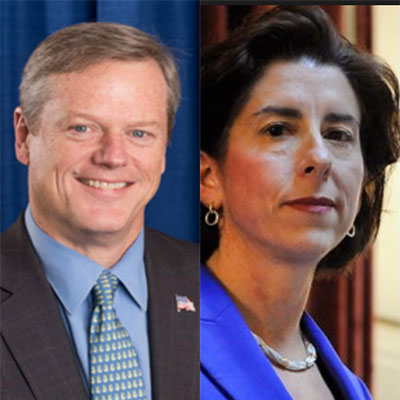
Kudos to Rhode Island Gov. Gina Raimondo and Massachusetts Gov. Charlie Baker for making a push for MBTA express trains between Boston and Providence. But this will require working it out with Amtrak, which runs on the same line. Again we need more tracks!! And an express train program may also require leasing electric-powered trains from Amtrak; the diesel trains now on the MBTA’s Providence-Boston route are less reliable than electric ones.
Michael Dukakis, the 1988 Democratic presidential nominee, former Amtrak chairman and now a Northeastern University political science professor, said at a Grow Smart RI meeting in April:
“The only way to solve this congestion problem is to have a first-class regional rail system not only for Massachusetts but for all of New England, with the six governors deeply and actively involved. It would take 60,000 to 70,000 cars off the road every day.”
Headquarters Town
As GoLocal has reported, Boston Energy, a global wind-turbine-maintenance company, plans to make Providence its U.S headquarters, to be located in the Cambridge Innovation Center in the Wexford complex, in exchange for the usual state incentives. I assume that most of the 50 people slated to work there will be well paid but 50 people ain’t much. With telecommunications being what they are these days, you just don’t need all that many people in many headquarters. Of course, it’s hoped that the move will substantially strengthen Rhode Island’s role as an offshore wind-power center even as the fossil-fuel-addicted Trump regime is trying to undermine that industry.
The main benefits from wind-industry growth, besides reduced air pollution and taking a nick out of global warming, will not be direct windpower jobs but a regional economy less vulnerable to the ups and downs of the fossil-fuel business, based far away from New England, especially as wind power and storage batteries become steadily more efficient.
To read the GoLocal story, please hit this link:
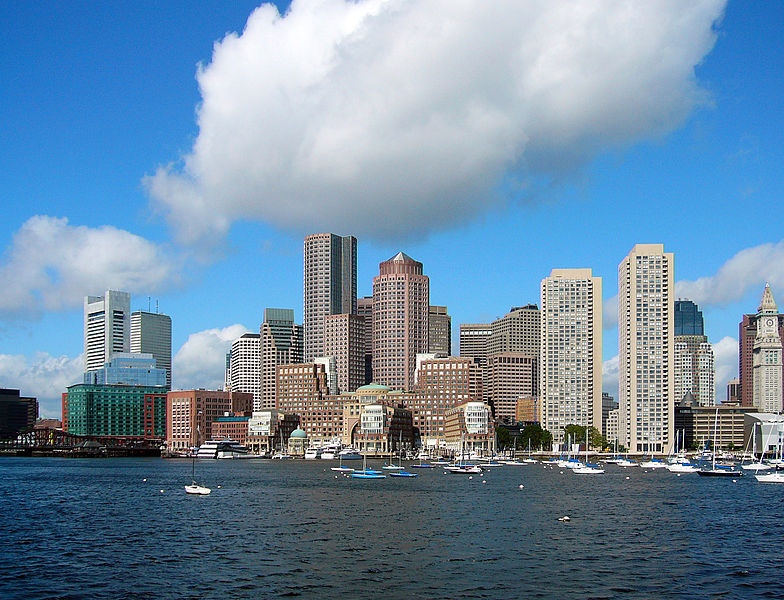
Will this happen in some of Providence’s new residential towers? Joe Walsh of The Boston Guardian (where I serve as unpaid president) reports that “downtown neighborhoods only added about 1,100 owner-occupied condos in the last 15 years, even as the total number of condos grew by nearly 6,000.’’ Much of this strange change can be explained by foreign buyers seeking a safe place to own real estate, as investments and/or as places to move to. Prosperous American cities such as Boston, San Francisco and New York are particularly attractive to rich people from nations that lack a rigorous rule of law that protects property rights. Consider Russia and China.
Owning a fancy condo in a rich U.S. city looks like a safe way to store wealth.
Consider that in at least one new Boston luxury building, Millennium Tower, three out of four units have owners who don’t claim owner-occupancy tax exemptions! That suggests why some of these buildings look remarkably dark at night. Some nearby store and restaurant owners complain that the near-empty buildings mean far fewer customers than you’d expect from proximity to such huge buildings.
You could see something like this happening in parts of downtown Providence and the East Side, particularly with rich parents of students at Brown seeking pied-a-terres. Jason Fane’s proposed 46-story Hope Point Tower, if the next recession doesn’t kill it, might lure a lot of these people.
Our Air Too!
Scientists can argue about how much the fire-ravaged Amazon rain forest serves as “the lungs of the world.’’ But what is clear is that the development-driven destruction of the Amazon and other tropical rain forests (the burning of Indonesia is another horror) is wreaking havoc with the ecological wealth of these areas and of course causing massive air and water pollution and erosion. Consider how much wildlife, some of it close to extinction, is being killed by these fires; the extinction of each species has an effect on others -- it’s all connected.
Brazilian President Jair Bolsonaro (a Trump pal) has asserted that the expressions of concern – and offers of aid – regarding the Amazonian fires (most of which are set) from French President Emmanuel Macron and some other foreign leaders violate Brazilian sovereignty. But the entire world is affected by such slow-motion catastrophes. It’s everyone’s business.
As John Donne famously wrote:
“No man is an island entire of itself; every man
is a piece of the continent, a part of the main;
if a clod be washed away by the sea, Europe
is the less, as well as if a promontory were, as
well as any manner of thy friends or of thine
own were; any man's death diminishes me,
because I am involved in mankind.
And therefore never send to know for whom
the bell tolls; it tolls for thee.’’
A major reason why fires are being set in the Amazon is to clear vast tracts for grazing of, and to raise food for, animals being raised for slaughter. The world would be a lot better off if we ate less meat.
South American Economic Chaos
In other South American news, U.S. right-wingers continue to assert that Venezuela’s impoverishment and tyranny are due to its “socialism’’ under its current dictator, Nicolas Maduro, and his predecessor and mentor, Hugo Chavez. They neglect to note that many capitalist countries, such as in Central America and Africa, are in terrible shape, too, and that such “socialist’’ places as the Scandinavian nations are thriving. No, the problem is the tradition of deep political corruption (right or left) in such nations as Venezuela, whatever the ideology that dictatorial regimes use to try to justify their tyranny and looting. For that matter, you could argue that Venezuela’s untrammeled pre-Chavez capitalism based on the country’s dependence on oil revenues, which can rise or fall sharply, led to the vast income inequality and other socio-economic ills that helped put Chavez into power and keep Maduro in power. Countries addicted to the revenues from the sale of one major natural resource tend to be corrupt.
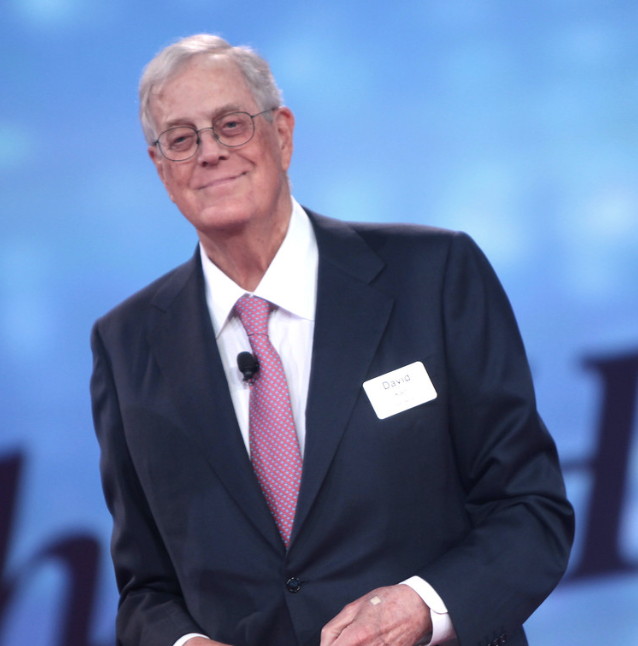
So, the ruthless, intensely avaricious David Koch of the Koch Brothers, who have used their billions to help turn the Republican Party into a tool for the further enrichment of the already hyper-rich, has gone to his reward at 79. Along the way, Mr. Koch endeared himself to the New York elite by giving money to, and slapping his name in big letters on, such high-end institutions as the Metropolitan Museum of Art.
The Koch Brothers’ late father, Fred Koch, the pro-Nazi founder of the fossil-fuel-heavy family fortune and co-founder of the John Birch Society, would have been proud of his sons.
The one area in which the Koch Brothers have taken issue with many of their right-wing friends has been their support of open immigration. They like cheap labor.
Reparations Won’t Work
Some Democratic candidates -- intent on political suicide? -- continue to promote financial reparations for the slavery that ancestors of African-Americans endured. But this would be administratively impossible and unfair: No one alive in America has owned slaves and most African-Americans have some white blood. Do we believe in blood guilt for what some our distant ancestors may have done?
Apportioning blame for American slavery is sure tricky. The African slaves who were brought to North America (who were a small percentage of the slaves brought to the Caribbean and Central and South America) had been captured and sold to European slave traders on the West African coast by Africans. (Slavery continues in parts of Africa to this day.)
Thomas Sowell, the conservative economist, and an African-American, succinctly noted:
"The region of West Africa … was one of the great slave-trading regions of the continent - before, during, and after the white man arrived. It was the Africans who enslaved their fellow Africans, selling some of these slaves to Europeans or to Arabs and keeping others for themselves. Even at the peak of the Atlantic slave trade, Africans retained more slaves for themselves than they sent to the Western Hemisphere. Arabs were the leading slave raiders in East Africa, ranging over an area larger than all of Europe."
Most African-Americans still suffer, in varying degrees, from the socio-economic effects of slavery and segregation. The fairest and most effective way to deal with that is through public policies that help address income and education inequality.
Miscellany
Will nothing stop the misuse and overuse of the word “incredibly’’ in place of “very’’?
And will nothing stop the obsession with Buddy Cianci?
There seem to be more acorns than usual on the ground now than usual for this time of year – the sort of thing that lures readers of The Old Farmer’s Almanac to make dubious predictions about the coming winter.
Boy Friends
Trump keeps trying to please Vladimir Putin. The latest example was at the recent G7 summit, in France, where Trump made a big push to admit Russia, though that kleptocratic state’s remarkably small – and shrinking -- economy would make it ineligible for membership. Is this because Trump, like Putin a thief, has had hundreds of millions of dollars in investments from Putin’s circle and/or Trump still wants to build that Trump Tower in Moscow? Is it because of Putin and Trump’s shared hatred of Barack Obama – Trump because Obama is much more popular than he is and because the former president made fun of the Orangeman at a White House Correspondents Association dinner, and Putin because Obama had sanctions imposed on Russia for occupying Ukraine’s Crimea and trying to seize eastern Ukraine? Another reason: Trump seems to derive a feeling of strength from identifying himself with tyrants – a feeling he doesn’t get from democratic leaders – those wimps!
Most likely it’s all of the above.
Christianity in the Midst of War
The Year of Our Lord 1943: Christian Humanism in an Age of Crisis, by Alan Jacobs, looks at Christian intellectuals, including Jacques Maritain, T.S. Eliot, C.S. Lewis, W.H. Auden and Simone Weil, as they addressed the moral, religious and cultural implications for Western Civilization during World War II as they looked toward the post-war world. This is an accessible book of great scholarship and insight.